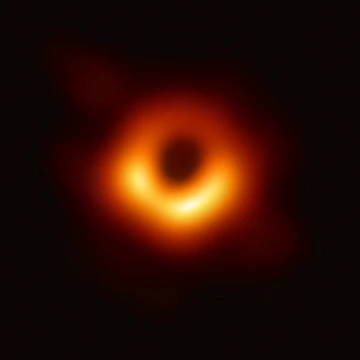
Black hole
An astronomical body from which nothing, not even light, can escape.

Event Horizon Telescope, uploader cropped and converted TIF to JPG · via Wikipedia: Black hole · CC BY 4.0
A black hole is an astronomical body with gravity so intense that nothing, not even light, can escape its pull. This inescapable region is bounded by the event horizon. According to general relativity, any sufficiently compact mass will inevitably form a black hole, and crossing the event horizon traps an object without causing any locally noticeable change. The theory also predicts a central singularity, where spacetime curvature becomes infinite.
The concept of objects too massive for light to escape dates back to the 18th century. The first solution to Einstein's equations describing a black hole was found in 1916, but it wasn't until the late 1950s that it was physically interpreted as a region from which nothing can escape. For decades, black holes were seen as mathematical curiosities; only in the 1960s did theoretical work show they were a generic prediction of general relativity. The first widely accepted black hole was Cygnus X-1, an X-ray source identified as a black hole binary through studies between 1971 and 1974.
Black holes typically form when massive stars collapse at the end of their life cycle, often as part of a supernova. After formation, they can grow by absorbing surrounding mass. Supermassive black holes, containing millions of solar masses, likely form by absorbing stars, merging with other black holes, or through the direct collapse of gas clouds. It is widely accepted that supermassive black holes reside at the centers of most galaxies.
Quantum field theory in curved spacetime suggests that event horizons emit Hawking radiation, with the emission rate inversely proportional to the black hole's mass. This slowly causes the black hole to lose mass, provided it is not accreting matter. However, even the smallest observed black holes—stellar-mass ones—gain mass from the cosmic microwave background faster than they lose it through Hawking radiation.
A black hole's presence is inferred through its interaction with matter and light. Infalling matter can form an accretion disk of heated plasma, which emits light. In extreme cases, this creates a quasar, one of the brightest objects in the universe. Merging black holes are detectable via gravitational waves. When stars orbit a black hole, their motions reveal the black hole's mass and location.
- Field
- Astrophysics, General Relativity
- Known for
- Prediction of objects from which light cannot escape; event horizon; singularity
Lore & Background
The idea of a body so massive that light could not escape was first proposed in the late 18th century by John Michell and independently by Pierre-Simon Laplace. Michell calculated that a star with the same density but 500 times the Sun's radius would have a surface escape velocity exceeding the speed of light. Laplace made a qualitative suggestion that a star could be invisible if sufficiently large. In 1916, Karl Schwarzschild found the first solution of general relativity that would characterize a black hole, though its nature was not understood at the time. By the late 1950s, this solution began to be interpreted physically as a region from which nothing can escape. Black holes were long considered a mathematical curiosity until the 1960s, when theoretical work showed they were a generic prediction of general relativity. The first widely accepted black hole was Cygnus X-1, proposed through studies between 1971 and 1974.
Reader's Guide
Black holes typically form as part of a supernova event when massive stars collapse at the end of their life cycle. After formation, a black hole can grow by absorbing mass from its surroundings. Supermassive black holes of millions of solar masses may form by absorbing stars and merging with other black holes, or via direct collapse of gas clouds. There is consensus that supermassive black holes exist in the centers of most galaxies. Quantum field theory in curved spacetime predicts that event horizons emit Hawking radiation, with the rate inversely proportional to mass, causing the black hole to lose mass very slowly if not accreting matter. However, even stellar black holes gain mass from the cosmic microwave background faster than they lose it via Hawking radiation. The presence of a black hole can be inferred through its interaction with matter: infalling matter can form an accretion disk heated by friction, emitting light; in extreme cases this creates a quasar. Merging black holes can be detected by gravitational waves. Astronomers have identified numerous stellar black hole candidates in binary systems and established that Sagittarius A* at the core of the Milky Way contains a supermassive black hole of about 4.3 million solar masses.
More in Black holes 1-24
Spotted an error? Know more?
Reader corrections go straight into our review queue. Suggest an edit · How this site is sourced