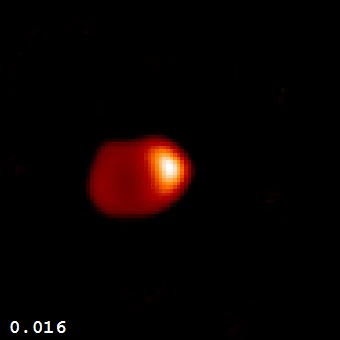
Phecda
Anchor star for classification, lower-left of the Big Dipper's bowl.

Phecda, also designated Gamma Ursae Majoris (γ UMa), is a star in the constellation Ursa Major. It is notable as one of the stable anchor points by which other stars are classified, a role it has held since 1943. Located about 83.2 light-years from the Sun, it forms the lower-left star of the Big Dipper's bowl and is a member of the Ursa Major moving group.
- Bayer designation
- Gamma Ursae Majoris
- Traditional names
- Phecda, Phad
- Distance from sun
- 83.2 ly
- Spectral type
- A0 Ve (Ae star)
- Mass
- 2.4 solar masses
- Age
- 333 million years
- Rotational velocity
- 386 km/s
Lore & Background
Phecda bears the traditional names Phecda or Phad, derived from the Arabic phrase 'fakhth al-dubb' meaning 'thigh of the bear'. To the Hindus, this star was known as Pulastya, one of the seven rishis. In Chinese astronomy, it is part of the Northern Dipper asterism, equivalent to the Big Dipper.
The star is an Ae star, surrounded by an envelope of gas that adds emission lines to its spectrum, hence the 'e' suffix in its classification of A0 Ve. It rotates rapidly at 386 km/s, causing an oblate shape: the equatorial radius is larger than the polar radius. Its effective temperature varies from 6,750 K at the equator to 10,520 K at the poles.
Phecda is an astrometric binary, with a companion that perturbs the primary star, causing it to wobble around the barycenter. The orbital period is 20.5 years. The secondary is a K-type main-sequence star with 0.79 times the Sun's mass.
Reader's Guide
Phecda's significance lies in its role as a spectral anchor point since 1943, providing a stable reference for stellar classification. As a member of the Ursa Major moving group, it shares a common motion with other bright stars of the Big Dipper, including Dubhe, Merak, and Megrez. Its proximity to the Mizar–Alcor system (separated by about 8.55 light-years) and to Merak (11.0 light-years) places it within a well-studied region of the local interstellar neighborhood. The star's rapid rotation and oblate shape, along with its gaseous envelope, make it a key example of an Ae star. The binary nature, with a 20.5-year orbital period and a K-type companion, adds to its astrophysical interest. Its traditional name, rooted in Arabic, and its recognition in Hindu and Chinese astronomy reflect its long cultural history.
Did You Know?
- Phecda has served as a stable anchor point for stellar classification since 1943.
- It is separated from the Mizar–Alcor system by an estimated 8.55 light-years.
- The star rotates at 386 km/s, causing its equatorial radius to be larger than its polar radius.
More in Binary and Multiple Stars, Part 4 1-24
Spotted an error? Know more?
Reader corrections go straight into our review queue. Suggest an edit · How this site is sourced