Beta2 Sagittarii
A probable astrometric binary in Sagittarius, also known as Arkab Posterior.

Beta2 Sagittarii (β2 Sagittarii) is a star in the southern zodiac constellation of Sagittarius, visible to the naked eye with an apparent visual magnitude of +4.29. Based on an annual parallax shift of 24.31 mas, it lies 134 light-years from Earth. It is a probable astrometric binary system, with its two components designated Beta2 Sagittarii A and B.
- Bayer designation
- β2 Sagittarii
- Apparent visual magnitude
- +4.29
- Parallax
- 24.31 mas
- Distance
- 134 light-years
- Spectral type
- F2/3 V (main sequence) or F-type giant (disputed)
- Projected rotational velocity
- 155 km/s
- Mass
- 1.4 solar masses
Lore & Background
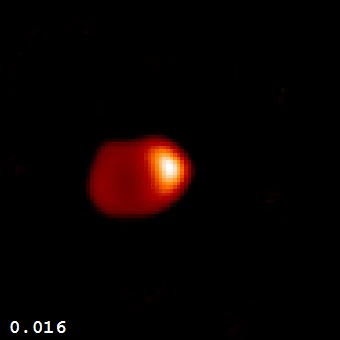
The system's traditional name is Arkab, and the International Astronomical Union approved the name Arkab Posterior for Beta2 Sagittarii on 5 October 2016. The name is understood to refer to the brightest component by visual brightness, Beta2 Sagittarii A. In Chinese astronomy, Beta2 Sagittarii is part of an asterism called Celestial Spring, which also includes Beta1 Sagittarii and Alpha Sagittarii. The visible component is classified as an F-type main-sequence star (F2/3 V) by Houk (1978), but Malaroda (1975) lists it as an F-type giant star. It spins rapidly, with a projected rotational velocity of 155 km/s, giving it an oblate shape with an equatorial bulge 22% larger than the polar radius. The star has an estimated 1.4 times the mass of the Sun and is about 933 million years old.
Reader's Guide
Beta2 Sagittarii is notable as a probable astrometric binary, meaning its binary nature is inferred from variations in its proper motion rather than direct visual separation. This makes it part of a class of systems that reveal companions through gravitational influence. Its rapid rotation and oblate shape provide insights into stellar physics, particularly how fast spin distorts a star's figure. The spectral classification dispute—whether it is a main-sequence star or a giant—reflects ongoing uncertainty in stellar characterization. The star's traditional name Arkab Posterior, officially recognized by the IAU in 2016, connects it to historical Arabic astronomy, while its inclusion in the Chinese Celestial Spring asterism shows its role in multiple cultural star patterns. As a naked-eye object at magnitude +4.29, it serves as a reference point for amateur astronomers and contributes to the broader understanding of stellar multiplicity and evolution in the Sagittarius region.
Did You Know?
- Beta2 Sagittarii is a probable astrometric binary, inferred from variations in its proper motion.
- Its equatorial bulge is 22% larger than its polar radius due to rapid rotation.
- The star has an estimated age of 933 million years.
Frequently Asked Questions
What is Beta2 Sagittarii?
Beta2 Sagittarii is a naked-eye star in the zodiac constellation Sagittarius that shines at an apparent visual magnitude of roughly +4.29. It also goes by the traditional Arabic name Arkab Posterior.
How far is Beta2 Sagittarii from Earth?
Its annual parallax shift of 24.31 milliarcseconds translates to a distance of about 134 light-years from our solar system.
Is Beta2 Sagittarii a binary star system?
It is classified as a probable astrometric binary, meaning two components—designated A and B—are inferred to orbit a common barycenter, though the companion has not been directly resolved in images.
What spectral type and rotation does Beta2 Sagittarii have?
The system is most often catalogued as an F2/3 V main-sequence star, though some sources argue it may instead be an F-type giant. It spins very quickly, with a projected rotational velocity of about 155 km/s.
Why is Beta2 Sagittarii interesting to multiple-star observers?
Because the companion is detected only through positional wobble rather than direct imaging, it serves as a good example of how astrometric methods reveal hidden stellar partners. Its disputed luminosity class and high rotation speed add extra layers of intrigue for anyone tracking southern-sky binaries.
More in Binary and Multiple Stars, Part 4 1-24
Spotted an error? Know more?
Reader corrections go straight into our review queue. Suggest an edit · How this site is sourced