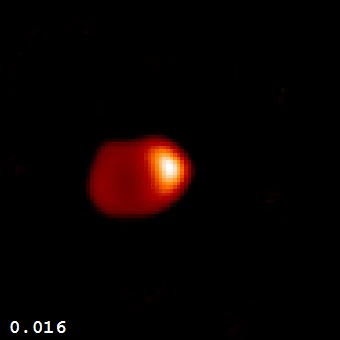
28 Cancri
A faint Delta Scuti variable and likely astrometric binary.

28 Cancri, also known as CX Cancri, is a star system located in the zodiac constellation Cancer. It sits near the threshold of naked-eye visibility, with an average apparent visual magnitude of 6.05. Based on parallax measurements from Earth's orbit, the system is roughly 384 light-years away, and it is receding from the Sun at a radial velocity of about +9 km/s. Variations in its proper motion indicate a 99.8% probability that it is an astrometric binary system.
The visible component is an F-type main-sequence star, classified as F0 Vn, meaning its spectral lines appear blurred due to rapid rotation. It spins with a projected rotational velocity of 133 km/s and has about 2.4 times the Sun's mass. Its photosphere radiates roughly 44 times the Sun's luminosity at an effective temperature of around 7,516 K. The star's brightness was first suggested to be variable in 1973 by John R. Percy, with confirmation by Stephen John Horan and colleagues in 1974. It received its variable star designation in 1979. As a Delta Scuti variable, it exhibits brightness changes with a period of 0.0960 days and an amplitude of 0.020 in magnitude.
- Constellation
- Cancer
- Mean apparent visual magnitude
- 6.05
- Distance
- ~384 light years
- Radial velocity
- +9 km/s
- Stellar classification
- F0 Vn
- Variable star designation
- CX Cancri
- Variable star type
- Delta Scuti variable
Lore & Background
The visible component of 28 Cancri has a stellar classification of F0 Vn, indicating it is an F-type main-sequence star with 'nebulous' lines due to rapid rotation. With 2.4 times the mass of the Sun, it is spinning with a high projected rotational velocity of 133 km/s. The star radiates roughly 44 times the Sun's luminosity from its photosphere at an effective temperature of around 7,516 K.
In 1973, John R Percy announced that 28 Cancri might be a variable star. Stephen John Horan et al. confirmed that the star's brightness varies, in 1974. In 1979, it was given its variable star designation. It is a Delta Scuti variable star with a period of 0.0960 days and an amplitude of 0.020 in magnitude.
Based upon proper motion variation, this is an astrometric binary system with high likelihood (99.8%). The system's annual parallax shift seen from Earth's orbit provides a distance estimate of about 384 light years, and it is moving away from the Sun with a radial velocity of around +9 km/s.
Reader's Guide
28 Cancri holds significance as a confirmed Delta Scuti variable star, a class of pulsating stars that help astronomers study stellar structure and evolution. Its variability was first suspected in 1973 and confirmed the following year, leading to its variable star designation CX Cancri in 1979. The star's rapid rotation, indicated by its 'nebulous' spectral lines and high projected rotational velocity of 133 km/s, is characteristic of many Delta Scuti variables and influences its pulsation behavior. The system's status as an astrometric binary with 99.8% likelihood adds another layer of interest, as the unseen companion's gravitational influence on the visible star's motion can be detected through precise proper motion measurements. With a mass 2.4 times that of the Sun and an effective temperature of about 7,516 K, 28 Cancri is a relatively hot, luminous main-sequence star radiating 44 times the Sun's luminosity. Its short pulsation period of 0.0960 days and small amplitude of 0.020 magnitude make it a typical member of the Delta Scuti class. The system's distance of roughly 384 light years places it within the solar neighborhood, allowing detailed study of its properties and binary nature.
Did You Know?
- 28 Cancri has a variable star designation CX Cancri.
- It is an astrometric binary system with a 99.8% likelihood.
- Its pulsation period is 0.0960 days with an amplitude of 0.020 magnitude.
The Binary Pair in Cancer
The 55 Cancri system sits roughly 41 light-years from the Sun, nestled within the zodiac constellation of Cancer. It is a binary arrangement of two very different stars: a K-type primary (55 Cancri A) and a much smaller red dwarf companion (55 Cancri B). The primary, classified as K0IV-V, is both smaller and slightly less massive than our Sun, making it cooler and dimmer. Its apparent magnitude of 5.95 places it right at the threshold of naked-eye visibility under exceptionally dark skies, while the red dwarf companion, at the 13th magnitude, demands a telescope to be seen. The two stars are separated by an estimated 1,065 astronomical units—about 6.15 light-days—yet they share a common proper motion, confirming they remain gravitationally bound despite the vast gap between them. The red dwarf was first identified as a companion back in 1918 by Adriaan van Maanen. Although the primary shows no variability in visible light and only modest chromospheric emission, it does flicker in X-rays, hinting at magnetic activity beneath its relatively calm surface.
A World of Eight Planets
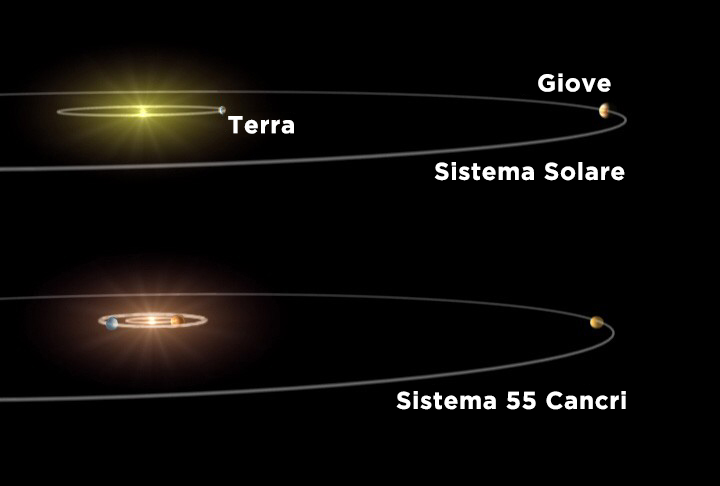
By 2025, the 55 Cancri system had become one of the richest planetary systems known. Five confirmed planets—Ab, Ac, Ae, Af, and Ad—circle the primary star, with a sixth candidate (Ag) still under investigation. The red dwarf companion hosts two of its own worlds, Bb and Bc, bringing the total to eight. The innermost planet around the primary, Ae, is unique in that it transits its host star as seen from Earth, offering a direct window into its atmosphere. Its neighbor Ab does not transit, yet astronomers have gathered tentative evidence that an extended atmosphere surrounding it does cross the stellar disk. The story began in 1997, when radial-velocity measurements revealed a Jupiter-mass companion completing an orbit every 14.7 days. That discovery was announced alongside the planets of Tau Boötis and Upsilon Andromedae. Residual drift in the velocity data pointed to additional, more distant objects, and by 1998 a possible circumstellar dust disk had also been reported, deepening the mystery of this remarkably populated system.
Names Honoring the Pioneers of the Sky
In July 2014, the International Astronomical Union launched NameExoWorlds, an open campaign inviting the public to propose and vote on proper names for select exoplanets and their host stars. The winning entry, submitted by the Royal Netherlands Association for Meteorology and Astronomy, was announced in December 2015. The primary star received the name Copernicus, while its five planets were christened Galileo, Brahe, Lipperhey, Janssen, and Harriot—each honoring a figure central to the birth of modern astronomy and the invention of the telescope. A small correction followed in January 2016 when the IAU fixed the spelling of Lipperhey, replacing the 19th-century error Lippershey with the astronomer's actual name. The following year, the IAU's Working Group on Star Names formally incorporated these designations into its first bulletin, and the names were entered into the official IAU Catalog of Star Names, giving the system a permanent place in astronomical nomenclature alongside its Flamsteed, Bayer, and Bright Star Catalogue identifiers.
The Super Metal-Rich Enigma
What makes 55 Cancri A scientifically fascinating is its unusual chemical makeup. The star contains 186 percent of the Sun's iron abundance and a carbon-to-oxygen ratio of 0.78, well above the solar value of 0.55. This extreme enrichment earns it the rare classification of a super metal-rich dwarf. One leading hypothesis suggests that heavy-element material from a protoplanetary disk settled into the star's outer layers, polluting its atmosphere. Because the star lacks a deep convection zone, those outer layers never fully mix, preserving the elevated abundances. This metallicity creates a genuine headache for astrophysicists: standard stellar-evolution models are less well calibrated for such objects, making both the star's mass and age difficult to pin down. Estimates range from 7.4 to 8.7 billion years in one set of models and 10.2 plus or minus 2.5 billion in another. Meanwhile, submillimeter observations have found no detectable dust within 100 AU, capping the fine-dust mass at under one-hundredth of one percent of Earth's mass, though an asteroid belt or Kuiper-belt analogue cannot be ruled out.
Gallery
Frequently Asked Questions
Who is 28 Cancri?
28 Cancri is a faint F-type main-sequence star sitting in the zodiac constellation Cancer, hovering right at the edge of naked-eye visibility with a mean visual magnitude of 6.05. It also carries the variable-star designation CX Cancri.
What is 28 Cancri's stellar classification and variability?
The visible component is classed F0 Vn, indicating a hot F-type star whose spectral lines are broadened by rapid rotation. It is additionally a Delta Scuti variable, producing small periodic pulsations in brightness.
Is 28 Cancri a binary or multiple star system?
Astrometric analysis of its proper motion yields a 99.8 % probability that an unseen companion orbits the F star, making it very likely an astrometric binary. The companion's mass and orbital parameters have not yet been directly measured.
How far away is 28 Cancri and is it moving toward or away from us?
Parallax data place the system at roughly 384 light-years from the Sun. It is receding from us at a radial velocity of about +9 km/s.
Why does 28 Cancri also go by the name CX Cancri?
The designation CX Cancri was assigned because the star shows the small, rapid brightness oscillations characteristic of Delta Scuti variables. It is the same object catalogued as 28 Cancri under the standard positional numbering for the Cancer field.
More in Binary and Multiple Stars, Part 4 1-24
Spotted an error? Know more?
Reader corrections go straight into our review queue. Suggest an edit · How this site is sourced