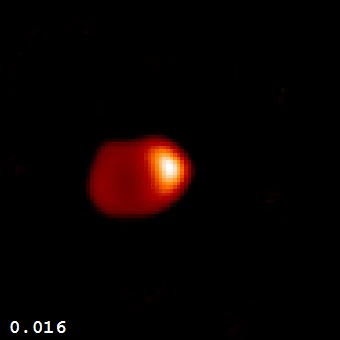
83 Cancri
An astrometric binary with an unseen white dwarf companion.

83 Cancri is a binary star system located in the northern constellation Cancer, close to the border with Leo. With an apparent visual magnitude of 6.61, it is difficult to see without optical aid. Although it carries a Flamsteed designation, the system is too dim to appear in the Bright Star Catalogue. Based on parallax measurements, it lies about 133 light-years from the Sun and is moving closer at a radial velocity of −15 km/s. The system also shows a relatively high proper motion across the sky.
The two stars orbit each other with a period of roughly 32 days and an orbital eccentricity of about 0.6. The visible star, component A, is an F-type main-sequence star classified as F4V. Its atmosphere is enriched with s-process elements, especially strontium and yttrium, likely due to mass transfer from its companion when that star was on the asymptotic giant branch. The primary is about 3.1 billion years old, with 1.1 times the Sun's mass and 1.5 times its radius. It shines with 3.1 times the Sun's luminosity and has an effective temperature of 6,218 K. The unseen secondary is probably a high-mass white dwarf, with an estimated mass of about 1.3 times that of the Sun.
- Apparent visual magnitude
- 6.61
- Distance
- 133 light years
- Radial velocity
- −15 km/s
- Orbital period
- ~32 days
- Orbital eccentricity
- ~0.6
- Spectral type (component a)
- F4V
- Mass (component a)
- 1.1 M☉
- Radius (component a)
- 1.5 R☉
- Luminosity (component a)
- 3.1 L☉
- Effective temperature (component a)
- 6,218 K
Lore & Background
The visible member of this system, designated component A, is an F-type main-sequence star with a stellar classification of F4V. Its atmosphere is enhanced with s-process elements, particularly strontium and yttrium, which is attributed to mass transfer from the companion while the latter was on the asymptotic giant branch. The primary is 3.1 billion years old with 1.1 times the mass of the Sun and 1.5 times the Sun's radius. It is radiating 3.1 times the luminosity of the Sun from its photosphere at an effective temperature of 6,218 K. The unseen secondary companion is most likely a high mass white dwarf, having around 1.3 times the Sun's mass. The pair have an orbital period of around 32 days and an eccentricity of about 0.6. The system is located at a distance of 133 light years from the Sun, based on parallax, but is drifting closer with a radial velocity of −15 km/s. 83 Cancri has a relatively high proper motion, traversing the celestial sphere at an angular rate of per annum.
Reader's Guide
83 Cancri is notable as an astrometric binary system where the primary star shows clear chemical peculiarities—enhanced s-process elements such as strontium and yttrium—that directly trace past mass transfer from its now-degenerate companion. This makes the system a valuable case study for binary evolution and the chemical enrichment of stellar atmospheres via asymptotic giant branch donor stars. The unseen secondary, likely a high-mass white dwarf of about 1.3 solar masses, represents the remnant of that donor star. The short orbital period of roughly 32 days and moderate eccentricity of 0.6 indicate a relatively close, interacting past. Despite its Flamsteed designation, the system's faintness (magnitude 6.61) excluded it from the Bright Star Catalogue, yet its astrometric and spectroscopic properties continue to inform models of binary mass transfer and white dwarf formation. The system's proper motion and radial velocity also contribute to kinematic studies of the local stellar population.
Did You Know?
- 83 Cancri has an apparent visual magnitude of 6.61, making it a challenge to view with the naked eye.
- The primary star is an F-type main-sequence star of class F4V.
- The unseen companion is most likely a high-mass white dwarf with about 1.3 times the Sun's mass.
The Binary Architecture and Stellar Properties
The 55 Cancri system sits roughly 41 light-years from Earth in the constellation Cancer, making it one of the relatively nearby stellar systems known to host multiple worlds. It is a binary pair: the brighter primary, a K-type star slightly smaller and less massive than our Sun, and a faint red dwarf companion first identified by Adriaan van Maanen back in 1918. The two stars are separated by an estimated 1,065 astronomical units—about 6.15 light-days—yet they share a common proper motion, confirming they remain gravitationally bound despite their wide spacing. The primary shines at apparent magnitude 5.95, barely reachable by the unaided eye under exceptionally dark conditions, while the red dwarf glimmers at 13th magnitude and demands a telescope for observation. The Gaia satellite's parallax measurement of 79.45 milliarcseconds underpins the distance estimate of 12.6 parsecs. Together, this pair forms a stable platform around which at least seven confirmed planets orbit, making it one of the most populous nearby systems studied by astronomers.
The NameExoWorlds Campaign and Dutch Astronomical Heritage
In July 2014, the International Astronomical Union opened its NameExoWorlds campaign, inviting the public to propose proper names for select exoplanets and their host stars. The system we know as 55 Cancri was among the targets. In December 2015, the IAU announced the winning submission, which came from the Royal Netherlands Association for Meteorology and Astronomy. The primary star received the name Copernicus, honoring Nicolaus Copernicus, while its five planets were christened Galileo, Brahe, Lipperhey, Janssen, and Harriot—each after a figure who helped shape modern astronomy or built early telescopes. A small but telling correction followed in January 2016: the IAU had initially spelled the fourth planet's name Lippershey, a 19th-century error, and revised it to Lipperhey to reflect the actual name of the Dutch spectacle maker. In 2016, the IAU's Working Group on Star Names formally entered these names into its official catalog, cementing the Dutch contribution to the system's identity.
Pioneering Planetary Discoveries and System Architecture
The 1997 announcement of a Jupiter-mass world orbiting 55 Cancri A—detected through periodic shifts in the star's radial velocity with a period near 14.7 days—placed this system among the earliest known hosts of multiple exoplanets. That initial discovery, designated 55 Cancri Ab, was made alongside the first detections around Tau Boötis and Upsilon Andromedae. Residual drift in the radial velocity data hinted at additional, more distant companions, and by 2025 five confirmed planets (Ab, Ac, Ae, Af, Ad) plus one candidate (Ag) orbit the primary, while the red dwarf companion B hosts two planets of its own (Bb and Bc). The innermost world, Ae, transits the primary as seen from Earth, offering a direct geometric window into its size. The non-transiting planet Ab shows tentative signs of an extended atmosphere that itself crosses the stellar disk. The system thus stands as one of the first to be known to harbor four, and later five, planets around a single star.
The Super Metal-Rich Enigma
One of the most striking features of 55 Cancri A is its unusually high abundance of elements heavier than helium. Its iron content stands at roughly 186 percent of the solar value, earning it classification as a super metal-rich star—a rarity among K-type dwarfs. The carbon-to-oxygen ratio also exceeds the solar figure, sitting at 0.78 versus 0.55. This enrichment complicates efforts to pin down the star's mass and age, because standard stellar-evolution models are less well calibrated for such compositions. Estimates for the star's age range from 7.4 to 8.7 billion years in some analyses, while other studies suggest 10.2 plus or minus 2.5 billion years, always placing it well beyond the age of our own Solar System. A leading hypothesis proposes that heavy-element-rich material from a protoplanetary disk settled into the star's outer atmosphere after formation. Because K-type dwarfs lack the deep convection zones that would dilute such pollution, the surface layers retain elevated metal abundances to this day.
Frequently Asked Questions
What is 83 Cancri?
83 Cancri is a dim binary star system located in the northern constellation Cancer, right along the border with Leo. Its combined visual magnitude of 6.61 means it is essentially invisible to the naked eye and requires binoculars or a small telescope to observe.
What are the components of 83 Cancri?
The visible primary, component A, is an F4V main-sequence star with a hot white-yellow appearance. Its companion is an unseen white dwarf that can only be detected through the astrometric wobble it induces on the primary.
What is 83 Cancri's orbital period and shape?
The two components complete one full orbit around their shared barycenter in roughly 32 days. The orbit is quite elongated, with an eccentricity near 0.6, so the separation between the stars changes noticeably throughout each cycle.
How far away is 83 Cancri and is it approaching us?
Parallax data places the system at approximately 133 light-years from the Sun. It is drifting closer at a radial velocity of about 15 km/s while also exhibiting a relatively high proper motion across the celestial sphere.
Why is 83 Cancri interesting to binary-star enthusiasts?
Although it holds a Flamsteed designation, its faintness keeps it out of the Bright Star Catalogue, so it is easy to overlook. Its value as a study object comes from the hidden white dwarf companion, making it a clean example of an astrometric binary where one member is entirely invisible to direct observation.
More in Binary and Multiple Stars, Part 4 1-24
Spotted an error? Know more?
Reader corrections go straight into our review queue. Suggest an edit · How this site is sourced