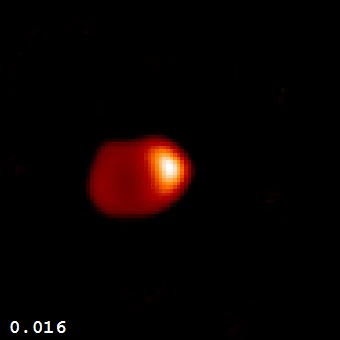
AZ Phoenicis
A pulsating Delta Scuti variable and astrometric binary.

AZ Phoenicis (HR 239) is a variable star in the constellation of Phoenix, near the limit of naked-eye visibility with an average visual apparent magnitude of 6.47. It is notable as a Delta Scuti variable that pulsates with a single period of 79.3 minutes, and as an astrometric binary detected through proper-motion acceleration by the Hipparcos spacecraft.
- Apparent magnitude
- 6.47
- Distance
- 322 ly
- Absolute magnitude
- 1.65
- Spectral type
- A9/F0III
- Radius
- 2.7 R☉
- Luminosity
- 19 L☉
- Effective temperature
- 7,280 K
Lore & Background
AZ Phoenicis was discovered to be variable by Werner Weiss in 1977, using observations with the 50-cm telescope at La Silla Observatory. Its variability arises from Delta Scuti pulsations with a single period of 79.3 minutes, causing its visual brightness to vary by an amplitude of 0.015 magnitudes. The star has also been classified as a possible Ap star, though this remains uncertain despite a large concentration of metals; its overall metallicity is about three times the solar value.
The star is classified with a spectral type of A9/F0III, indicating a giant of type A or F. It has an estimated radius of 2.7 times the solar radius, shines with 19 times the solar luminosity, and has an effective temperature of 7,280 K. Astrometric observations by the Hipparcos spacecraft detected a significant acceleration in its proper motion, establishing it as an astrometric binary.
Reader's Guide
AZ Phoenicis holds significance as a Delta Scuti variable with a single, well-defined pulsation period of 79.3 minutes, a relatively rare characteristic among such stars. Its variability was identified from ground-based observations at La Silla Observatory, contributing to the understanding of short-period pulsating stars. The star's classification as a possible Ap star, though uncertain, is supported by its high metallicity—roughly three times solar—which makes it an interesting object for studies of chemical peculiarity and pulsation in evolved giants. The detection of astrometric acceleration by Hipparcos reveals that AZ Phoenicis is not a single star but an astrometric binary, implying an unseen companion that perturbs its motion. This combination of pulsation, high metallicity, and binarity makes it a valuable target for further investigation into stellar evolution and binary dynamics. Its location at a distance of 322 light-years and near the limit of naked-eye visibility also places it within reach of amateur and professional observations alike.
Did You Know?
- AZ Phoenicis varies in brightness with an amplitude of only 0.015 magnitudes.
- Its variability was discovered by Werner Weiss in 1977 using a 50-cm telescope.
- The star has a metallicity about three times that of the Sun.
- Hipparcos detected a significant acceleration in its proper motion, indicating it is an astrometric binary.
Frequently Asked Questions
What is AZ Phoenicis?
AZ Phoenicis (catalogued as HR 239) is a pulsating star in the southern constellation Phoenix, sitting roughly 322 light-years from Earth. It is classified as a Delta Scuti variable and also hosts an unseen companion revealed through astrometric wobble.
How does AZ Phoenicis vary, and can you see it with the naked eye?
The star oscillates with a single dominant period of about 79.3 minutes, typical of Delta Scuti-type pulsations. Its average visual magnitude of 6.47 puts it right at the threshold of naked-eye visibility under truly dark skies.
Is AZ Phoenicis a confirmed binary system?
Yes—the Hipparcos spacecraft detected a subtle acceleration in the star's proper motion, indicating the gravitational pull of a companion that has never been directly imaged. This classifies it as an astrometric binary rather than a visual or spectroscopic pair.
What are the key physical properties of AZ Phoenicis?
With a spectral type of A9/F0III, the star has a radius about 2.7 times the Sun's and radiates roughly 19 times the Sun's luminosity, corresponding to an absolute magnitude of 1.65. These figures place it in the subgiant regime just off the main sequence.
Why do variable-star observers and binary-star researchers both care about this star?
Its short 79-minute pulsation cycle makes it a convenient target for rapid-cadence photometry, while the hidden companion adds a second line of inquiry into unseen-mass detection. Packing both a well-defined oscillation mode and an astrometric binary signature into one faint Phoenix star gives researchers a compact two-in-one case study.
More in Binary and Multiple Stars, Part 4 1-24
Spotted an error? Know more?
Reader corrections go straight into our review queue. Suggest an edit · How this site is sourced