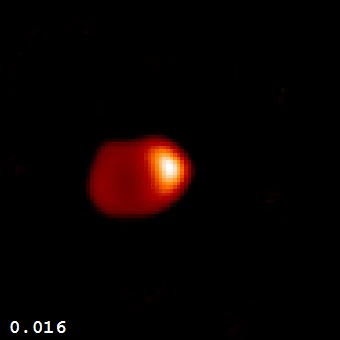
Beta Crateris
Binary star with a barium-enhanced primary and a low-mass white dwarf companion.

Beta Crateris, also designated β Crateris, is a binary star system located in the southern constellation Crater. It appears as a single point of light to the naked eye, with an apparent visual magnitude of 4.46. Based on parallax measurements, the system lies roughly 317 light-years from the Sun.
The system is an astrometric binary, meaning its companion is detected through gravitational influence rather than direct imaging. The two stars orbit each other every 6.0 years, with a projected separation of 8.3 astronomical units (AU) and an estimated semimajor axis of 9.3 AU. The primary star, component A, is classified as an A-type giant (A2 III), though some sources list it as a main-sequence star (A1 V) or a subgiant (A2 IV). Its spectrum shows an overabundance of barium, likely from a past mass transfer event.
The secondary, component B, is a white dwarf with a spectral type of DA and an effective temperature of 36,885 K. It has been cooling for about four million years. Unusually, its mass is only 43% that of the Sun, suggesting its progenitor transferred material to the primary. Alternative explanations involve a triple-star system or a highly eccentric binary orbit that led to grazing interactions. The white dwarf emits X-rays.
Historically, 16th-century astronomer Al Tizini included this star in the set Al Sharāsīf (the Ribs of Hydra), which stretched from β Crateris westward to κ Hydrae. In the star catalogue Technical Memorandum 33-507, β Crateris is listed as Al Sharasīf II, while κ Hydrae is Al Sharasīf I. In Chinese astronomy, β Crateris belongs to the Wings asterism, which comprises 22 stars including α, γ, ζ, λ, η, δ, ι, κ, and ε Crateris, along with several other stars such as ν Hydrae, HD 95808, HD 93833, θ Crateris, HD 102574, HD 100219, HD 99922, HD 100307, HD 96819, χ1 Hydrae, HD 102620, and HD 103462. Within this asterism, β Crateris itself is known by a specific Chinese name.
- Bayer designation
- β Crateris
- Apparent visual magnitude
- 4.46
- Distance
- ~317 ly
- Orbital period
- 6.0 years
- Projected separation
- 8.3 AU
- Semimajor axis
- 9.3 AU
- Primary classification
- A2 III (giant), also listed as A1 V (main sequence) or A2 IV (subgiant)
Lore & Background
Beta Crateris carries the Bayer designation β Crateris, Latinized from Beta Crt. The 16th-century astronomer Al Tizini assigned it to Al Sharāsīf (the Ribs of Hydra), a set that included stars from β Crateris westward through κ Hydrae. In the catalogue of stars in Technical Memorandum 33-507, β Crateris was listed as Al Sharasīf II, while κ Hydrae was Al Sharasīf I. In Chinese astronomy, β Crateris belongs to the Wings asterism, which consists of many stars across Crater and Hydra; β Crateris itself is known by a specific Chinese designation within that asterism.
Reader's Guide
The system's significance lies in its binary nature and the unusual properties of its components. The primary star has a disputed classification: it is listed as an A-type giant (A2 III), but some sources assign it a main sequence class of A1 V, while others call it a subgiant of class A2 IV. Its spectrum shows enhanced barium, likely from a past mass transfer event. The secondary is a white dwarf of spectral class DA with an effective temperature of 36,885 K, which has been cooling for about four million years. Its mass is unusually low—only 43% that of the Sun—suggesting that the white dwarf progenitor transferred matter to its companion. Alternative explanations involve the evolution of a triple star system or a binary with a highly eccentric orbit leading to grazing interactions. The white dwarf is also a source of X-ray emission. These features make Beta Crateris a valuable case study for binary evolution and mass transfer processes.
Did You Know?
- The primary star shows enhanced barium in its spectrum, possibly from a past mass transfer event.
- The white dwarf companion has an unusually low mass of 43% that of the Sun.
- The white dwarf has an effective temperature of 36,885 K and has been cooling for about four million years.
- The system has an orbital period of 6.0 years and a semimajor axis of 9.3 AU.
Stellar Architecture: A Hidden Binary Pair
Beta Crateris presents one of the more intriguing stellar pairings within the constellation of the Cup. Classified at magnitude 4.5, this system sits 296 ± 8 light-years from Earth and is composed of two fundamentally different stellar objects orbiting one another. The primary is a white-hued giant star of spectral type A1III, while its companion is a white dwarf of spectral type DA1.4. The contrast between the two is stark: the dwarf companion is so much smaller than the giant primary that it cannot be resolved as a separate object even by the Hubble Space Telescope. This makes Beta Crateris a case where one member of the binary is effectively hidden behind the brilliance of the other, a reminder that what the eye perceives as a single point of light in the southern sky may in fact conceal an entire second star. The system's position within Crater places it among a group of aging stars, though unlike its brighter neighbors Delta and Alpha Crateris, which are orange giants, Beta Crateris's primary belongs to the hotter, whiter A-type category.
Position in the Constellation's Stellar Hierarchy
Within the constellation of Crater, Beta Crateris holds the position of the third-brightest star, trailing behind Delta Crateris at magnitude 3.56 and Alpha Crateris at magnitude 4.07. The constellation as a whole contains no star brighter than third magnitude, and within its borders there are thirty-three stars at or brighter than apparent magnitude 6.5. The three brightest—Delta, Alpha, and Gamma Crateris—form a recognizable triangle situated near the brighter star Nu Hydrae in the neighboring constellation Hydra. German cartographer Johann Bayer assigned Greek letters from alpha through lambda to label the most prominent stars in Crater, and Beta Crateris received its designation within that early naming scheme. The constellation's official boundaries, established by Belgian astronomer Eugène Delporte in 1930, are defined by a polygon of six segments, and the International Astronomical Union adopted the three-letter abbreviation Crt in 1922. Beta Crateris, at roughly 296 light-years, is considerably more distant than its brighter neighbors, making it a fainter and more challenging target for visual observation despite its respectable magnitude.
Mythological Heritage of the Cup
The constellation Crater, in which Beta Crateris resides, carries one of the most vivid narratives from Greek mythology. The story involves a crow or raven serving Apollo, sent to fetch water. The bird delays its journey to wait for figs to ripen, then retrieves water in a cup and brings back a water snake, blaming it for drinking the water. Apollo, seeing through the deception, cast the crow, the cup, and the snake into the sky as a permanent warning against sinning against the gods. The cup—Crater—was associated with Apollo and perched on the back of Hydra, the water snake. The constellation was among the forty-eight listed by the second-century astronomer Ptolemy. In Babylonian star catalogues dating back to at least 1100 BC, the stars of Crater were possibly incorporated with those of Corvus in the Babylonian Raven. British scientist John H. Rogers proposed that Corvus, Crater, and Hydra together served as death symbols marking the gate to the underworld. The cup also featured in the iconography of Mithraism, a tradition of middle-eastern origin that spread into Ancient Greece and Rome.
Observational Access and Cross-Cultural Mapping
Because Crater lies in the southern celestial hemisphere, the entire constellation—including Beta Crateris—is visible to observers located south of 65 degrees north latitude. The constellation spans 282.4 square degrees, accounting for 0.685 percent of the total sky, and ranks fifty-third among the eighty-eight modern constellations in area. Its borders touch Leo and Virgo to the north, Corvus to the east, Hydra to the south and west, and Sextans to the northwest. In Chinese astronomy, the stars of Crater fall within the Vermillion Bird of the South, where they depict, alongside some stars from Hydra, the Red Bird's wings. This grouping also denotes the twenty-seventh lunar mansion. In the Society Islands, the constellation was recognized under the name Moana-'ohu-noa-'ei-ha'a-moe-hara, a phrase translating roughly to vortex-ocean-in-which-to-lose-crime. These diverse cultural mappings illustrate how a single cluster of stars, including the binary system Beta Crateris, has been woven into very different cosmological and narrative traditions across civilizations.
Frequently Asked Questions
What is Beta Crateris and where can I find it in the sky?
Beta Crateris (β Crateris) is a binary star system situated in the southern constellation Crater. To the unaided eye it looks like an ordinary single star with an apparent visual magnitude of 4.46, so you simply need a dark sky and a clear view of Crater to spot it.
What makes Beta Crateris's stellar composition unusual?
The primary star shows a significant barium enhancement in its spectrum, which is a hallmark of mass transfer from a companion. That companion turns out to be a low-mass white dwarf, making the pair a classic example of a barium star system.
How do astronomers know Beta Crateris has a companion if they can't see it?
The system is classified as an astrometric binary, meaning the companion's presence is inferred from the primary's subtle gravitational wobble rather than from direct imaging. The white dwarf is too faint to resolve visually, so its mass and orbit are derived from precise positional measurements over time.
What are the orbital parameters of the two stars in Beta Crateris?
The pair completes one full orbit every 6.0 years, with a projected separation of about 8.3 AU and an estimated semimajor axis of roughly 9.3 AU. For context, that's a bit more than the distance between the Sun and Uranus.
How far is Beta Crateris from Earth?
Parallax measurements place the system at approximately 317 light-years from the Sun. That puts it well beyond the nearest stellar neighborhoods but still close enough for detailed astrometric and spectroscopic study.
More in Binary and Multiple Stars, Part 4 1-24
Spotted an error? Know more?
Reader corrections go straight into our review queue. Suggest an edit · How this site is sourced