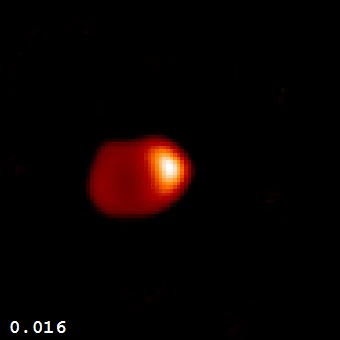
54 Eridani
A suspected astrometric binary and semiregular variable red giant.

54 Eridani is a suspected astrometric binary system roughly 400 light-years away in the constellation Eridanus. Naked-eye observers see it as a faint, reddish star with an apparent visual magnitude of 4.32. The system is moving toward the Sun at a radial velocity of −33 km/s.
Benjamin Apthorp Gould first noted the star’s variability in his 1879 *Uranometria Argentina*, but it did not receive its variable star designation, DM Eridani, until 1973. The visible component is an aging red giant on the asymptotic giant branch, classified as M3/4 III. As a semiregular variable of subtype SRb, its brightness fluctuates between magnitudes 4.28 and 4.36, with two pulsation periods of 18.8 and 45.5 days, each having an amplitude of 0.019 in magnitude. With its core hydrogen and helium exhausted, the star has swollen to about 69 times the Sun’s radius, radiating 1,021 times the Sun’s luminosity from a photosphere at an effective temperature of 3,915 K.
In the obsolete constellation Sceptrum Brandenburgicum, 54 Eridani was the second-brightest star, after 53 Eridani.
- Constellation
- Eridanus
- Apparent magnitude
- 4.32 (baseline), ranging from 4.28 to 4.36
- Spectral type
- M3/4 III
- Distance
- ~400 light years
- Radial velocity
- −33 km/s
- Luminosity
- 1,021 L☉
- Radius
- 69 R☉
Lore & Background
54 Eridani is a suspected astrometric binary star system, though the companion has not been directly observed. The visible component is an aging red giant star currently on the asymptotic giant branch, with a stellar classification of M3/4 III. It is a semiregular variable star of subtype SRb, ranging in magnitude from 4.28 down to 4.36, with pulsation periods of 18.8 and 45.5 days, each with an amplitude of 0.019 in magnitude. The variability of 54 Eridani was announced by Benjamin Apthorp Gould in his Uranometria Argentina, published in 1879, but it was not given its variable star designation, DM Eridani, until nearly 100 years later, in 1973. With the hydrogen and helium at its core exhausted, the star has expanded to around 69 times the Sun's radius and radiates 1,021 times the luminosity of the Sun from its swollen photosphere at an effective temperature of 3,915 K. It was the second-brightest star in the obsolete constellation of Sceptrum Brandenburgicum after 53 Eridani.
Reader's Guide
54 Eridani holds significance as a suspected astrometric binary, suggesting the presence of an unseen companion that may be revealed through precise positional measurements. Its designation as DM Eridani, assigned nearly a century after its variability was first noted, reflects the slow formal recognition of variable stars discovered in the 19th century. As a semiregular variable of subtype SRb, it exhibits two distinct pulsation periods, providing insight into the internal dynamics of evolved red giants on the asymptotic giant branch. Its role as the second-brightest star in the now-defunct constellation Sceptrum Brandenburgicum ties it to the history of obsolete constellations, which were once used to honor royal patrons but have since been abandoned in modern star charts. The star's reddish hue and naked-eye visibility make it a accessible target for amateur astronomers monitoring its small but regular brightness changes. Its heliocentric radial velocity of −33 km/s indicates it is moving closer to the Earth, a kinematic detail that may eventually refine distance estimates and orbital parameters if the binary nature is confirmed.
Frequently Asked Questions
What is 54 Eridani?
54 Eridani is a faint reddish naked-eye star in the constellation Eridanus with a baseline apparent magnitude of 4.32. It is catalogued as the suspected astrometric binary DM Eridani and hosts an aging red giant on the asymptotic giant branch with a spectral type of M3/4 III.
Is 54 Eridani actually a confirmed binary system?
The system is classified as a suspected astrometric binary, meaning positional wobble hints at a companion, but no secondary star has been directly resolved or imaged. Only the primary red giant is currently visible to observers, so the nature of the unseen companion remains uncertain.
What kind of variable star is 54 Eridani?
It is designated a semiregular variable of subtype SRb, meaning its brightness drifts in a somewhat irregular pattern rather than repeating on a strict clockwork period. The visible magnitude oscillates roughly between 4.28 and 4.36 around its 4.32 baseline.
How far away is 54 Eridani and how is it moving relative to us?
The system sits approximately 400 light-years from Earth in the constellation Eridanus. It is approaching the Sun at a radial velocity of about −33 km/s, making it a relatively nearby star drifting in our direction.
Who first noticed that 54 Eridani varies in brightness?
Benjamin Apthorp Gould flagged the star's changing light as early as 1879 in his catalogue Uranometria Argentina. It took another nearly century before the star formally received its variable-star designation, DM Eridani, in 1973.
More in Binary and Multiple Stars, Part 4 1-24
Spotted an error? Know more?
Reader corrections go straight into our review queue. Suggest an edit · How this site is sourced