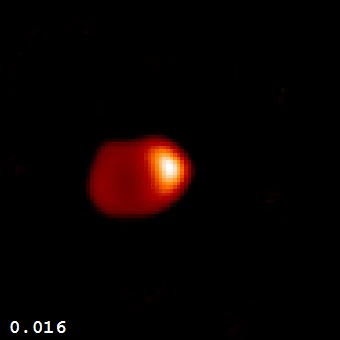
Chi Cancri
A candidate astrometric binary with an F-type main-sequence primary.

Chi Cancri, also known by its Bayer designation χ Cancri (abbreviated Chi Cnc or χ Cnc), is a candidate astrometric binary star system located in the northern zodiac constellation of Cancer. The system has a yellow-white color and is faintly visible without a telescope, with an apparent visual magnitude of 5.14. Parallax measurements place it about 59 light-years from the Sun, and it is moving away at a radial velocity of +33 km/s. Its closest approach to the Sun is estimated to have occurred roughly 274,000 years ago, when it came within 12.87 parsecs.
The visible star in the system is an F-type main-sequence star with a stellar classification of F6V. The luminosity class 'V' indicates it generates energy through hydrogen fusion in its core. This star is about 5.8 billion years old and rotates slowly, with a projected rotational velocity of only 4.2 km/s. It has roughly the same mass as the Sun but is 1.4 times larger in radius. From its photosphere, Chi Cancri radiates 2.4 times the Sun's luminosity at an effective temperature of 6,130 K. An infrared excess detected at the 18μm wavelength band suggests a circumstellar disk of dusty debris orbits the star.
- Bayer designation
- χ Cancri
- Apparent visual magnitude
- 5.14
- Distance from sun
- 59 ly
- Radial velocity
- +33 km/s
- Stellar classification (visible componen
- F6V
- Age
- 5.8 billion years
- Projected rotational velocity
- 4.2 km/s
- Mass
- ~1 solar mass
- Radius
- 1.4 solar radii
- Luminosity
- 2.4 solar luminosities
Lore & Background
The visible component of Chi Cancri is an F-type main-sequence star with a stellar classification of F6V, where the luminosity class 'V' indicates it is generating energy through core hydrogen fusion. The star is 5.8 billion years old and spins with a projected rotational velocity of just 4.2 km/s. It has about the same mass as the Sun but 1.4 times the Sun's radius, and radiates 2.4 times the luminosity of the Sun from its photosphere at an effective temperature of 6,130 K. The system displays an infrared excess in the 18μm wavelength band, suggesting a circumstellar disk of dusty debris is orbiting the star. It is estimated to have made its closest approach to the Sun some 274,000 years ago, when it came to within 12.87 pc.
Reader's Guide
Chi Cancri is notable as a candidate astrometric binary, meaning its binary nature is inferred from subtle positional shifts rather than direct imaging or spectroscopic detection. The primary star's characteristics—an F6V main-sequence star with a mass similar to the Sun but a larger radius and higher luminosity—place it in a well-studied class of solar-type stars. Its slow rotation (4.2 km/s) and age of 5.8 billion years suggest it is a relatively mature, magnetically quiet star. The detection of an infrared excess at 18μm indicates the presence of a circumstellar debris disk, which may be analogous to the Kuiper Belt in the Solar System and offers clues about planetary system formation and evolution. The system's past close approach to the Sun, about 274,000 years ago at a distance of 12.87 pc, provides a historical context for its current motion and radial velocity of +33 km/s, showing it is now receding. As a naked-eye object of magnitude 5.14, Chi Cancri is accessible to amateur astronomers and serves as a target for studies of binary dynamics and debris disk properties.
Did You Know?
- The visible component is an F-type main-sequence star with classification F6V.
- It displays an infrared excess at 18μm, suggesting a circumstellar debris disk.
- The system made its closest approach to the Sun about 274,000 years ago, coming within 12.87 pc.
Frequently Asked Questions
What is Chi Cancri?
Chi Cancri (χ Cancri) is a yellow-white star system located in the zodiac constellation Cancer. It is faintly visible to the unaided eye at an apparent visual magnitude of 5.14 and carries the Bayer designation χ Cancri.
What type of star is Chi Cancri's visible component?
The primary star we can observe is classified as F6V, identifying it as an F-type main-sequence dwarf. This makes it a hot, yellow-white hydrogen-fusing star on the main sequence.
How far away is Chi Cancri?
Parallax measurements place the system at roughly 59 light-years from the Sun. It is currently moving away from us at a radial velocity of about 33 kilometers per second.
Is Chi Cancri a confirmed binary star?
It is currently catalogued as a candidate astrometric binary, meaning orbital wobble data hints at a companion but the system has not been fully confirmed. The suspected secondary has not yet been directly resolved or imaged.
How old is Chi Cancri and how close has it come to the Sun?
The system is estimated to be around 5.8 billion years old, slightly older than the Sun. Its nearest approach to our star occurred roughly 274,000 years ago, when it passed within about 12.87 parsecs.
More in Binary and Multiple Stars, Part 4 1-24
Spotted an error? Know more?
Reader corrections go straight into our review queue. Suggest an edit · How this site is sourced