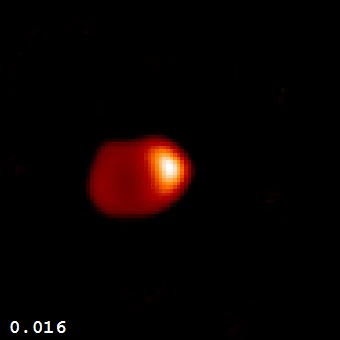
58 Aquarii
A triple system with an Am primary and a white dwarf tertiary.

58 Aquarii (58 Aqr) is a triple star system found in the constellation Aquarius. Its apparent visual magnitude of 6.39 places it at sixth magnitude, making it difficult to see without optical aid. Parallax measurements put the system roughly 243 light-years from Earth.
The primary star, designated 58 Aquarii Aa, is a main-sequence star with a spectral type of A9/F0 V, blending characteristics of A- and F-type stars. It is a chemically peculiar Am star, meaning it displays strong metallic lines in its spectrum but lacks a detectable magnetic field. This star has about 1.7 times the Sun’s mass, 2.4 times its radius, and shines with 12 times the Sun’s luminosity. Its photosphere has an effective temperature of around 7,000 K.
The secondary component, 58 Aquarii Ab, is a K-type dwarf roughly 70% the size of the Sun. It was first identified through astrometric data from the Hipparcos spacecraft and later confirmed by interferometric observations. This inner pair is expected to evolve into a common envelope binary once 58 Aquarii Aa expands during its red giant phase, with mass transfer likely occurring between the two.
The third member, 58 Aquarii B, is a white dwarf located at a wide separation from the inner binary.
- Flamsteed designation
- 58 Aquarii
- Apparent visual magnitude
- 6.39
- Distance
- 243 light years
- Primary classification
- A9/F0 V (Am star)
- Primary mass
- 1.7 M☉
- Primary radius
- 2.4 R☉
- Primary luminosity
- 12 L☉
- Primary effective temperature
- 7,000 K
- Secondary type
- K-type dwarf
- Secondary size
- ~70% of the Sun's size
Lore & Background
The primary component, 58 Aquarii Aa, is a main sequence star with a stellar classification of A9/F0 V, showing a spectrum with mixed traits of A- and F-type stars. It is a chemically peculiar Am star, exhibiting metallic lines and no magnetic field. The star has 1.7 times the mass of the Sun, 2.4 times the Sun's radius, and radiates 12 times the Sun's luminosity from its photosphere at an effective temperature of 7,000 K.
The secondary component, 58 Aquarii Ab, is a K-type dwarf with around 70% of the Sun's size. It was initially uncovered via astrometry from the Hipparcos spacecraft and later detected through interferometric observations by Waisberg, Ygal and Katz. This inner system is expected to become a common envelope binary when 58 Aquarii Aa expands in the red giant phase, with mass transfer between components also anticipated.
The tertiary component, 58 Aquarii B, is a widely separated white dwarf.
Reader's Guide
58 Aquarii is notable as a triple star system that offers insight into stellar evolution and binary interactions. The primary is an Am star, a chemically peculiar type that shows enhanced metallic lines and no magnetic field, making it a subject of interest for studies of stellar atmospheres and chemical peculiarity. The inner pair, comprising an A/F-type main sequence star and a K-type dwarf, is destined to undergo common envelope evolution when the primary becomes a red giant, leading to mass transfer between the components. This future phase provides a natural laboratory for understanding the processes that shape close binary systems and produce exotic remnants. The tertiary white dwarf, widely separated from the inner pair, adds a long-term dynamical component to the system. The discovery of the secondary via Hipparcos astrometry and later interferometric confirmation highlights the role of precision astrometry and high-resolution imaging in uncovering faint companions. Overall, 58 Aquarii serves as a valuable example of a multiple star system with a chemically peculiar primary and a predicted evolutionary path involving common envelope interaction.
Did You Know?
- 58 Aquarii is a triple star system with a white dwarf tertiary component.
- The secondary was first uncovered via astrometry from the Hipparcos spacecraft.
- The inner pair is expected to become a common envelope binary when the primary expands as a red giant.
Frequently Asked Questions
What is 58 Aquarii?
58 Aquarii is a triple star system in the constellation Aquarius, listed under Flamsteed's catalog numbering. It sits approximately 243 light-years from Earth and shines at an apparent visual magnitude of about 6.39, right at the threshold of naked-eye visibility.
What are the three components of the 58 Aquarii system?
The system pairs a main-sequence Am-type primary (designated 58 Aquarii Aa) with a secondary companion and a white dwarf serving as the tertiary member. The primary is classified A9/F0 V, carries roughly 1.7 solar masses, and has a radius about 2.4 times the Sun's.
Why is the primary star of 58 Aquarii called a chemically peculiar Am star?
Its spectrum shows unusually strong absorption lines from heavy metals, which is the hallmark of Am classification. Unlike its Ap counterparts, however, 58 Aquarii Aa has no detectable magnetic field, making it a somewhat atypical member of the chemically peculiar family.
Can you see 58 Aquarii with the naked eye?
At magnitude 6.39 it is technically at the outer limit of unaided vision, so only truly dark skies and excellent eyesight will reveal it. In practice, a small telescope or a pair of binoculars makes a much more reliable way to spot the system.
Why do multiple-star researchers find 58 Aquarii noteworthy?
Having a chemically peculiar Am primary coexist with a white dwarf tertiary offers a rare window into how stars of very different evolutionary stages interact within a single bound system. Its relatively modest distance of 243 light-years also allows precise parallax work to pin down the orbital geometry.
More in Binary and Multiple Stars, Part 4 1-24
Spotted an error? Know more?
Reader corrections go straight into our review queue. Suggest an edit · How this site is sourced