Omicron Piscium
A binary star in Pisces, visible to the naked eye.

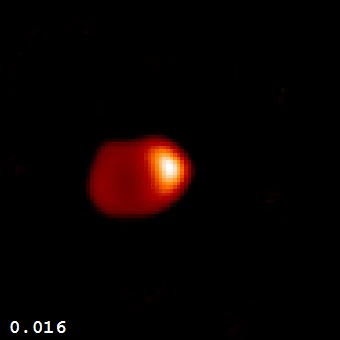
Omicron Piscium (ο Psc) is a binary star system in the constellation Pisces. It shines at magnitude 4.27, making it visible without a telescope, and lies about 280 light-years away, as measured by a parallax shift of 11.67 milliarcseconds. Because it sits near the ecliptic, the Moon can occasionally pass in front of it, and planets do so very rarely; Venus will occult it on 13 May 2027, visible from Newfoundland and the Atlantic Ocean. The system belongs to the Milky Way’s thin disk population.
The two stars are called Omicron Piscium A (officially named Torcular) and B. The Bayer designation ο Piscium comes from the Latinized form of the Greek letter. The A and B labels follow the Washington Multiplicity Catalog’s convention for multiple-star systems, which the International Astronomical Union has adopted.
Historically, the system was known as Torcularis septentrionalis, a name from the 1515 Almagest. This derives from the Greek word ληνός (“full”), which was mistakenly written for λίνος (“linen”). In 2016, the IAU’s Working Group on Star Names began cataloging proper names for individual stars rather than whole systems. On 5 September 2017, it approved Torcular for Omicron Piscium A, and that name now appears on the IAU’s official list.
In Chinese astronomy, an asterism called “Official in Charge of the Pasturing” includes Omicron Piscium along with Eta, Rho, Pi, and 104 Piscium. The Chinese name for Omicron Piscium itself is derived from that asterism.
The system is a probable astrometric binary. The visible star, Omicron Piscium A, is an evolved K-type giant with a classification of K0 III. At an estimated age of 390 million years, it has a 76% chance of being on the horizontal branch (a red clump star fusing helium in its core) rather than on the red-giant branch. It has about three times the Sun’s mass, has expanded to over 14 times the Sun’s radius, and shines with 132 times the Sun’s luminosity. Its photosphere has an effective temperature of 5,004 K.
- Bayer designation
- ο Piscium
- Apparent visual magnitude
- 4.27
- Distance from sun
- roughly 280 light-years
- Parallax
- 11.67 mas
- Spectral type (component a)
- K0 III
- Mass (component a)
- three times the Sun's mass
- Radius (component a)
- over 14 times the Sun's radius
Lore & Background
The system bears the traditional name Torcularis septentrionalis, taken from the 1515 Almagest, which is translated from the Greek ληνός ('full'), erroneously written for λίνος ('linen'). In 2016, the IAU organized a Working Group on Star Names (WGSN) to catalog and standardize proper names for stars, and on 5 September 2017 it approved the name Torcular for the component Omicron Piscium A. The two components are designated Omicron Piscium A (formally named Torcular) and B, following the convention of the Washington Multiplicity Catalog (WMC) adopted by the IAU. In Chinese, the star is part of an asterism meaning 'Official in Charge of the Pasturing', which includes Omicron Piscium, Eta Piscium, Rho Piscium, Pi Piscium, and 104 Piscium; the Chinese name for Omicron Piscium itself is derived from that asterism.
Reader's Guide
Omicron Piscium is a probable astrometric binary system, with the visible component, Omicron Piscium A, being an evolved K-type giant star of class K0 III. At an estimated age of 390 million years, it is most likely (76% chance) on the horizontal branch rather than the red-giant branch, making it a red clump star that generates energy through helium fusion at its core. The star has three times the mass of the Sun and has expanded to over 14 times the Sun's radius, radiating 132 times the Sun's luminosity from its photosphere at an effective temperature of 5,004 K. Its position near the ecliptic makes it subject to lunar and rare planetary occultations, with the next planetary occultation by Venus on 13 May 2027. As a member of the thin disk population of the Milky Way, the system contributes to understanding the structure and evolution of stars in the galactic disk. The formal naming of its primary component as Torcular by the IAU in 2017 reflects ongoing efforts to standardize stellar nomenclature.
Did You Know?
- The next planetary occultation of Omicron Piscium will be by Venus on 13 May 2027 over Newfoundland and the Atlantic Ocean.
- The visible component, Omicron Piscium A, is a red clump star with a 76% chance of being on the horizontal branch.
- The system's traditional name Torcularis septentrionalis comes from the 1515 Almagest and is derived from a Greek word erroneously written for 'linen'.
- Omicron Piscium A has an effective temperature of 5,004 K and radiates 132 times the Sun's luminosity.
More in Binary and Multiple Stars, Part 4 1-24
Spotted an error? Know more?
Reader corrections go straight into our review queue. Suggest an edit · How this site is sourced