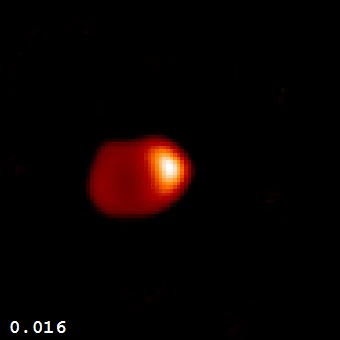
Omicron Aurigae
An astrometric binary with a chemically peculiar A-type primary.

Omicron Aurigae, also known by its Bayer designation ο Aurigae, is an astrometric binary star system in the northern constellation Auriga. It has an apparent visual magnitude of 5.47, making it just barely visible without a telescope. Based on its annual parallax shift, the system is roughly 400 light-years from Earth, and it is moving toward the Sun at a radial velocity of −8 km/s. Omicron Aurigae belongs to the Ursa Major stream, a group of stars that share a common motion through space.
The visible component is a chemically peculiar star, classified as an A-type star. Its spectrum shows unusually high levels of chromium and europium. A magnetic field has been detected around the star, and it emits X-rays with a luminosity of log Lx = 29.1. This star has about 1.9 times the Sun’s mass and 3.2 times its radius. It rotates with a projected rotational velocity of 35 km/s and radiates 50 times the Sun’s luminosity from its photosphere, which has an effective temperature of 8,300 K.
- Bayer designation
- ο Aurigae
- Apparent visual magnitude
- 5.47
- Distance
- ~400 ly
- Radial velocity
- −8 km/s
- Mass (visible component)
- 1.9 M☉
- Radius (visible component)
- 3.2 R☉
- Luminosity (visible component)
- 50 L☉
- Effective temperature
- 8,300 K
- Projected rotational velocity
- 35 km/s
- Spectral type
- A-type (chemically peculiar, Cr and Eu enhanced)
Lore & Background
The visible component of Omicron Aurigae is a chemically peculiar star of spectral type A, exhibiting anomalously high abundances of chromium (Cr) and europium (Eu) in its spectrum. A magnetic field has been detected, and the star is a source of X-ray emission with a luminosity of log Lx = 29.1. The star has 1.9 times the mass of the Sun and 3.2 times the Sun's radius, radiating 50 times the Sun's luminosity from its photosphere at an effective temperature of 8,300 K. It spins with a projected rotational velocity of 35 km/s.
Reader's Guide
Omicron Aurigae is notable as an astrometric binary system, meaning its binary nature is inferred from precise positional measurements rather than direct imaging or spectroscopic shifts. The primary star's status as a chemically peculiar A-type star with enhanced chromium and europium, along with a detected magnetic field and X-ray emission, places it among the class of magnetic Ap stars. Its membership in the Ursa Major stream of co-moving stars links it to a kinematic group of stars sharing a common motion through the galaxy, providing context for studies of stellar populations and evolution. The system's proximity of about 400 light-years and faint naked-eye visibility make it accessible for detailed astrophysical investigation, particularly in understanding the interplay between magnetic fields, chemical peculiarities, and X-ray activity in intermediate-mass stars. The radial velocity of −8 km/s indicates it is moving toward the Sun, a fact that contributes to its kinematic characterization.
Did You Know?
- It is a member of the Ursa Major stream of co-moving stars.
- The star has a detected magnetic field and emits X-rays with log Lx = 29.1.
More in Binary and Multiple Stars, Part 4 1-24
Spotted an error? Know more?
Reader corrections go straight into our review queue. Suggest an edit · How this site is sourced