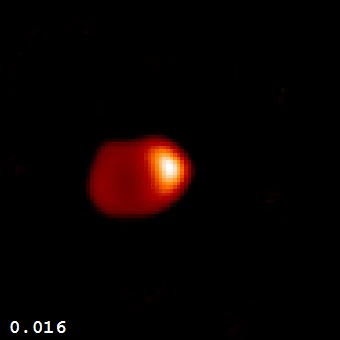
OMEGACat BH-2
First black hole discovered in Omega Centauri globular cluster.

oMEGACat BH-2 is a binary system located in the central region of the Omega Centauri globular cluster, at a distance of 5,494 parsecs (17,919 light-years) in the constellation Centaurus. It consists of a stellar-mass black hole and a visible main-sequence companion star, and is notable as the first black hole discovered in the Omega Centauri globular cluster. The system holds the record for the longest orbital period known among black hole binaries.
- Distance
- 5,494 parsecs (17,919 light-years)
- Constellation
- Centaurus
- Black hole mass
- significantly lower than expected for a low-metallicity environment such as Omega Centauri
- Companion mass
- main-sequence star
- Orbital period
- longest-period black hole binary known to date
- Semi major axis
- 31 AU
- Orbital eccentricity
- high (e = )
Lore & Background
The system was discovered as part of the international oMEGACat project, led by Nadine Neumayer and Anil Seth, which aimed to create a catalog of proper motions and spectra for 1.4 million stars in the cluster. A research team led by Matthew Whitaker from the University of Utah applied astrometry to measure the very small movements of stars over time, analyzing more than 20 years of archival data from the Hubble Space Telescope and incorporating recent data from the James Webb Space Telescope to refine the measurements. They discovered a main-sequence star moving in an elongated orbit around an invisible gravitational center. A previous study by another group of scientists had classified the hidden component as a neutron star, but the University of Utah team's refined mass estimate ruled out that possibility.
Reader's Guide
oMEGACat BH-2 is significant as the first black hole identified in the Omega Centauri globular cluster, a system where theoretical models predict approximately 10,000 smaller stellar-mass black holes, yet none had been detected in prior radial velocity, radio, or X-ray surveys. Its discovery demonstrates the power of astrometric techniques using long-baseline archival data from the Hubble Space Telescope combined with high-precision near-infrared data from the James Webb Space Telescope. The system's long orbital period and high eccentricity, with a semi-major axis of 31 AU, make it the longest-period black hole binary known. Despite covering only about a quarter of the orbital period in observations, the parameters were determined with high accuracy due to recording of the periastron passage, where the radial velocity of the visible companion is maximal. The binary is weakly gravitationally bound and has an estimated projected lifespan of about 800 million years before it is expected to disrupt due to dynamical scattering during close encounters with other stars or binaries. The results were published on July 13, 2026, in The Astrophysical Journal Letters.
Did You Know?
- The system has the longest orbital period of any known black hole binary.
- The black hole's mass is significantly lower than expected for a low-metallicity environment like Omega Centauri.
- The binary is expected to disrupt in about 800 million years due to dynamical scattering.
More in Binary and Multiple Stars, Part 4 1-24
Spotted an error? Know more?
Reader corrections go straight into our review queue. Suggest an edit · How this site is sourced