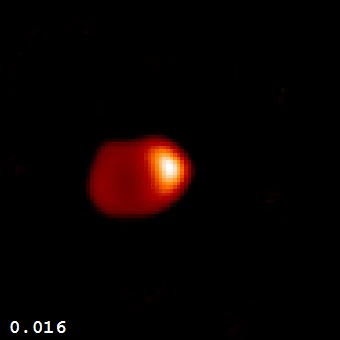
Omega Sagittarii
A binary star system in Sagittarius, formally named Terebellum.

Omega Sagittarii, also known by its Latinized Bayer designation ω Sagittarii, is a binary star system located in the constellation Sagittarius, close to the eastern boundary with Capricornus. Its formal proper name is Terebellum. The system has a yellowish tint and is just barely visible without a telescope, with an apparent visual magnitude of 4.70. Based on parallax measurements, it lies about 76 light-years from the Sun and is moving closer at a radial velocity of −16 km/s. Because it sits near the ecliptic, the star can be occulted by the Moon.
The two stars in this system orbit each other once every 1712.74 days, following a highly elliptical path with an eccentricity of 0.82. The visible component is a G-type subgiant, classified as G5 IV. It is roughly three billion years old and rotates at a projected speed of 5.6 km/s. Its photosphere radiates seven times the Sun's luminosity, with an effective temperature of 5,499 K.
In terms of nomenclature, ω Sagittarii (Latinized as Omega Sagittarii) is the Bayer designation. Historically, this star was part of an asterism called Terebellum, which also included 59, 60, and 62 Sagittarii. A 1971 NASA memorandum listed Omega Sagittarii as Terebellum I, with the other three stars as Terebellum II, III, and IV respectively. In 2016, the International Astronomical Union established a Working Group on Star Names to standardize proper names, and on 5 September 2017, the name Terebellum was officially approved for Omega Sagittarii. In Chinese astronomy, the same four stars form an asterism known as Dog Territory, with Omega Sagittarii itself carrying a specific Chinese name derived from that grouping.
- Apparent visual magnitude
- 4.70
- Distance
- 76 light years
- Radial velocity
- −16 km/s
- Orbital period
- 1712.74 days
- Orbital eccentricity
- 0.82
- Stellar classification
- G5 IV
- Effective temperature
- 5,499 K
Lore & Background
Omega Sagittarii is a binary star system whose components orbit each other with a period of 1712.74 days and an eccentricity of 0.82. The visible component is a G-type subgiant star with a stellar classification of G5 IV. It is three billion years old and spins with a projected rotational velocity of 5.6 km/s. The star radiates seven times the luminosity of the Sun from its photosphere at an effective temperature of 5,499 K.
This star, together with 60, 62, and 59 Sagittarii, formed the asterism called 'Terebellum'. According to a 1971 NASA memorandum, Terebellum was originally the title for four stars: Omega Sagittarii as Terebellum I, 59 Sagittarii as Terebellum II, 60 Sagittarii as Terebellum III, and 62 Sagittarii as Terebellum IV. In 2016, the IAU organized a Working Group on Star Names (WGSN) to catalog and standardize proper names for stars. The WGSN approved the name Terebellum for Omega Sagittarii on 5 September 2017, and it is now included in the List of IAU-approved Star Names.
In Chinese, the asterism consisting of Omega Sagittarii, 60 Sagittarii, 62 Sagittarii, and 59 Sagittarii is called 'Dog Territory'. Consequently, the Chinese name for Omega Sagittarii itself is derived from that asterism.
Reader's Guide
Omega Sagittarii, as part of the Terebellum asterism, holds a place in both historical and modern astronomical nomenclature. The asterism originally comprised four stars—Omega, 59, 60, and 62 Sagittarii—with Omega designated as Terebellum I in a 1971 NASA memorandum. This grouping reflects a tradition of naming star patterns that predates modern cataloging. The formal adoption of the name Terebellum for Omega Sagittarii by the IAU Working Group on Star Names in 2017 standardizes this historical usage within the official list of star names. The system's position near the ecliptic makes it subject to lunar occultations, a characteristic that has practical significance for observational astronomy. As a binary with a highly eccentric orbit (eccentricity 0.82) and a period of 1712.74 days, it provides a case study in stellar dynamics. The visible component, a G5 IV subgiant, is three billion years old and radiates seven solar luminosities, offering insights into the evolution of intermediate-mass stars. Its proximity at 76 light years and its motion toward the Sun (radial velocity −16 km/s) make it a nearby system of interest for both amateur and professional study.
Did You Know?
- Omega Sagittarii is formally named Terebellum, approved by the IAU Working Group on Star Names on 5 September 2017.
- The system has an orbital eccentricity of 0.82, one of the highest among binary stars.
- Its position near the ecliptic means it is subject to lunar occultations.
More in Binary and Multiple Stars, Part 4 1-24
Spotted an error? Know more?
Reader corrections go straight into our review queue. Suggest an edit · How this site is sourced