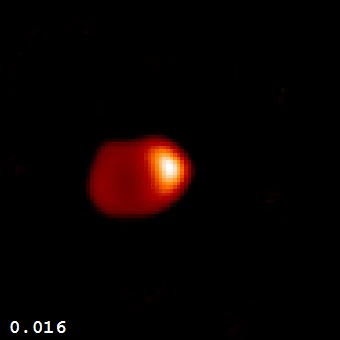
NGC 1850 BH1
A disputed binary system possibly containing a black hole or a stripped star.

NGC 1850 BH1 is a binary star system found within the cluster NGC 1850 in the Large Magellanic Cloud. It was identified in 2022 by a team searching for black holes in that galaxy, led by Sara Saracino. The system consists of a visible star—a main-sequence star near the end of its life, with a mass around five times that of the Sun, just beginning to overflow its Roche lobe—and an unseen companion. Using radial velocity and light curve modeling, the team calculated the companion’s mass at 11.1 solar masses, which would classify it as a black hole.
However, the black hole interpretation has been challenged. A black hole in such a binary would typically emit X-rays, but observations by the Chandra X-ray Observatory detected no X-rays from the source. A 2022 study by Kareem El-Badry and Kevin B. Burdge argued that the visible star’s mass was likely overestimated; its observed density suggests it cannot exceed about 1.5 solar masses and is probably a stripped star of roughly 1.1 solar masses with a large radius of 5.7 solar radii. If so, the unseen companion would be a main-sequence star of about 3.5 solar masses, not a black hole. A separate study by Heloise Stevance, Steven Parsons, and Jan J. Eldridge reached a similar conclusion, finding that a black-hole binary with the observed mass parameters is extremely unlikely and that a stripped-star system fits better.
In 2023, Saracino’s team responded with a follow-up study, arguing that the black hole possibility should not be dismissed. They pointed out that even in the stripped-star scenario, the unseen object, if it were a star, should still be bright enough to appear in the system’s spectrum—unless it is hidden by an optically thick accretion disk. They also noted that even if the unseen companion’s mass is lower than originally calculated, it could still exceed the Tolman–Oppenheimer–Volkoff limit, meaning a black hole remains a viable explanation.
- Discovery year
- 2022
- Discovery team lead
- Sara Saracino
- Location
- NGC 1850 cluster in the Large Magellanic Cloud
- Visible star mass initial estimate
- approximately 5 solar masses
- Unseen companion mass initial estimate
- 11.1 solar masses
- Visible star mass revised estimate
- ~1.1 solar masses
- Visible star radius revised estimate
- 5.7 solar radii
Lore & Background
The binary system NGC 1850 BH1 was discovered by a team led by Sara Saracino in 2022. The team identified a visible star of approximately 5 solar masses at the main-sequence turnoff, which was beginning to fill its Roche lobe. Using radial velocity and light curve modeling, they determined the mass of the unseen companion to be 11.1 solar masses, which would firmly classify it as a black hole. However, no X-ray emission from the source was detected by the Chandra observatory, casting doubt on the black hole interpretation.
A 2022 study by Kareem El-Badry and Kevin B. Burdge argued that the mass of the visible star was likely overestimated, finding that its observed density is too low to exceed about 1.5 solar masses. They concluded the visible star is most likely a ~1.1 solar mass stripped star with a large radius of 5.7 solar radii, which would be consistent with a ~3.5 solar mass main-sequence companion rather than a black hole. A study by Heloise Stevance, Steven Parsons, and Jan J. Eldridge reached a similar conclusion, finding that a black-hole binary system with the observed mass parameters is extremely unlikely and that a stripped star system is a better explanation.
A follow-up study by Sara Saracino's team in 2023 refuted these alternative interpretations, stating that the possibility of a black hole should not be ruled out. They argued that even in the stripped-star scenario, the unseen object, if a star, should still be bright enough to be detectable in the binary's spectrum, and would have to be obscured by an optically thick accretion disk. They also noted that even if the mass of the unseen star was lower than originally calculated, it would still not rule out a black hole, since the object would still be more massive than the TOV limit.
Reader's Guide
NGC 1850 BH1 holds significance as a contested candidate for a stellar-mass black hole in a binary system outside the Milky Way. Its discovery by Sara Saracino's team in 2022 represented a potential breakthrough in finding black holes in the Large Magellanic Cloud. The subsequent debate over its nature highlights the challenges in identifying black holes via indirect methods, particularly when X-ray emission is absent. The alternative interpretation—that the system contains a stripped star and a main-sequence companion—illustrates how uncertainties in stellar mass and evolutionary state can lead to radically different conclusions. The 2023 rebuttal by the original discovery team underscores the ongoing nature of the dispute, with arguments based on detectability of the companion and the TOV limit. The system thus serves as a case study in the complexities of binary system analysis and the importance of multi-wavelength observations in resolving such ambiguities.
Did You Know?
- NGC 1850 BH1 is located in the Large Magellanic Cloud.
- A 2023 study by Saracino's team argued that the black hole possibility should not be ruled out.
More in Binary and Multiple Stars, Part 4 1-24
Spotted an error? Know more?
Reader corrections go straight into our review queue. Suggest an edit · How this site is sourced