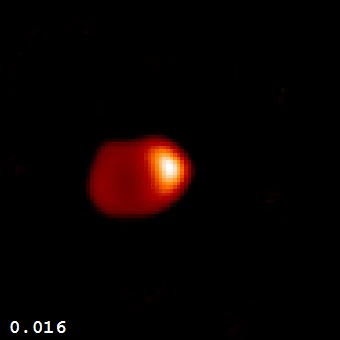
LHS 1678
A nearby astrometric binary with three small exoplanets.

LHS 1678 (also designated TOI-696) is an astrometric binary star system located about 65 light-years (19.9 parsecs) from Earth in the constellation Caelum. It consists of a red dwarf primary and a companion likely to be a brown dwarf, making it notable as a nearby binary system with an uncertain secondary nature. The red dwarf hosts three small exoplanets, all smaller than Earth, discovered via the transit method.
- Distance
- ~65 light-years (19.9 pc)
- Constellation
- Caelum
- Apparent magnitude
- 12.5
- Spectral type (primary)
- M3V
- Mass (primary)
- 0.345 M☉
- Radius (primary)
- 0.329 R☉
- Effective temperature (primary)
- 3490 K
Lore & Background
LHS 1678 is an astrometric binary, meaning its binary nature was inferred from precise positional measurements rather than direct imaging. The primary, LHS 1678 A, is a red dwarf of spectral type M3V with 0.345 times the mass and 0.329 times the radius of the Sun. Its surface temperature is 3490 K, and it emits only 1.45% of the Sun's luminosity. The star is metal-poor, with an iron abundance 44% of the solar level, and has an estimated age of 4.22 billion years. It occupies an unusual position in the HR diagram, lying in a gap associated with the transition from partially to fully convective interiors in red dwarfs. The star shows little variability, no signs of starspots or flares, and no magnetic activity.
The secondary component, LHS 1678 B, is a probable brown dwarf detected through long-baseline astrometry from RECONS. Its nature remains uncertain; it may be a Jovian planet, but astrometric monitoring suggests it is likely a brown dwarf. A white dwarf companion is ruled out by astrometry and radial velocity. The projected separation between the two components is at most 5 AU, and the orbit is highly inclined, with possible orbital periods of 42 or 100 years and corresponding semi-major axes of 36 or 210 AU. The companion has not been directly observed; observations with the Very Large Telescope's NaCo adaptive optics rule out any companion more massive than a certain threshold at separations larger than 5 AU.
The system has a high proper motion, moving noticeably across the sky between 1983 and 2022. It is moving away from Earth. The nearest star to LHS 1678 is Alpha Caeli, at a distance of 3.3 light-years.
Reader's Guide
LHS 1678 is significant as a nearby astrometric binary system that hosts multiple small exoplanets, offering a rare opportunity to study planet formation and dynamics around a low-mass star with a likely brown dwarf companion. The system's three exoplanets—LHS 1678 b, c, and d—are all smaller than Earth and orbit very close to their host star, with orbital periods of about 21 hours, 3.7 days, and 5 days, respectively. Planets c and d are near a 4:3 orbital resonance, though no transit-timing variations were detected over three years. The masses of the planets have not been measured directly, but estimates have been made using the forecaster procedure, with large margins of error. The uncertain nature of the secondary companion—whether a brown dwarf or a massive planet—highlights the challenges in characterizing low-mass companions in binary systems. The system's location in the HR diagram gap adds to its interest for stellar astrophysics, as it may help clarify the transition between partially and fully convective stellar interiors. Future radial velocity measurements could determine the planetary masses, and continued astrometric monitoring may resolve the companion's true nature.
Did You Know?
- LHS 1678 is located about 65 light-years away in the constellation Caelum.
- The red dwarf primary has only 0.345 times the mass of the Sun and a surface temperature of 3490 K.
- The system's three exoplanets are all smaller than Earth and orbit within 5 days.
- The secondary companion is likely a brown dwarf, but its nature remains uncertain.
More in Binary and Multiple Stars, Part 4 1-24
Spotted an error? Know more?
Reader corrections go straight into our review queue. Suggest an edit · How this site is sourced