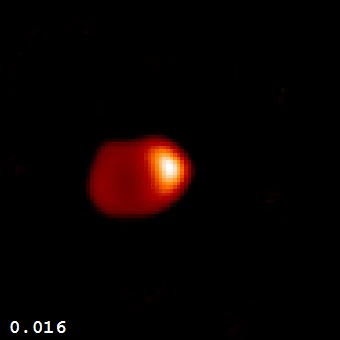
Kappa Fornacis
Hierarchical triple with a G-type primary and a close M-dwarf binary.

Kappa Fornacis (κ For) is a hierarchical triple star system approximately 72 light-years away, notable for its complex architecture: a somewhat evolved G-type primary orbited by a close pair of red dwarfs. The system has been studied through astrometric, spectroscopic, and direct imaging techniques, revealing a long-period binary orbit and a short-period subsystem that explains the star's excess X-ray and radio emission.
- Distance
- 72 light-years
- Apparent magnitude
- 5.2
- Spectral type (primary)
- G1 V
- Primary mass
- ~1.2 solar masses
- Primary age
- 5–6 billion years
- Orbital period (ab)
- 26.5 ± 2 years
- Subsystem orbital period
- ~3.7 days
Lore & Background
Kappa Fornacis was first noted as a possible binary when an X-ray and radio source was found 0.23 arcseconds north of the star in 1995, suggesting youth or a companion. The Hipparcos mission later detected a large proper-motion acceleration of 19.4 mas/year, indicating an astrometric binary with a period of 26.5 ± 2 years. The companion's light was not seen, leading to an initial interpretation as a white dwarf. Radial-velocity surveys found a long-period trend, and a preliminary orbit was derived, though initially shorter than the astrometric one; later HARPS data brought the period into better agreement. The companion was first resolved in 2007 and 2008 at a separation of about 0.5 arcseconds, confirming the astrometric orbit. The secondary was found to be too faint for its mass, suggesting either a massive white dwarf or a close M-dwarf binary. Tokovinin (2013) combined spectroscopic and visual data to show that the secondary's photometric colors are consistent with an early M-dwarf, but it lies above the main sequence, indicating it is actually two stars. Weak absorption lines in Hα varying by about 80 km/s over a few days confirmed a close binary of two approximately equal-mass red dwarfs orbiting every ~3.7 days. Such close binaries maintain high activity due to tidal synchronization, making the subsystem the source of the excess energy.
Reader's Guide
Kappa Fornacis is significant as a well-characterized hierarchical triple system that illustrates the interplay between astrometric, spectroscopic, and direct imaging methods in resolving multiple-star architectures. The system's history shows how initial misinterpretations—such as the companion being a white dwarf—were corrected as more data accumulated. The resolved secondary, itself a close binary of M-dwarfs, explains the star's X-ray and radio activity, analogous to active binaries like CM Draconis. The primary, a G1 V star slightly evolved above the main sequence, has a mass about 20% larger than the Sun and an age of 5–6 billion years, placing it among older thin-disk stars. Its low chromospheric activity (log R'HK ≈ -5.0) and solar-like metallicity are consistent with its age. The system's kinematics (UVW = -19.5, -16.2, -9.6 km/s) confirm it as a member of the thin disk. Kappa Fornacis serves as a benchmark for understanding the evolution of solar-type stars in multiple systems and the long-term activity of close binary subsystems.
Did You Know?
- Kappa Fornacis is a hierarchical triple system with a G1 V primary and a close pair of M-dwarfs.
- The secondary subsystem has an orbital period of about 3.7 days, causing high stellar activity.
- The system's astrometric binary period is 26.5 ± 2 years, confirmed by half a century of proper motion data.
- The primary is about 5–6 billion years old, slightly older than the Sun.
More in Binary and Multiple Stars, Part 4 1-24
Spotted an error? Know more?
Reader corrections go straight into our review queue. Suggest an edit · How this site is sourced