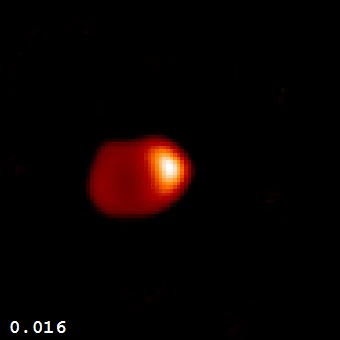
Iota Sagittarii
A K-type giant in Sagittarius with a faint red dwarf companion.

Iota Sagittarii, also cataloged as Iota Sgr or ι Sagittarii, lies in the zodiac constellation Sagittarius. Its apparent visual magnitude of +4.118 makes it visible without optical aid. From Earth, an annual parallax shift of 17.94 milliarcseconds places the star about 182 light-years away. It is receding from the solar system at a radial velocity of +35.8 km/s. Proper motion data from the Hipparcos mission reveal it to be an astrometric binary. The primary component is an evolved K-type giant or bright giant, with a stellar classification of K0 II-III. After correcting for limb darkening, its measured angular diameter, at the estimated distance, corresponds to a physical size roughly 15 times the Sun’s radius. This star has about 1.4 times the Sun’s mass and radiates 87 times the Sun’s luminosity from its enlarged photosphere, which has an effective temperature near 4,594 K. The companion was directly imaged for the first time in 2014 using the SPHERE instrument on the Very Large Telescope. It sits separated from the primary by a small angular distance and is more than 4,000 times fainter. This companion is an M-type red dwarf, with an estimated mass.
- Apparent magnitude
- +4.118
- Distance
- 182 light-years
- Parallax
- 17.94 mas
- Radial velocity
- +35.8 km/s
- Spectral type
- K0 II-III
- Radius
- ~15 solar radii
- Mass
- 1.4 solar masses
Lore & Background
The primary component of Iota Sagittarii shows the spectrum of an evolved K-type giant or bright giant star with a stellar classification of K0 II-III. Its measured angular diameter, after correction for limb darkening, yields a physical size of about 15 times the radius of the Sun. It has 1.4 times the mass of the Sun and is radiating 87 times the Sun's luminosity from its enlarged photosphere at an effective temperature of about 4,594 K. The companion star was directly observed for the first time in 2014 with the SPHERE instrument on the Very Large Telescope. It is separated from the primary star and is more than 4,000 times fainter than it. This is an M-type red dwarf star with an estimated mass.
Reader's Guide
Iota Sagittarii is notable as an astrometric binary, its binary nature revealed by proper motion data from the Hipparcos mission. The direct observation of its companion in 2014 using the SPHERE instrument on the Very Large Telescope marked a significant step in confirming the system's duplicity. The primary, a K0 II-III giant or bright giant, is a relatively massive evolved star, while the companion is a much fainter M-type red dwarf. The system's distance of 182 light-years places it within the local stellar neighborhood, and its radial velocity of +35.8 km/s indicates it is moving away from Earth. The companion's extreme faintness—more than 4,000 times fainter than the primary—highlights the challenge of detecting such low-mass stellar companions around evolved stars. The system contributes to the understanding of binary star formation and evolution, particularly for intermediate-mass stars that have left the main sequence.
Did You Know?
- Iota Sagittarii is an astrometric binary, identified from Hipparcos proper motion data.
- The primary star has a radius about 15 times that of the Sun.
More in Binary and Multiple Stars, Part 4 1-24
Spotted an error? Know more?
Reader corrections go straight into our review queue. Suggest an edit · How this site is sourced