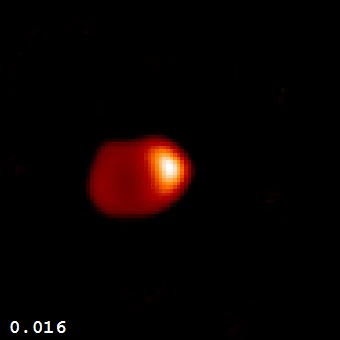
HD 32356
An orange-hued K-type bright giant in Camelopardalis.

HD 32356, also known as HR 1624, is an astrometric binary system in the northern circumpolar constellation Camelopardalis, near the star β Camelopardalis. The star we see is an orange-hued giant faintly visible without a telescope, with an apparent magnitude of 5.99. Based on parallax data from Gaia DR3, it lies about 557 light-years away and is moving closer to us, with a heliocentric radial velocity that is not specified. At that distance, interstellar dust dims its light by 0.29 magnitudes, giving it an absolute magnitude of +0.23.
The visible star is classified as K5 II, meaning it is an evolved K-type bright giant that has stopped fusing hydrogen in its core and left the main sequence. It has 1.18 times the Sun's mass but, at 4.27 billion years old, has swollen to 30.67 times the Sun's radius. Its enlarged photosphere shines with 300 times the Sun's luminosity, though its effective temperature is not given. HD 32356 A is metal-poor, with an iron content roughly half the Sun's, and rotates so slowly that its projected rotational velocity cannot be measured accurately.
- Constellation
- Camelopardalis
- Apparent magnitude
- 5.99
- Distance
- 557 light-years
- Spectral type
- K5 II
- Mass
- 1.18 M☉
- Radius
- 30.67 R☉
- Luminosity
- 300 L☉
Lore & Background
HD 32356 is an astrometric binary, with its visible component classified as a K5 II bright giant. This evolved star has ceased hydrogen fusion at its core and left the main sequence. At an age of 4.27 billion years, it has expanded to 30.67 times the Sun's radius while retaining only 1.18 times the Sun's mass. The star radiates 300 times the luminosity of the Sun from its enlarged photosphere. Gaia DR3 parallax measurements place it at a distance of 557 light-years, and it is currently drifting closer with a heliocentric radial velocity. Its brightness is diminished by interstellar extinction of 0.29 magnitudes, yielding an absolute magnitude of +0.23. HD 32356 A is metal deficient, with an iron abundance roughly half of the Sun's, and it spins too slowly for its projected rotational velocity to be measured accurately.
Reader's Guide
HD 32356 serves as an example of an evolved K-type bright giant in a binary system, offering insight into the later stages of stellar evolution for intermediate-mass stars. Its status as an astrometric binary, detected through positional perturbations rather than direct imaging or spectroscopy, highlights the utility of precise astrometric measurements in uncovering hidden companions. The star's metal deficiency, with iron abundance roughly half solar, places it among the population of chemically peculiar giants that may have formed from gas with lower metallicity or undergone internal mixing processes. Its slow rotation, too slow for measurement, is consistent with the expected spin-down of evolved giants. The system's location in the northern circumpolar constellation Camelopardalis, near β Camelopardalis, makes it accessible for long-term monitoring. The combination of its distance, extinction, and absolute magnitude provides a useful calibration point for understanding the intrinsic properties of K5 II stars in the solar neighborhood.
Did You Know?
- HD 32356 is an astrometric binary located in the constellation Camelopardalis.
- The visible component has a spectral classification of K5 II, indicating it is an evolved bright giant.
- The star's iron abundance is roughly half that of the Sun.
More in Binary and Multiple Stars, Part 4 1-24
Spotted an error? Know more?
Reader corrections go straight into our review queue. Suggest an edit · How this site is sourced