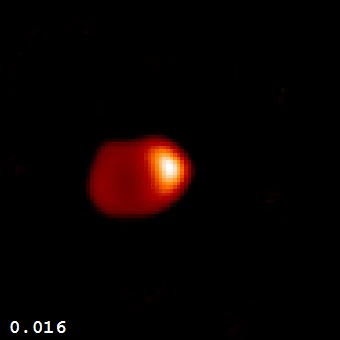
HD 187086
Probable astrometric binary red giant in Telescopium.

HD 187086, also known as HR 7537, is a probable astrometric binary (87% chance) located in the southern constellation Telescopium. It is a red giant star on the asymptotic giant branch, with an average apparent magnitude of 5.9, making it faintly visible to the naked eye. The star is notable for its variability and its status as a candidate binary system.
- Apparent magnitude
- 5.9 (average)
- Distance
- 1,020 light years
- Spectral type
- M1 III
- Mass
- 1.76 M☉
- Radius
- 111 R☉
- Luminosity
- 1,031 L☉
- Metallicity
- [Fe/H] = +0.24
Lore & Background
HD 187086 has a stellar classification of M1 III, indicating it is a red giant currently on the asymptotic giant branch, fusing hydrogen and helium shells around an inert carbon core. It has 1.76 times the mass of the Sun but has expanded to 111 times the solar radius, radiating 1,031 times the solar luminosity from its enlarged photosphere. The star is particularly metal enriched, with an iron abundance of [Fe/H] = +0.24.
The star's variability was first noticed by P.M. Corben in 1971 after it had been listed as an ordinary M-type giant a year prior. HD 187086 fluctuates between magnitudes 5.95 and 6.07. In 2002, Chris Koen and Laurent Eyer reported that Hipparcos data shows periodic fluctuations with an amplitude of 0.023 magnitudes and a period of 7.6805 days. As of 2004, however, it is not confirmed to be variable.
HD 187086 is a probable astrometric binary with an 87% chance of being such. It is located at a distance of 1,020 light years based on Gaia DR3 parallax measurements and is rapidly drifting closer with a heliocentric radial velocity. At its current distance, its brightness is diminished by 0.27 magnitudes due to interstellar dust, and it has an absolute magnitude of −0.8.
Reader's Guide
HD 187086 holds significance as a probable astrometric binary system, with an 87% probability, making it a candidate for further study of binary dynamics among evolved stars. Its classification as an M1 III red giant on the asymptotic giant branch places it in a late stage of stellar evolution, where it fuses hydrogen and helium shells around an inert carbon core. The star's high metallicity ([Fe/H] = +0.24) and large radius (111 R☉) contribute to its high luminosity (1,031 L☉), while its variability—first noted by P.M. Corben in 1971 and later analyzed by Chris Koen and Laurent Eyer in 2002—remains unconfirmed as of 2004, adding an element of uncertainty to its observational record. The star's rapid approach toward the solar system, combined with its distance of 1,020 light years and interstellar extinction of 0.27 magnitudes, provides context for its apparent brightness. As a faint naked-eye object in Telescopium, HD 187086 serves as a target for astrometric and photometric monitoring to resolve its binary status and variability, contributing to the understanding of red giant evolution and binary star formation in the Milky Way.
Did You Know?
- HD 187086 has an 87% chance of being an astrometric binary.
- It is a red giant on the asymptotic giant branch with an inert carbon core.
- It has a high metallicity of [Fe/H] = +0.24.
More in Binary and Multiple Stars, Part 4 1-24
Spotted an error? Know more?
Reader corrections go straight into our review queue. Suggest an edit · How this site is sourced