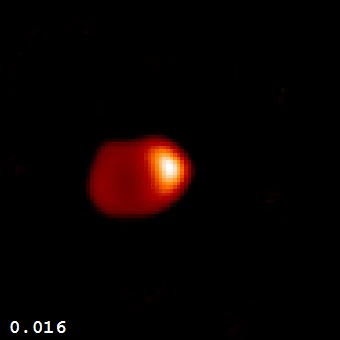
HD 181295
A probable astrometric binary in Telescopium with an unseen companion.

HD 181295 is a star in the southern constellation Telescopium, near the limit of naked-eye visibility at apparent magnitude 6.42. It is notable as a probable astrometric binary, with proper motion variations first detected in a 2005 Hipparcos survey indicating an unseen companion.
- Apparent magnitude
- 6.42
- Distance
- 252 light-years
- Absolute magnitude
- +2.14
- Spectral type
- F0 V
- Mass
- 1.74 M☉
- Radius
- 2.35 R☉
- Luminosity
- 13.3 L☉
Lore & Background
HD 181295 is an F-type main-sequence star with a stellar classification of F0 V, generating energy via hydrogen fusion at its core. It has 1.74 times the mass of the Sun and 2.35 times the radius of the Sun, radiating 13.3 times the solar luminosity from its photosphere. The star is rather evolved for its class at an age of 1.41 billion years, having completed 77.3% of its main sequence lifetime. Its iron abundance is [Fe/H] = −0.27, and it spins modestly with a projected rotational velocity that yields a rotation period within 2.7 days. The star's brightness is diminished by 0.22 magnitudes due to interstellar extinction, and it is currently drifting closer with a heliocentric radial velocity.
Reader's Guide
HD 181295's significance lies in its status as a probable astrometric binary, with proper motion variations first detected in a 2005 Hipparcos survey. A follow-up survey published in 2006 confirmed a 97% probability that an unseen companion is tugging on the visible star. This makes HD 181295 a valuable target for studying binary star dynamics and the properties of low-mass companions that are not directly observable. The system's relatively close distance of 252 light-years allows for detailed astrometric analysis, and the visible component's well-characterized properties—mass, radius, luminosity, and evolutionary stage—provide a solid foundation for modeling the companion's orbit and mass. The star's advanced main-sequence age (77.3% complete) adds context to its evolutionary state, while its modest rotation and slightly metal-poor composition ([Fe/H] = −0.27) offer clues about its formation history. As a probable astrometric binary, HD 181295 contributes to the census of multiple-star systems in the solar neighborhood and helps refine our understanding of stellar multiplicity rates among F-type stars.
Did You Know?
- HD 181295 has a 97% probability of being an astrometric binary based on a 2006 follow-up survey.
- The star has completed 77.3% of its main sequence lifetime at an age of 1.41 billion years.
- Its brightness is reduced by 0.22 magnitudes due to interstellar extinction.
More in Binary and Multiple Stars, Part 4 1-24
Spotted an error? Know more?
Reader corrections go straight into our review queue. Suggest an edit · How this site is sourced