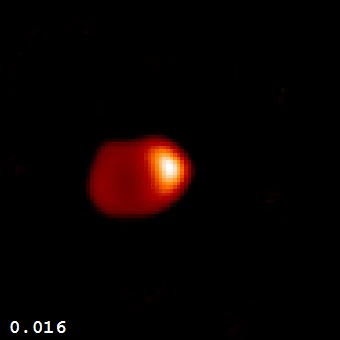
HD 174881
Binary of two K-type giants in Lyra, 396 pc away.

HD 174881 is a binary star system in the northern constellation Lyra. It consists of two evolved giant stars that have exhausted their core hydrogen and expanded. The system is faintly visible to the naked eye under very dark skies, with an apparent visual magnitude of +6.209. Its distance, derived from dynamical parallax, is about 396 pc, and interstellar extinction dims its light by 0.22 magnitudes.
- Apparent magnitude
- +6.209
- Distance
- 396 pc
- Extinction
- 0.22 mag
- Orbital period
- 215 days
- Eccentricity
- 0.12
- Primary mass
- >3 M☉
- Primary radius
- 34 R☉
- Primary luminosity
- 460 L☉
- Primary temperature
- 4620 K
- Secondary mass
- >3 M☉
Lore & Background
HD 174881 was first identified as a binary in 1995 through spectroscopic observations. Subsequent observations refined its orbit and spatially resolved the two stars for the first time, providing tests of stellar evolution in evolved stars. The orbit is nearly circular, with an eccentricity of 0.12, and the stars complete a revolution every 215 days. Both components are over three times as massive as the Sun, with radii of 34 and 23 solar radii and luminosities of 460 and 250 times solar. Their effective temperatures, 4,620 K and 4,880 K, give them an orange hue characteristic of K-type stars. The system is estimated to be 250 million years old.
Reader's Guide
HD 174881 is significant as a binary system of two evolved giant stars whose orbital parameters and physical properties have been measured with increasing precision. The first spectroscopic detection in 1995 led to later spatially resolved observations that improved the orbit and allowed direct tests of stellar evolution models for post-main-sequence stars. The system's low eccentricity and short orbital period of 215 days make it a valuable laboratory for studying the evolution of close binary giants. An infrared excess has been detected, indicating the presence of cold dust at temperatures between 15 and 20 K, which may also account for the observed extinction. This dust could be a remnant of earlier mass loss or a debris disk. The system's age of 250 million years places it in a relatively young evolutionary stage for giants, and its distance of about 396 pc, combined with the extinction of 0.22 magnitudes, provides a well-constrained context for modeling its stellar and orbital evolution.
Did You Know?
- HD 174881 was first detected as a binary in 1995 via spectroscopic observations.
- The system has an infrared excess suggesting cold dust at 15–20 K.
- Both stars are evolved giants with radii 34 and 23 times that of the Sun.
More in Binary and Multiple Stars, Part 4 1-24
Spotted an error? Know more?
Reader corrections go straight into our review queue. Suggest an edit · How this site is sourced