HD 16754
Hierarchical triple star system with young solar-type companions.

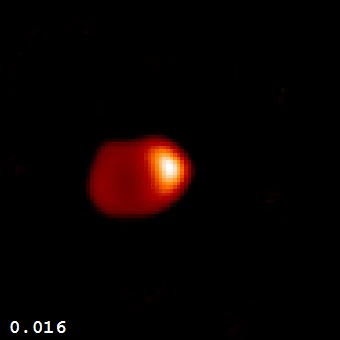
HD 16754, also designated s Eridani, is a triple star system in the constellation Eridanus. Visible to the naked eye as a faint point of light with an apparent visual magnitude of +4.74, it is located 40.4 light-years away and is drifting further with a radial velocity of +18 km/s. The system is notable for being a hierarchical triple discovered through interferometric observations, with an inner binary orbiting the primary star.
- Bayer designation
- s Eridani
- Apparent visual magnitude
- +4.74
- Distance
- 40.4 light-years
- Radial velocity
- +18 km/s
- Primary spectral type
- A1 Vb
- Primary mass
- 2.0 solar masses
- Primary radius
- 1.7 solar radii
Lore & Background
HD 16754 was flagged as an astrometric binary based on proper motion measurements from the Hipparcos spacecraft. Interferometric observations in 2026 revealed it to be a hierarchical triple star system, with the primary star orbited by an inner binary. The components of the inner binary have a projected separation that, if close to the semi-major axis, implies an orbital period of roughly one month; the overall system's projected separation suggests an outer orbital period of about five years. The expected timescale of the Kozai mechanism is 300 years, short enough for changes in the inner system's eccentricity and inclination to be detected within a decade.
The primary component is an A-type main-sequence star with a stellar classification of A1 Vb, having 2.0 times the mass and 1.7 times the radius of the Sun. Earlier measurements showed a high projected rotational velocity of 168 km/s, but Ammler-von Eiff and Reiners (2012) found a much lower velocity of 13 km/s. The secondary and tertiary components, named s Eridani Ab1 and Ab2, are slightly smaller and cooler than the Sun, with masses, radii, and temperatures of 5,400 K and 5,100 K respectively. The presence of young solar-type stars explains the hard X-ray emission from the system, which would not be expected for an A-type star.
The system has been considered a member of the Columba association of co-moving stars, which would give it an age of 30 million years. However, stellar isochrones estimate the system's age at 160 million years, arguing against membership in the association.
Reader's Guide
HD 16754 is significant as a hierarchical triple system that offers a laboratory for studying dynamical interactions among stars. The discovery of an inner binary with a projected separation implying a one-month orbital period, combined with an outer companion on a five-year orbit, makes it a rare case where the Kozai mechanism may operate on a timescale of 300 years—short enough for observable changes in eccentricity and inclination over a decade. The system's hard X-ray emission, unexpected for an A-type primary, is explained by the presence of young solar-type companions, which are themselves slightly smaller and cooler than the Sun. The discrepancy between the system's age as inferred from the Columba association (30 million years) and from stellar isochrones (160 million years) highlights ongoing uncertainty about its membership and evolutionary history. Additionally, HD 16754 forms a wide sextuple system with two optical companions: component B, a binary of two red dwarfs separated by a projected distance of about a hundred au, and component D, a single red dwarf. These components contribute to the system's X-ray luminosity and extend its hierarchical structure, making HD 16754 a valuable target for studies of multiple-star formation and long-term orbital evolution.
Did You Know?
- HD 16754 is also known by the Bayer designation s Eridani.
- The system was revealed to be a hierarchical triple by interferometric observations in 2026.
- The inner binary has an orbital period of roughly one month, while the outer system orbits in about five years.
- The system's hard X-ray emission is attributed to young solar-type companions, not the A-type primary.
More in Binary and Multiple Stars, Part 4 1-24
Spotted an error? Know more?
Reader corrections go straight into our review queue. Suggest an edit · How this site is sourced