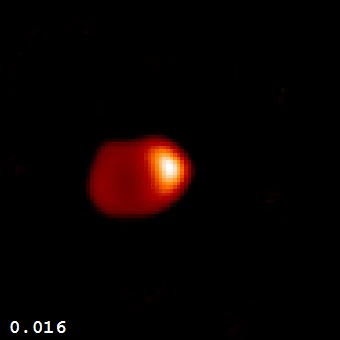
HD 11007
A probable astrometric binary in Triangulum, faintly visible to the naked eye.

HD 11007 (also cataloged as LTT 10624 and HR 523) is likely an astrometric binary system in the northern constellation Triangulum. Its primary star appears as a faint, whitish-yellow point of light to the naked eye, with an apparent magnitude of 5.81. Based on Gaia DR3 parallax data, the system lies about 90.4 light-years away and is moving closer to Earth, as indicated by its heliocentric radial velocity. Interstellar dust dims its light by 0.09 magnitudes at this distance, giving it an absolute magnitude of +3.56. The star also exhibits a high proper motion of 341 milliarcseconds per year, meaning it travels quickly across the sky.
The primary is classified as F8 V, a typical F-type main-sequence star that fuses hydrogen in its core. However, it is slightly evolved, sitting 1.62 magnitudes above the zero-age main sequence. It has about 111% of the Sun’s mass and a radius 1.67 times larger. Its luminosity is 3.23 times that of the Sun, somewhat over-luminous for its class, with an effective temperature and projected rotational velocity that are somewhat constrained. The star is metal-poor, with an iron abundance only 63.1% of the Sun’s. Estimated to be 6.6 billion years old, HD 11007 A was once thought to belong to the thick disk population but is now considered an older member of the thin disk.
References: BD+31 00316, 011007, 08433, 0523.
- Apparent magnitude
- 5.81
- Distance
- 90.4 light-years
- Absolute magnitude
- +3.56
- Proper motion
- 341 mas/yr
- Stellar classification
- F8 V
- Mass
- 111% solar
- Radius
- 1.67 solar radii
- Luminosity
- 3.23 solar
- Iron abundance
- 63.1% solar
- Age
- 6.6 billion years
Lore & Background
HD 11007 is a probable astrometric binary system, with the primary being an F-type main-sequence star of spectral type F8 V. It is slightly evolved, standing 1.62 magnitudes above the zero age main sequence, and radiates 3.23 times the luminosity of the Sun from its photosphere. The star has 111% of the Sun's mass and a radius 1.67 times solar, with an effective temperature that is not specified in the available data. It spins modestly with a somewhat constrained projected rotational velocity.
The star is metal deficient, with an iron abundance only 63.1% of the solar value. The system is estimated to be 6.6 billion years old. It was suspected to be part of the thick disk population but is now considered to be one of the older members of the thin disk population. The system is drifting closer to Earth, as indicated by its heliocentric radial velocity, and exhibits a high proper motion of 341 milliarcseconds per year.
Reader's Guide
HD 11007 is notable as a probable astrometric binary, meaning its binary nature is inferred from gravitational perturbations on the primary's motion rather than direct imaging. Its status as an older member of the thin disk population, rather than the thick disk as once suspected, places it within the broader context of Galactic stellar populations. The star's slight evolution above the zero age main sequence, combined with its metal deficiency, provides a case study for the chemical evolution of the thin disk over billions of years. Its high proper motion and close proximity (90.4 light-years) make it a useful target for astrometric studies, particularly for confirming its binary nature. The system's modest spin and constrained projected rotational velocity offer constraints on stellar rotation models for F-type stars of its age. The interstellar extinction of 0.09 magnitudes affecting its observed brightness is a minor but measurable factor in its photometric characterization.
Did You Know?
- HD 11007 is a probable astrometric binary located in the northern constellation Triangulum.
- The primary star has an iron abundance that is only 63.1% of the solar value.
- It is moving relatively fast across the sky with a proper motion of 341 mas/yr.
More in Binary and Multiple Stars, Part 4 1-24
Spotted an error? Know more?
Reader corrections go straight into our review queue. Suggest an edit · How this site is sourced