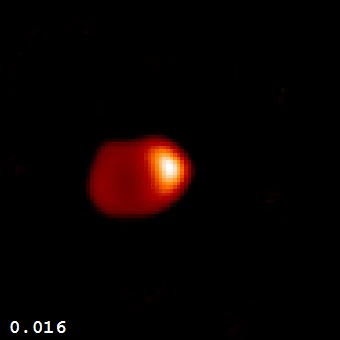
Gamma Tucanae
A suspected astrometric binary in Tucana, possibly with a distant companion.

Gamma Tucanae, also known by its Latin designation γ Tucanae, sits in the southern constellation Tucana, where it represents the tip of the toucan's beak. With an apparent magnitude of +3.99, it is just bright enough to be spotted without a telescope. Parallax measurements place it roughly 75 light-years from Earth, and it is drifting farther away at a radial velocity of +18 km/s.
Astronomers disagree on its exact classification. One study from 1975 lists it as F1 III, suggesting a more evolved giant star. Another from 1979 classifies it as F3 IV/V, indicating a star transitioning between the main sequence and subgiant phase. A more recent analysis from 2006 gives it a class of F4 V, which would make it a typical main-sequence star. It is also suspected to be an astrometric binary.
The visible component has about 1.55 times the Sun’s mass and 2.2 times its radius. At roughly 1.4 billion years old, it spins quickly, with a projected rotational velocity of 94 km/s. Its photosphere radiates 11 times the Sun’s luminosity at an effective temperature of 6,679 K.
There is a 95% chance that Gamma Tucanae has a distant companion: HD 223913, a G0 V main-sequence star of magnitude 6.64. This star has the same mass as the Sun and lies about 3.5 parsecs away from Gamma Tucanae.
- Apparent visual magnitude
- +3.99
- Parallax
- 43.37 mas
- Distance
- 75 light years
- Radial velocity
- +18 km/s
- Mass
- 1.55 solar masses
- Radius
- 2.2 solar radii
- Age
- 1.4 billion years
- Projected rotational velocity
- 94 km/s
- Luminosity
- 11 solar luminosities
- Effective temperature
- 6,679 K
Lore & Background
There is disagreement in the literature as to the stellar classification of this star. One catalog lists it as F1 III, which would suggest it is an evolved F-type giant star. Another lists it as F3 IV/V, which appears to indicate a less evolved F-type star transitioning between the main sequence and subgiant star. A third classifies it as F4 V, which would match an ordinary F-type main-sequence star. This star is a suspected astrometric binary. The visible component has 1.55 times the mass of the Sun and 2.2 times the Sun's radius. At the age of around 1.4 billion years, it retains a relatively high rate of spin with a projected rotational velocity of 94 km/s. It is radiating 11 times the Sun's luminosity from its photosphere at an effective temperature of 6,679 K.
Reader's Guide
Gamma Tucanae is notable for the uncertainty surrounding its evolutionary status, with classifications ranging from a giant to a main-sequence star. This ambiguity reflects the challenges in precisely determining the stage of a star's life cycle from spectral data alone. Its status as a suspected astrometric binary adds further interest, suggesting the presence of an unseen companion that perturbs its motion. Additionally, Gamma Tucanae may have a distant co-moving companion – a magnitude 6.64 G-type main-sequence star of class G0 V designated HD 223913. This object has the same mass as the Sun and is separated from Gamma Tucanae by about 3.5 pc, with a 95% probability that the two are physically associated. If confirmed, this wide binary system would provide a valuable laboratory for studying stellar evolution and dynamics across a large separation. The star's relatively high rotation speed for its age also offers clues about its angular momentum history.
Did You Know?
- Gamma Tucanae marks the toucan's beak in the constellation Tucana.
- It is a suspected astrometric binary.
- The star has a 95% chance of having a distant co-moving companion, HD 223913.
- Its projected rotational velocity is 94 km/s, high for a star aged 1.4 billion years.
More in Binary and Multiple Stars, Part 4 1-24
Spotted an error? Know more?
Reader corrections go straight into our review queue. Suggest an edit · How this site is sourced