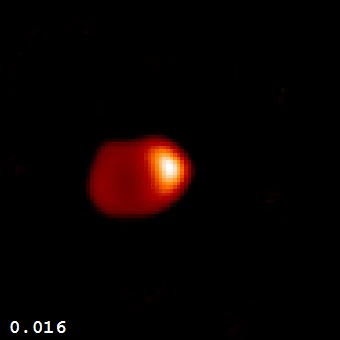
Gaia BH3
Most massive known stellar black hole in the Milky Way.

Gaia BH3, also cataloged as Gaia DR3 4318465066420528000, is a binary system in the constellation Aquila. It contains a metal-poor giant star of spectral type G and a stellar-mass black hole. The system lies 1,926 light-years from Earth. This black hole was the first discovered using preliminary astrometric data from Gaia’s fourth data release.
The black hole and its companion star orbit their common center of mass every 11.6 years. The black hole is the most massive stellar black hole known in the Milky Way. It is the second stellar black hole confirmed to be more massive than about 10 solar masses, after Cygnus X-1. Its mass is similar to those of merging binary black holes detected through gravitational waves. Such massive black holes were thought to form from metal-poor stars, and the metal-poor nature of Gaia BH3’s companion supports that idea.
Gaia BH3 belongs to a low-mass, disrupted star cluster that now exists as a halo stellar stream called ED-2. This stream is very old, with an age comparable to the globular cluster Messier 92. This suggests Gaia BH3 likely formed more than 13 billion years ago. The black hole may have formed through the direct collapse of a massive star, or alternatively through binary interactions within the original star cluster. The ED-2 cluster has a mass between 2,000 and 42,000 solar masses.
The system was identified during astrometric analysis in preparation for Gaia’s Data Release 4. Its discovery was announced in a paper published in the journal *Astronomy & Astrophysics* on 16 April 2024.
- Distance
- 1926 light years
- Constellation
- Aquila
- Orbital period
- 11.6 years
- Black hole mass
- most massive known stellar black hole in the Milky Way
- Companion star
- metal-poor giant star, spectral type G
- Discovery announcement
- 16 April 2024
Lore & Background
Gaia BH3 was identified in astrometric observations with Gaia during an analysis in preparation for Data Release 4, and announced with the publication of a scientific paper in the journal Astronomy & Astrophysics on 16 April 2024. The black hole and its companion star orbit the system barycentre every 11.6 years. The black hole's mass is the most massive known stellar black hole in the Milky Way, and it is the second known stellar black hole more massive than about 10 solar masses, after Cygnus X-1. Its mass is quite similar to the mass of merging binary black holes found via gravitational waves. These massive black holes were suspected to be formed by metal-poor stars, and the fact that Gaia BH3 has a metal-poor companion strengthens this conclusion. Gaia BH3 was found to be part of a disrupted star cluster of low mass, which today is a halo stellar stream called ED-2. This stellar stream is very old, with an age comparable to the globular cluster Messier 92, meaning that Gaia BH3 likely formed more than 13 billion years ago. The black hole might have formed via direct collapse of a massive star, or alternatively via binary interaction inside the star cluster. The ED-2 star cluster has a mass between 2,000 and 42,000 solar masses.
Reader's Guide
Gaia BH3 is significant as the most massive known stellar black hole in the Milky Way, and its discovery from preliminary Gaia DR4 astrometric data marks a milestone in black hole detection. Its mass is quite similar to the mass of merging binary black holes found via gravitational waves, providing a local analogue to those distant events. The system's metal-poor companion star supports the theory that massive stellar black holes form from metal-poor stars. Furthermore, Gaia BH3's association with the disrupted star cluster ED-2, a very old halo stellar stream, suggests the black hole formed more than 13 billion years ago, either via direct collapse of a massive star or through binary interaction within the cluster. This connection to an ancient, low-mass star cluster strengthens the link between early star formation and the production of massive black holes, offering insight into the origins of black holes that merge in the present-day universe.
Did You Know?
- It was the first black hole discovered from preliminary Gaia DR4 astrometric data.
- The black hole's mass is similar to merging binary black holes found via gravitational waves.
- Gaia BH3 is part of the very old halo stellar stream ED-2, likely formed more than 13 billion years ago.
More in Binary and Multiple Stars, Part 4 1-24
Spotted an error? Know more?
Reader corrections go straight into our review queue. Suggest an edit · How this site is sourced