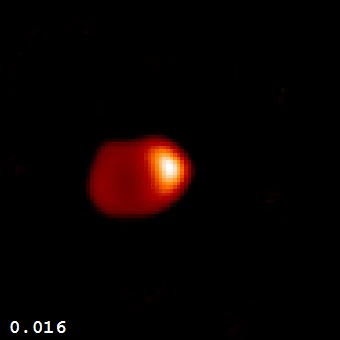
Gaia BH2
Third-closest known black hole system, discovered via Gaia astrometry.

Gaia BH2 is a binary system in the constellation Centaurus, composed of a red giant and a stellar-mass black hole. Located about 3,800 light-years away, it is the third-closest known black hole system to Earth and the second black hole discovered from Gaia DR3 astrometric data.
- Distance
- ~3,800 light-years
- Constellation
- Centaurus
- Orbital period
- 1,277 days (~3.5 years)
- Eccentricity
- 0.518
- Black hole schwarzschild radius
- ~26.4 km
- Red giant temperature
- 4604 K
Lore & Background
Gaia BH2 was originally identified as a black hole binary candidate in 2022 through astrometric observations by Gaia, alongside Gaia BH1. At that time, it was not clear whether the system definitely harbored a black hole, but it was the only plausible candidate in the Gaia data other than Gaia BH1. Later radial velocity observations confirmed the black hole and refined the orbital parameters.
The black hole and red giant orbit the system barycenter every 1,277 days with a moderate eccentricity of 0.518. The black hole's mass implies a Schwarzschild radius of about 26.4 km. The red giant has a temperature of 4604 K and is enriched in alpha elements, suggesting it underwent mass transfer with another star.
Reader's Guide
Gaia BH2's significance lies in its confirmation as the second black hole discovered from Gaia DR3 astrometric data, demonstrating the power of astrometry in detecting black holes in wide binaries. As the third-closest known black hole system to Earth, it provides a valuable laboratory for studying black hole formation and evolution. The system's moderate eccentricity and long orbital period offer insights into the dynamics of black hole–red giant binaries. The red giant's alpha-element enrichment hints at past mass transfer, which may have played a role in the black hole's formation. Together with Gaia BH1 and Gaia BH3, it forms a growing sample of nearby black holes that can be studied in detail, helping to refine models of stellar evolution and binary interactions.
Did You Know?
- The black hole and red giant orbit every 1,277 days with an eccentricity of 0.518.
- The red giant is enriched in alpha elements, indicating past mass transfer.
More in Binary and Multiple Stars, Part 4 1-24
Spotted an error? Know more?
Reader corrections go straight into our review queue. Suggest an edit · How this site is sourced