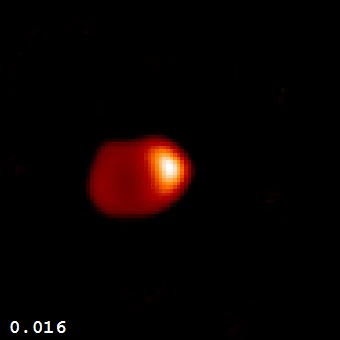
Gaia BH1
Nearest known black hole system as of 2026.

Gaia BH1 is a binary system located about 478 parsecs away in the constellation Ophiuchus. It contains a G-type main-sequence star, similar to the Sun, and a stellar-mass black hole. As of 2026, it is the closest system astronomers are reasonably confident contains a black hole, with Gaia BH3, Gaia BH2, and A0620-00 being the next nearest.
The star and black hole orbit each other every 185.387 days, with an orbital eccentricity of 0.4323. The star has a temperature of about 5850 K and is roughly the same mass and radius as the Sun. The black hole's mass gives it a Schwarzschild radius of about 28 kilometers.
The system was discovered in 2022 using astrometric data from the Gaia spacecraft, along with radial velocity measurements. The discovery team concluded that no astrophysical explanation other than a black hole could account for the star's motion. Unlike systems such as LB-1 and HR 6819, which are sometimes called "black hole impostors," the evidence for a black hole in Gaia BH1 does not rely on the star's mass or the orbit's inclination, and there is no sign of mass transfer between the two objects. The same team also identified another candidate black hole system, later confirmed in 2023 as Gaia BH2. A separate team independently detected Gaia BH1 and reported slightly different parameters.
- Distance
- 478 pc
- Constellation
- Ophiuchus
- Orbital period
- 185.387 days
- Orbital eccentricity
- 0.4323
- Star type
- G-type main-sequence star
- Star temperature
- 5850 K
- Black hole schwarzschild radius
- 28 km
Lore & Background
The star and black hole orbit each other with a period of 185.387 days and an eccentricity of 0.4323. The star is similar to the Sun, with a temperature of about 5850 K, while the black hole has a mass of about 9.6 solar masses. Given this mass, the black hole's Schwarzschild radius should be about 28 km.
Gaia BH1 was discovered in 2022 via astrometric observations with Gaia, and also observed via radial velocity. The discovery team found no astrophysical scenario that could explain the observed motion of the G-type star, other than a black hole. The system differs from 'black hole impostors' such as LB-1 and HR 6819 in that the evidence for a black hole does not depend on the mass of the star or the inclination of the orbit, and there is no evidence of mass transfer.
The discovery team also found a second system that is a candidate for containing a black hole, which was also reported by another team of astronomers, and was confirmed in 2023 as Gaia BH2. The black hole was also independently detected by a second team, who found slightly different parameters.
Reader's Guide
Gaia BH1 is significant as the nearest known system that astronomers are reasonably confident contains a black hole, as of 2026. Its discovery in 2022 via astrometric observations with Gaia, supplemented by radial velocity measurements, provided a robust case for a black hole because the evidence did not rely on the mass of the star or the orbital inclination, and there was no sign of mass transfer. This distinguishes it from earlier 'black hole impostors' such as LB-1 and HR 6819. The system's parameters—a G-type star similar to the Sun orbiting a black hole with a period of 185.387 days and an eccentricity of 0.4323—offer a well-characterized example of a detached black hole binary. The independent detection by a second team, which found slightly different parameters, underscores the ongoing refinement of such measurements. Gaia BH1's proximity at 478 parsecs makes it a benchmark for studying black holes in quiescent binaries, and it is followed in distance by Gaia BH3, Gaia BH2, and A0620-00.
Did You Know?
- The black hole in Gaia BH1 has a Schwarzschild radius of about 28 km.
- The discovery team found no astrophysical scenario other than a black hole to explain the star's motion.
More in Binary and Multiple Stars, Part 4 1-24
Spotted an error? Know more?
Reader corrections go straight into our review queue. Suggest an edit · How this site is sourced