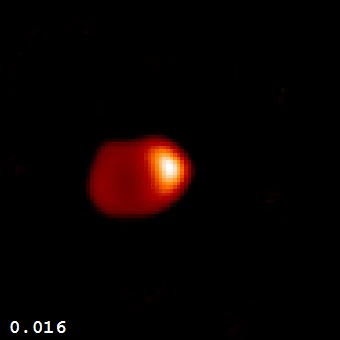
Epsilon Fornacis
A high proper motion binary star in Fornax.

Epsilon Fornacis (ε Fornacis) is a high proper motion binary star in the southern constellation of Fornax. It is faintly visible to the naked eye with an apparent visual magnitude of 5.89, and based on an annual parallax shift of 31.06 mas, the system lies roughly 105 light years from the Sun. The system is an astrometric binary, with an orbital period of about 37.7 years and an eccentricity of 0.28.
- Bayer designation
- ε Fornacis
- Apparent visual magnitude
- 5.89
- Parallax
- 31.06 mas
- Distance
- 105 light years
- Orbital period
- 13,770 days (37.7 years)
- Orbital eccentricity
- 0.28
- Semimajor axis
- 13 au
Lore & Background
The primary component, ε Fornacis A, is an evolved K-type subgiant star with a stellar classification that includes a suffix indicating abnormally weak absorption lines of iron and the carbon-hydrogen bond. Earlier classifications consistently showed it as type G5 IV, matching the subgiant categorization. The primary has an estimated 91% of the Sun's mass but has expanded to 253% of the Sun's radius. It has a quiet, inactive chromosphere and is most likely an old star with an age over 12 billion years. The star spins slowly with a projected rotational velocity of 1.1 km/s. Since leaving the main sequence, it has increased in luminosity to 4.5 times that of the Sun, radiating from an outer atmosphere at an effective temperature of 5,068 K. The secondary component, ε Fornacis B, has a minimum mass based on the estimated orbit, though the exact value is not specified in the available data.
Reader's Guide
Epsilon Fornacis is notable as an astrometric binary system whose orbital parameters have been determined from radial velocity data, yielding a period of 37.7 years and a semimajor axis of 13 au. The primary star's evolved state as a K-type subgiant with an age exceeding 12 billion years makes it an old stellar object, and its quiet chromosphere and slow rotation are consistent with advanced age. The system's high proper motion and faint naked-eye visibility contribute to its interest for studies of binary dynamics and stellar evolution. The interstellar absorption factor of 0.09 reduces its apparent magnitude, and the primary's unusual spectral features—weak iron and CH lines—add to its classification history, which previously favored a G5 IV type. The secondary's mass is constrained only by the orbit, leaving its exact nature uncertain. Overall, the system provides a case study of an evolved, low-mass binary with a long orbital period and a well-characterized primary.
Did You Know?
- The system has an orbital period of roughly 13,770 days (37.7 years).
- The system's visual magnitude is reduced by interstellar absorption of 0.09.
More in Binary and Multiple Stars, Part 4 1-24
Spotted an error? Know more?
Reader corrections go straight into our review queue. Suggest an edit · How this site is sourced