Epsilon Aquilae
A binary star system with a disputed barium-star classification.

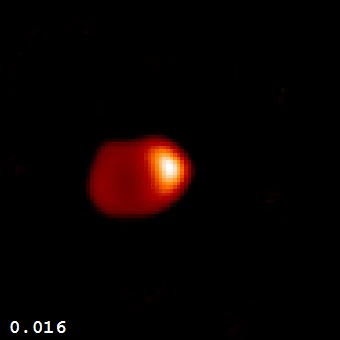
Epsilon Aquilae, also called Arin-majlep, is a binary star system located in the equatorial constellation Aquila, close to its western border with Hercules. It has an apparent visual magnitude of 4.02, making it visible without a telescope, and is roughly 179 light-years from Earth. The system is moving toward us at a radial velocity of −46 km/s.
The Bayer designation Epsilon Aquilae comes from the Latinized Greek letter ε Aquilae, often shortened to Epsilon Aql or ε Aql. Its traditional name, Deneb el Okab, derives from the Arabic phrase for "the tail of the eagle." In Mandarin, it was associated with the ancient states of Wú and Yuè, names it shared with the brighter star ζ Aquilae. To distinguish the two, Epsilon Aquilae is sometimes called Deneb el Okab Borealis, as it lies north of Zeta Aquilae (Deneb el Okab Australis). In Marshallese, ε, ζ, and ω Aquilae together are known as Arin-majlep, meaning "replica of the Big Eye," with Altair being the Big Eye (Majlep). The IAU Working Group on Star Names officially adopted Arin-majlep for Epsilon Aquilae on 18 June 2026, while ζ Aquilae is officially named Okab.
The binary nature of this system was first reported by German astronomer F. Kustner in 1914, but confirmation came only in 1974. It is a single-lined spectroscopic binary, with the two stars orbiting each other every 1,271 days (about 3.5 years) on an eccentric (oval) path with an eccentricity of 0.27. Two visual companions were reported by German astronomer R. Engelmann in 1887. Component B, magnitude 10.56, lies at a certain angular separation from the primary at a position angle of 184° (as of 2014). Component C, magnitude 11.25, is at a different separation with a position angle of 159° (as of 2015).
The primary star is an evolved giant with a stellar classification that shows a mild overabundance of the CN molecule in its spectrum. Its chemical makeup suggests it has undergone first dredge-up. It has more than twice the Sun’s mass and has expanded to about ten times the Sun’s radius. It shines with 54 times the Sun’s luminosity, radiating from its outer envelope at an effective temperature of 4,760 K, giving it the orange hue of a K-type star.
- Bayer designation
- Epsilon Aquilae (ε Aql)
- Apparent visual magnitude
- 4.02
- Distance
- approximately 179 ly
- Radial velocity
- −46 km/s
- Orbital period
- 1,271 days (3.5 years)
- Eccentricity
- 0.27
- Spectral type
- K-type giant
Lore & Background
The binary nature of this system was reported by German astronomer F. Kustner in 1914, but it was not confirmed until 1974. It is a single-lined spectroscopic binary; the pair orbit each other over a period of 1,271 days (3.5 years) with an eccentricity of 0.27. Two visual companions were reported by German astronomer R. Engelmann in 1887: component B, magnitude 10.56, at an angular separation along a position angle of 184° relative to the primary as of 2014; and component C, magnitude 11.25, at a separation with a position angle of 159° as of 2015.
The primary component is an evolved giant star with a stellar classification showing a mild overabundance of the CN molecule in the spectrum. Its chemical abundances suggest it has gone through first dredge-up. It has more than double the mass of the Sun and has expanded to ten times the Sun's radius, shining with 54 times the Sun's luminosity from an outer envelope at an effective temperature of 4,760 K, giving it the orange hue of a K-type star. This star has been designated a barium star, meaning its atmosphere is extremely enriched with barium and other heavy elements, but this is disputed, with astronomer Andrew McWilliam (1990) finding normal abundances from an s-process.
Reader's Guide
Epsilon Aquilae holds significance as a binary system whose duplicity was suspected early in the 20th century but only confirmed decades later, illustrating the challenges of detecting spectroscopic binaries. Its disputed barium-star status—some studies finding heavy-element enrichment, others normal s-process abundances—makes it a point of interest in stellar nucleosynthesis and the evolution of binary systems. The system also carries rich cultural nomenclature: the traditional name Deneb el Okab (Arabic for 'the tail of the eagle') is shared with ζ Aquilae, with Epsilon specifically called Deneb el Okab Borealis due to its northern position. In Marshallese, it is known as Arin-majlep, 'the replica of the Big Eye,' with the Big Eye (Majlep) being Altair. The IAU Working Group on Star Names adopted the name Arin-majlep for ε Aquilae on 18 June 2026. Additionally, it has Mandarin associations with the ancient states of Wú and Yuè, linked to the Twelve States asterism.
Did You Know?
- Epsilon Aquilae is also named Arin-majlep, meaning 'replica of the Big Eye' in Marshallese, with Altair as the Big Eye.
- The binary nature was reported in 1914 but not confirmed until 1974.
- It has two visual companions, B and C, reported by German astronomer R. Engelmann in 1887.
- The star's classification as a barium star is disputed; astronomer Andrew McWilliam (1990) found normal abundances from an s-process.
More in Binary and Multiple Stars, Part 4 1-24
Spotted an error? Know more?
Reader corrections go straight into our review queue. Suggest an edit · How this site is sourced