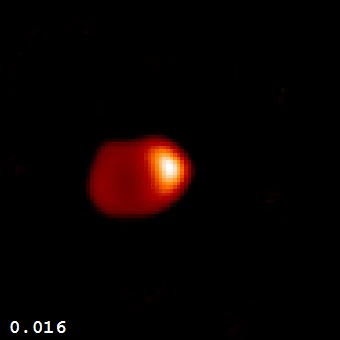
Delta Aquilae
An astrometric binary star system in the constellation Aquila.

Delta Aquilae, also known as Guqi, is a binary star system located in the equatorial constellation Aquila. With an apparent visual magnitude of 3.4, it lies roughly 50.6 light-years from Earth and is moving toward us at a radial velocity of −30 km/s. In about 335,000 years, it is expected to pass within 7.774 parsecs of the Sun.
The system’s binary nature was first identified in 1936 by H. L. Alden at Yale Observatory. It is an astrometric binary, meaning the secondary star is detected only through its gravitational pull on the primary, as the two components have never been resolved by telescope. They orbit each other every 3.422 years with an orbital eccentricity of about 0.36.
The primary star, designated component Aa, is an aging subgiant with a stellar classification of F0 IV. It has exhausted most of the hydrogen in its core and is evolving into a giant. Its mass is about 65% greater than the Sun’s, and its radius is more than double the Sun’s. It shines with roughly 8.5 times the Sun’s luminosity, and its effective temperature gives it the yellow-white hue typical of an F-type star. Delta Aquilae A is a Delta Scuti variable, meaning its brightness fluctuates due to pulsations in its outer layers. It also spins rapidly, with a projected rotational velocity that provides a lower bound on its equatorial speed.
The secondary star, component Ab, is smaller, with about 67% of the Sun’s mass and an estimated 61% of its radius. It is likely a K-type star.
Historically, Delta Aquilae was part of several naming traditions. Along with Eta and Theta Aquilae, it was known as Al Mizān (the Scale-beam), with Delta Aquilae specifically called Al Mizān I. Jim Kaler suggested the name Almizan Occidental for it as the westernmost star of that asterism. Antonín Bečvář listed it as Deneb Okab, meaning “tail of the eagle” in Arabic, though this may be a misnomer since the star lies in the constellation’s center, usually associated with the chest, while Epsilon and Zeta Aquilae were traditionally called Deneb al Okab.
- Bayer designation
- δ Aquilae
- Apparent visual magnitude
- 3.4
- Distance
- 50.6 ly
- Radial velocity
- −30 km/s
- Binary type
- astrometric binary
- Orbital period
- 3.422 years
- Orbital eccentricity
- 0.36
- Primary spectral type
- F0 IV
- Primary mass
- 1.65 M☉
- Primary radius
- >2 R☉
Lore & Background
The binary nature of Delta Aquilae was first reported by H. L. Alden at Yale Observatory in 1936. It is an astrometric binary where the two components orbit each other with a period of 3.422 years and an eccentricity of about 0.36. The presence of the secondary component is revealed by its gravitational perturbation of the primary; the individual components have not been resolved with a telescope. The primary member, designated component Aa, is an aging subgiant star with a stellar classification of F0 IV, indicating it is exhausting hydrogen at its core and evolving into a giant star. It has 65% greater mass than the Sun and has expanded to more than double the Sun's radius, radiating about 8.5 times the Sun's luminosity. Delta Aquilae A is a Delta Scuti variable, exhibiting luminosity variations caused by pulsations in its outer envelope, and spins rapidly with a projected rotational velocity of about 80 km/s. The secondary, component Ab, is a smaller star with about 67% of the Sun's mass and an estimated 61% of the Sun's radius; it may be a K-type star.
Reader's Guide
Delta Aquilae holds significance as an astrometric binary discovered in the mid-20th century, a type where the secondary is detected only through its gravitational influence. Its primary is a Delta Scuti variable, a class of pulsating stars important for asteroseismology. The system's predicted close approach to the Sun in about 335,000 years makes it a target for studies of stellar dynamics. Historically, the star has been part of multiple naming traditions: it was included with η Aql and θ Aql as Al Mizān (the Scale-beam), with δ Aql designated Al Mizān I. Jim Kaler suggested the name Almizan Occidental for it as the westernmost star of that asterism. Antonín Bečvář listed it as Deneb Okab, meaning 'tail of eagle' in Arabic, though the star lies in the constellation's center, usually identified with the chest; this may be a misnomer, as ε Aql and ζ Aql were collectively known as Deneb al Okab by medieval Arabian astronomers. In the Calendarium of Al Achsasi al Mouakket, it was Djenubi Menkib al Nesr, translated as Australior Humerus Vulturis, 'the southern shoulder of the eagle'. In Chinese astronomy, it is part of the Right Flag asterism, and the IAU Working Group on Star Names adopted the name Guqi for this star on 18 June 2026. It was also once part of the now-obsolete constellation Antinous.
Did You Know?
- Delta Aquilae is an astrometric binary whose components have never been resolved with a telescope.
- The primary is a Delta Scuti variable star that pulsates in brightness.
- The system is predicted to come within 7.774 pc of the Sun in about 335,000 years.
Frequently Asked Questions
What is Delta Aquilae?
Delta Aquilae, nicknamed Guqi, is a bright binary star system in the constellation Aquila with an apparent visual magnitude of 3.4. It sits roughly 50.6 light-years from Earth and is currently drifting toward us at a radial velocity of about −30 km/s.
What type of binary system is Delta Aquilae?
It is an astrometric binary, meaning the companion star has never been directly imaged or resolved by any telescope. Its existence is confirmed solely by the tiny gravitational wobble it produces in the primary star's apparent position.
How was Delta Aquilae's binary nature first identified?
In 1936, H. L. Alden working at Yale Observatory detected the subtle positional shifts of the primary star that revealed an unseen gravitational companion. This made Delta Aquilae one of the earlier catalogued astrometric binaries.
What is Delta Aquilae's orbital period?
The two components complete a full orbit around their common barycentre every 3.422 years, a relatively short period that reflects a fairly tight gravitational binding between the pair.
Will Delta Aquilae pass close to the Sun in the future?
Yes—current orbital projections indicate the system will swing within approximately 7.774 parsecs of the Sun in roughly 335,000 years. Given its present inward radial velocity of −30 km/s, that flyby is a near-certain future event on astronomical timescales.
More in Binary and Multiple Stars, Part 4 1-24
Spotted an error? Know more?
Reader corrections go straight into our review queue. Suggest an edit · How this site is sourced