Zeta Andromedae
A binary star system with resolved starspots and magnetic field studies.

Zeta Andromedae, officially named Shimu, is a binary star system in the northern constellation Andromeda. It is notable as a spectroscopic binary whose primary is an orange K-type giant, and as an RS Canum Venaticorum-type variable star whose brightness changes due to the ellipsoidal shape of that object. The system is also one of the few stars resolved using Doppler imaging and long-baseline infrared interferometry, allowing observation of starspots and magnetic field behavior.
- Apparent visual magnitude range
- 3.92 to 4.14
- Orbital period
- 17.77 days
- Distance
- approximately 181 light-years
- Heliocentric radial velocity
- −24.4 km/s
- Spectral type of primary
- orange K-type giant
- Mean apparent magnitude
- +4.08
- Variable star type
- RS Canum Venaticorum-type
Lore & Background
The star's location is in the northern constellation Andromeda, where it is the second-most southerly of the stars in the often drawn characteristic shape representing the mythical princess asterism, after η Andromedae. Its Bayer designation is Zeta Andromedae, and it also has the Flamsteed designation 34 Andromedae. In Chinese, it is part of the Legs asterism and is called 奎宿二 (Kuí Sù èr, the Second Star of Legs). An older Chinese name is Tian Shi Mu, The Eye of the Celestial Pig, from which the IAU Working Group on Star Names approved the name Shimu for Zeta Andromedae A on 16 March 2025.
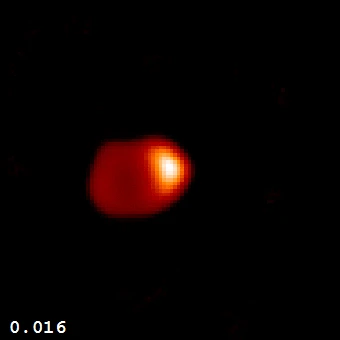
The system is a spectroscopic binary with an orbital period of 17.77 days. The primary is a magnetically active star with a brightness that varies from magnitude +3.92 to +4.14 over that period, and its spectrum shows strong and variable Ca II H and K lines. The secondary could be either a K-type main sequence star or a white dwarf. Resolved images of the primary, Zeta Andromedae Aa, allowed observation of starspots, and their asymmetric distribution showed that the magnetic field is generated by a mechanism different from the solar dynamo, while a Sun-like differential rotation was observed.
Reader's Guide
Zeta Andromedae holds significance as a binary system whose primary has been resolved using Doppler imaging and long-baseline infrared interferometry, a rare achievement that has provided direct visual information about a star beyond the Sun. The resolved images allowed astronomers to recover additional information about the star, including the observation of starspots and their asymmetric distribution. This asymmetry indicated that the star's magnetic field is generated by a mechanism different from the solar dynamo, while a Sun-like differential rotation was observed. These findings contribute to the understanding of stellar magnetic activity and dynamo processes in evolved stars. The system is also an RS Canum Venaticorum-type variable star, with brightness changes caused by the ellipsoidal shape of the primary. The WDS notes three visual companions to the eclipsing binary, though the closest two are background objects; companion C at 97″ shares a common proper motion and a similar parallax, suggesting it may be physically associated.
More in Binary and Multiple Stars, Part 3 1-24
Spotted an error? Know more?
Reader corrections go straight into our review queue. Suggest an edit · How this site is sourced