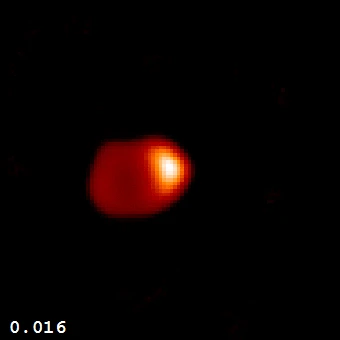
BD−07 436
Binary star with a hot Jupiter and conflicting stellar ages.

BD−07 436, renamed WASP-77 in 2012, is a binary star system located roughly 344 light-years from Earth. Its overall abundance of heavy elements is comparable to that of the Sun, and both stars exhibit moderate chromospheric activity, including X-ray flares. The primary star, BD−07 436A (WASP-77A), is a G-type main-sequence star that rotates rapidly, a spin-up caused by tidal forces from its close-orbiting giant planet, WASP-77Ab. The secondary, BD−07 436B, is a K-type main-sequence star orbiting at a distance of 461+200−140 AU.
Age estimates for the two stars are inconsistent. Based on rotation rates, the secondary appears to be about one billion years old, while the primary is only 0.4 billion years old. X-ray luminosity suggests even more divergent ages: 4.5 billion years for the primary and over 8.9 billion years for the secondary. These values may be unreliable, as binary evolution could affect both spin rates and X-ray output. When placed on the H-R diagram, the stars yield ages of 7.99 and 7.3 billion years, respectively.
The system hosts a transiting hot Jupiter, WASP-77Ab, detected in 2012 on a very tight, circular orbit. The planet likely has an extended gaseous envelope and is losing mass. Its equilibrium temperature is 1715+26−25 K, with a nightside temperature of 1786±84 K and a dayside temperature of 1842+34−33 K. Water vapor has been detected on the planet's dayside, indicating a carbon-to-oxygen ratio similar to or lower than that of the Sun.
- Distance
- 344 light-years
- Primary type
- G-type main-sequence star
- Secondary type
- K-type main-sequence star
- Secondary orbital distance
- 461+200−140 AU
- Primary age spin rate
- 0.4 billion years
- Secondary age spin rate
- 1 billion years
- Planet equilibrium temperature
- 1715+26−25 K
Lore & Background
BD−07 436 is a binary system whose primary, BD−07 436A (WASP-77A), is a G-type main-sequence star rotating rapidly due to tidal spin-up from its close-orbiting giant planet. The secondary, BD−07 436B, is a K-type main-sequence star orbiting at a distance of 461+200−140 AU. The system's heavy-element concentration is similar to the Sun, and both stars show moderate chromospheric activity, including X-ray flares.
Age estimates for the two stars are inconsistent. Using spin rates, the primary appears 0.4 billion years old and the secondary 1 billion years old. X-ray luminosity yields ages of 4.5 billion years for the primary and >8.9 billion years for the secondary. These values may be unreliable due to binary evolution effects. Ages inferred from the stars' positions in the H-R diagram are 7.99 and 7.3 billion years respectively.
In 2012, a transiting hot Jupiter, WASP-77Ab, was detected on a very tight, circular orbit. The planet may have an extended gaseous envelope and is losing mass. Its equilibrium temperature is 1715+26−25 K, with nightside temperature 1786±84 K and dayside temperature 1842+34−33 K. Water vapour was detected on the dayside, indicating a carbon-to-oxygen ratio similar to solar or lower.
Reader's Guide
BD−07 436 is significant as a binary system that hosts a transiting hot Jupiter, WASP-77Ab, providing a rare opportunity to study planetary atmospheres in a binary environment. The detection of water vapour on the planet's dayside and the inferred solar-like C/O ratio offer clues about planetary formation and composition. The system's age discrepancies—ranging from 0.4 billion years to over 8.9 billion years depending on the method—highlight the challenges of stellar age determination, especially in binary systems where tidal interactions and binary evolution can skew spin rates and X-ray luminosities. The primary's rapid rotation, attributed to tidal spin-up by the planet, illustrates the dynamical interplay between a star and its close-in giant planet. The moderate chromospheric activity and X-ray flares add to the system's complexity. As a reference object, BD−07 436 underscores the need for multiple age indicators and caution in interpreting stellar ages in evolved or interacting systems.
Did You Know?
- BD−07 436 is also known as WASP-77 since 2012.
- The primary star is rotating rapidly due to tidal spin-up by its close-orbiting giant planet.
- Water vapour was detected on the dayside of the planet WASP-77Ab.
The Quadruple Architecture of Capella
Capella presents itself to the naked eye as a single point of light, yet it is in fact a quadruple star system arranged into two binary pairs. The primary pair, Capella Aa and Capella Ab, are two bright-yellow giant stars each carrying roughly 2.5 times the Sun's mass. They trace a tight circular orbit separated by about 0.74 AU, completing one full revolution around each other every 104 days. Capella Aa is the cooler and more luminous member, classified as G8III, with a luminosity of roughly 78.7 times the Sun's and a radius about 12 times solar. It is an aging red clump star currently fusing helium into carbon and oxygen at its core. Capella Ab, a G0III star, is slightly smaller and hotter, with a luminosity near 72.7 solar and a radius of about 8.83 times the Sun's. It occupies the Hertzsprung gap, a brief subgiant phase as it expands and cools toward red giant status. Far from this bright pair, at a separation of approximately 10,000 AU, orbit two faint, small, relatively cool red dwarfs designated Capella H and Capella L.
Mythology, Weather Lore, and Ancient Architecture
The name Capella derives from Latin for a small female goat, a reference to the mythological goat Amalthea who suckled the infant Zeus. The Greek star name Aἴξ simply means the Goat, and because its pronunciation closely resembles the word for the Aegean Sea, ancient observers linked the star to weather forecasting and seasonal wind direction. In classical times it was regarded as a portent of rain, and in English literature it is sometimes called the Shepherd's Star. The goat symbolism stretches back to Mesopotamia, where a 7th-century BC document called MUL.APIN listed a constellation named GAM, Gamlum, or MUL.GAM, representing a scimitar or crook that may have denoted the star alone or the entire Auriga constellation. An Akkadian inscription from the 20th century BC is thought to reference Capella as well. Bedouin astronomers later organized the stars of Auriga into a herd of goats, echoing the Greek tradition. Remarkably, at the pre-Columbian site of Monte Albán in Oaxaca, Mexico, Building J was constructed around 275 BC with its steps aligned perpendicular to Capella's rising position, so that a person standing in the doorway would face the star directly. Its heliacal rising coincided within a day of the Sun passing directly overhead at that location.
Pioneering Observational Milestones
The recognition that Capella was not a single star arrived in 1899 through two nearly simultaneous discoveries. Professor William Wallace Campbell at Lick Observatory, analyzing photographic plates from August 1896 to February 1897, detected a second spectrum superimposed on the first, with Doppler shifts indicating the components were orbiting one another. Almost at the same time, British astronomer Hugh Newall observed the composite spectrum using a four-prism spectroscope on a 25-inch telescope at Cambridge. Despite these spectroscopic proofs, visually separating the two stars proved extremely difficult. Capella earned the nickname The Interferometrist's Friend and was finally resolved interferometrically in 1919 by John Anderson and Francis Pease at Mount Wilson Observatory, yielding the first interferometric measurement of any object outside the Solar System. A high-precision orbit followed in 1994 from the Mark III Stellar Interferometer at the same site. In September 1995, Capella became the first astronomical object imaged by a separate-element optical interferometer, the Cambridge Optical Aperture Synthesis Telescope. In 1914, Finnish astronomer Ragnar Furuhjelm noted a faint companion with similar proper motion, suggesting a physical binding to the spectroscopic binary.
Names, Designations, and the IAU Catalogue
Capella carries a rich set of catalog identifiers reflecting its importance in stellar astronomy. Its Bayer designation is α Aurigae, Latinised as Alpha Aurigae and abbreviated Alpha Aur or α Aur, while its Flamsteed number is 13 Aurigae. It appears in multiple star catalogues as ADS 3841, CCDM J05168+4559, and WDS J05167+4600. Because of its relative proximity at 42.9 light-years, it is listed in the Gliese-Jahreiss Catalogue with the designation GJ 194 for the bright giant pair and GJ 195 for the faint red dwarf pair. The traditional name Capella, meaning small female goat in Latin, had an alternative classical form, Capra, which was more commonly used in ancient times. In 2016, the International Astronomical Union established a Working Group on Star Names to standardize proper stellar names. The group's first bulletin, issued in July 2016, included Capella among the first two approved batches, officially entering it into the IAU Catalog of Star Names. The catalogue specifically assigns the name to the component star α Aurigae Aa.
Frequently Asked Questions
What is BD−07 436?
BD−07 436, also catalogued as WASP-77 since 2012, is a binary star system roughly 344 light-years from Earth. It pairs a G-type main-sequence primary with a K-type main-sequence companion, and the primary hosts a close-orbiting hot Jupiter.
How far apart are the two stars in BD−07 436?
The K-type secondary circles the G-type primary at a mean separation of about 461 AU, with an uncertainty of +200/−140 AU. That makes it a moderately wide binary rather than a tight pair.
Why do the two stars in BD−07 436 seem to have different ages?
Rotation-based dating puts the primary near 0.4 billion years and the secondary near 1 billion years, a clear inconsistency for coeval stars. The primary's anomalously fast spin, driven by tidal torque from its giant planet, is the most likely culprit distorting the age estimate.
What is causing BD−07 436A to rotate so rapidly?
Tidal forces from the hot Jupiter WASP-77Ab, which orbits very close to the primary, have spun the G-type star up beyond what its true age would predict. That artificial spin-up is what makes the usual rotation-versus-age calibration unreliable for this star.
What is the metallicity and activity level of BD−07 436?
The system's overall heavy-element abundance is close to solar, so it is neither notably metal-rich nor metal-poor. Both stars display moderate chromospheric activity, including detectable X-ray flares.
More in Binary and Multiple Stars, Part 3 1-24
Spotted an error? Know more?
Reader corrections go straight into our review queue. Suggest an edit · How this site is sourced