Alpha Ophiuchi
Binary star and brightest in Ophiuchus, rapidly rotating and oblate.

Alpha Ophiuchi, also known as Rasalhague, is a binary star system and the brightest star in the constellation Ophiuchus. Its traditional name comes from the Arabic for "the head of the serpent collector." In 2016, the International Astronomical Union officially approved Rasalhague as the star's proper name. In Chinese astronomy, it is called Hòu, representing a senior assistant to the emperor, sometimes described as an astrologer. About five degrees west-north-west of Rasalhague lies Rasalgethi, one of the brightest stars in the neighboring constellation Hercules.
The system consists of two stars orbiting each other every 8.62 years. Their orbital parameters were poorly known until 2011, when adaptive optics observations provided a better fit, allowing the masses of both components to be determined; these were further refined in a 2021 study. The primary, Alpha Ophiuchi A, has a mass of about 2.2 times that of the Sun, though other estimates range from 1.92 to 4.8 solar masses. The secondary, Alpha Ophiuchi B, has 0.82 solar masses, suggesting a spectral type between K5V and K7V—a main-sequence star still fusing hydrogen in its core. The pair reached their closest approach around April 19, 2012, with an angular separation of 50 milliarcseconds.
The system has a combined apparent magnitude of +2.07 and lies about 48.6 light-years from Earth. The primary is classified as A5IVnn, indicating a bluish-white subgiant that has evolved off the main sequence after exhausting its core hydrogen. However, models suggest it still has about 25% hydrogen in its core, meaning it may still be on the main sequence. It radiates about 25 times the Sun's luminosity and has an effective temperature of about 8,000 K, giving it the white hue typical of an A-type star. Its spectrum shows unusually strong absorption lines of singly-ionized calcium, likely due to interstellar matter between Earth and the star rather than a property of the star itself.
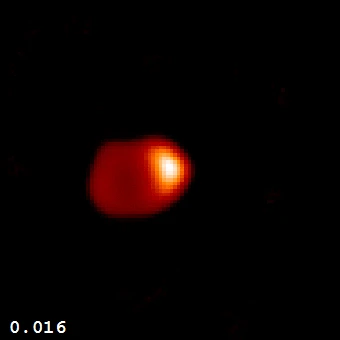
Alpha Ophiuchi A rotates very rapidly, with a projected rotational velocity of 240 km/s—about 88.5% of the breakup speed. This rapid spin gives it an oblate spheroid shape, with an equatorial bulge about 20% larger than its polar radius. The polar radius is calculated at 2.388 solar radii, and the equatorial radius at 2.858 solar radii.
- Bayer designation
- α Ophiuchi
- Traditional name
- Rasalhague
- Combined apparent magnitude
- +2.07
- Distance from earth
- 48.6 light-years (14.9 parsecs)
- Orbital period
- 8.62 years
- Mass of primary (alpha ophiuchi a)
- 2.2 solar masses (range 1.92–4.8 solar masses)
- Mass of secondary (alpha ophiuchi b)
- 0.82 solar masses
Lore & Background
The name Alpha Ophiuchi is a Romanisation of the star's Bayer designation, α Ophiuchi. It is also known by the traditional name Rasalhague, from the Arabic رأس الحواء raʼs al-ḥawwāʼ 'the head of the serpent collector'. In 2016, the International Astronomical Union organized a Working Group on Star Names (WGSN) to catalog and standardize proper names for stars. The WGSN's first bulletin of July 2016 included a table of the first two collections of approved names, formally listing Alpha Ophiuchi as Rasalhague. In Chinese astronomy, this star is named Hòu (Chinese: 候), representing a senior assistant to the emperor, sometimes said to be an astrologer.
Alpha Ophiuchi is a binary star system with an orbital period of about 8.62 years. The orbital parameters were only poorly known until 2011 when observations using adaptive optics produced a better orbital fit, allowing the individual masses of the two components to be determined. The orbital elements and masses were further improved in a 2021 study. The primary component, Alpha Ophiuchi A, has a mass of about 2.2 times the mass of the Sun, while the secondary, Alpha Ophiuchi B, has 0.82 solar masses. Estimates of the mass of the primary by other means range from a low of 1.92 to 2.10 solar masses, up to 2.84 or even 4.8 solar masses. The mass of the secondary suggests that it has a stellar classification in the range K5V to K7V, which indicates it is a main sequence star that is still generating energy by the thermonuclear fusion of hydrogen at its core. The pair reached periastron passage, or closest approach, around April 19, 2012, when they had an angular separation of 50 milliarcseconds.
This star system has a combined apparent magnitude of +2.07 and is located at a distance of about 48.6 light-years (14.9 parsecs) from the Earth. The stellar classification of A5IVnn indicates that the primary is a bluish-white subgiant star that has evolved away from the main sequence after consuming the hydrogen at its core. However, it is modelled to still a hydrogen abundance of 25% in the core, thus being a main sequence star. It is radiating about 25 times the luminosity of the Sun and has an effective temperature of about 8,000 K, giving it the characteristic white hue of an A-type star. The spectrum of Alpha Ophiuchi shows an anomalously high level of absorption of the lines for singly-ionized calcium (Ca II). However, this is likely the result of interstellar matter between the Earth and the star, rather than a property of the star or circumstellar dust.
Reader's Guide
Alpha Ophiuchi A is a rapidly rotating star with a projected rotational velocity of 240 km s−1. It is spinning at about 88.5% of the rate that would cause the star to break up. This gives it an oblate spheroid shape with an equatorial bulge about 20% larger than the polar radius. The polar radius is calculated to be 2.388 R☉ and the equatorial radius 2.858 R☉. Because of the oblateness and rapid spin, the surface gravity at the pole is higher than at the equator. An effect known as gravity darkening means that the temperature at the poles is also higher than at the equator. The polar temperature is calculated to be 9,384 K and the equatorial temperature 7,569 K. The energy radiated by an oblate star is higher along its axis of rotation because of the larger projected area and the Stefan–Boltzmann law. The axis of rotation of α Ophiuchi is inclined about 69° to the line of sight from the Earth. The apparent bolometric luminosity seen at this angle is 25.6 L☉, but the true luminosity of the star is thought to be 31.3 L☉. Since a star's effective temperature is simply the temperature which would produce its total energy output from a black body, the true effective temperature of 8,336 K is different from the apparent effective temperature of 8,047 K. Five degrees west-north-west of Rasalhague lies Rasalgethi, one of the brightest stars in the nearby constellation Hercules.
Did You Know?
- Alpha Ophiuchi A spins at about 88.5% of its breakup speed, causing an equatorial bulge 20% larger than its polar radius.
- The binary system has an orbital period of about 8.62 years, with periastron passage around April 19, 2012.
- The secondary component, Alpha Ophiuchi B, has a mass of 0.82 solar masses and is likely a K5V to K7V main sequence star.
- The star's spectrum shows anomalously high absorption of singly-ionized calcium lines, likely due to interstellar matter.
Frequently Asked Questions
What is Alpha Ophiuchi?
Alpha Ophiuchi is a binary star system that holds the title of brightest star in the constellation Ophiuchus. It is also widely recognized by its traditional name, Rasalhague.
Where does the name Rasalhague come from?
The name traces back to an Arabic phrase meaning "the head of the serpent collector," a nod to the constellation's serpent-bearer imagery. The International Astronomical Union formally adopted Rasalhague as the star's official proper name in 2016.
How far is Alpha Ophiuchi from Earth?
The system lies approximately 48.6 light-years (about 14.9 parsecs) away, placing it among the relatively nearby bright stars visible without a telescope. Its combined apparent magnitude of +2.07 makes it easily spotted in the night sky.
What are the key orbital and physical properties of the Alpha Ophiuchi binary?
The primary component, Alpha Ophiuchi A, carries roughly 2.2 solar masses and spins fast enough to take on a noticeably oblate shape. The two stars complete a full orbit around their shared barycenter every 8.62 years.
What is the Chinese designation for Alpha Ophiuchi and what does it signify?
In traditional Chinese astronomy the star is called Hòu, a title referring to a senior assistant to the emperor, sometimes described as an astrologer. It sits roughly five degrees west-north-west of Rasalgethi, one of the brightest stars in the neighboring constellation Hercules.
More in Binary and Multiple Stars, Part 3 1-24
Spotted an error? Know more?
Reader corrections go straight into our review queue. Suggest an edit · How this site is sourced