Atlas (star)
Binary star in the Pleiades, named after the Titan Atlas.

Atlas, designated 27 Tauri, is a binary star system in the constellation of Taurus. It is a member of the Pleiades open star cluster (M45) and lies 444 light-years (136 parsecs) away, 3.92 degrees north of the ecliptic. Its proper name, approved by the IAU Working Group on Star Names in 2016, derives from the Titan Atlas, father of the Pleiades sisters in Greek mythology.
- Designations
- 27 Tauri, Atlas
- Distance
- 444 light-years (136 parsecs)
- Constellation
- Taurus
- Cluster
- Pleiades (M45)
- Binary period
- 291 days
- Semi-major axis
- 13 mas
- Eccentricity
- 0.24
- Inclination
- 108°
Lore & Background
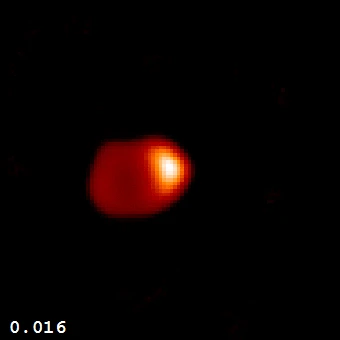
Atlas is a binary star system with a well-defined orbit of 291 days, a semi-major axis of 13 mas, and an eccentricity of 0.24. At an inclination of 108° to the plane of the sky, it does not show eclipses. The primary star, component Aa1, is calculated to be 1.6 magnitudes brighter than the secondary, component Aa2. The primary is rapidly rotating and significantly oblate, with a polar-to-equatorial radius ratio of 0.83; its rotation inclination is either 64°±20° or 116°±20°, the latter consistent with alignment with the orbit.
An outer star, component Ab (sometimes component B in CCDM and SIMBAD), has been claimed to be resolved at 0.784″ from the unresolved spectroscopic binary, with an apparent magnitude of 6.8, three magnitudes fainter than the combined magnitude of the closer pair. It would have an estimated mass twice that of the Sun. However, no new detections have been reported since 1929, even though more recent instruments would be able to identify it. In the WDS catalog, there are 8 other stars, ranging from B to I, classed as companions of Atlas.
Low-amplitude variability of Atlas was tentatively detected by STEREO and clearly detected by Kepler/K2. The light curve varies with several periods, the most prominent being 2.427, 0.7457, and 1.214 days.
Reader's Guide
Atlas is notable as a binary star system within the Pleiades cluster, one of the most recognizable open clusters in the night sky. Its proper name, approved by the IAU in 2016, connects it to Greek mythology as the father of the Pleiades sisters. The system's well-characterized orbit—with a 291-day period, 13 mas semi-major axis, and 0.24 eccentricity—provides a valuable case study for binary star dynamics. The primary star's rapid rotation and oblateness, along with its rotation inclination possibly aligned with the orbit, offer insights into stellar structure and spin-orbit coupling. The unresolved outer companion, claimed in 1929 but not subsequently detected despite improved instruments, remains an open question. The detection of low-amplitude variability by STEREO and Kepler/K2, with multiple periods, adds to its interest as a variable star. The system's location 3.92 degrees north of the ecliptic and its membership in the Pleiades make it a frequent target for both amateur and professional observers.
Did You Know?
- The primary star has a polar-to-equatorial radius ratio of 0.83 due to rapid rotation.
- The outer companion, component Ab, has not been detected since 1929.
- The light curve of Atlas shows prominent periods of 2.427, 0.7457, and 1.214 days.
From Optical Pairs to Gravitational Proof
For centuries after the telescope's invention, astronomers noted pairs of stars sitting close together in the sky. Giovanni Battista Riccioli spotted Mizar in the Big Dipper as a double in 1650, and Father Fontenay made the same observation for Acrux in the Southern Cross by 1685. Yet these sightings alone could not distinguish true gravitational companions from mere line-of-sight alignments. That gap was bridged in 1767 by John Michell, an English natural philosopher and clergyman, who turned to statistics. Examining the Pleiades cluster, he calculated that the odds of such tight groupings arising by random chance were roughly one in half a million, leading him to propose that mutual gravitational pull held these pairs together. William Herschel then spent decades from 1779 onward cataloguing around 700 double stars, originally hoping to exploit parallax for distance measurement. By 1803, his 25 years of positional tracking revealed curved relative paths rather than parallax shifts, confirming true orbital motion. The first full binary orbit was finally computed in 1827 by Félix Savary for Xi Ursae Majoris, cementing the reality of gravitationally bound stellar pairs.
The Taxonomy of Paired Stars
The vocabulary surrounding stellar pairs carries precise distinctions that matter to astronomers. A binary star is reserved for two stars that genuinely revolve around a shared center of mass, a term Sir William Herschel coined in 1802 when he described a real double star held together by the bond of their own mutual gravitation. The broader label double star simply means two stars appear close together in the sky; many such pairs are optical doubles, where the two stars sit at vastly different distances from the Sun and share no physical connection. Beyond the binary-versus-double distinction, pairs are further categorized by how we detect them. Visual binaries can be split with a telescope or powerful binoculars. Spectroscopic binaries betray themselves through periodic shifts in spectral lines. Photometric binaries, including eclipsing binaries, show brightness changes as one component passes in front of the other. Astrometric binaries reveal an unseen companion through a wobble in the visible star's position. A single system can belong to several of these classes simultaneously.
Engines of Stellar Evolution
Binary stars occupy a central place in astrophysics because they offer something single stars cannot: a direct, geometric route to measuring stellar mass. By tracking the orbital motion of two gravitationally bound objects, astronomers can apply Newtonian mechanics to derive masses without relying on indirect model assumptions, and in doing so they test the broader theories that govern how stars are born, live, and die. When the two components orbit close enough, their gravity warps each other's outer atmospheres, and in the most extreme cases mass flows from one star to the other. That exchange can push a pair's joint evolution into regimes a solitary star would never reach. The consequences are dramatic: binary systems serve as the progenitors of novae and type Ia supernovae, and they frequently form the dense nuclei around which planetary nebulae expand. Well-known examples include Sirius, the bright companion pair visible to the naked eye, and Cygnus X-1, a system whose unseen component is a well-established black hole.
Mapping the Invisible Orbits
Despite their importance, the vast majority of known binary systems remain only partially characterized. The Washington Double Star Catalog, maintained by the United States Naval Observatory, listed more than 100,000 pairs of double stars as of mid-2017, a figure that includes both true binaries and optical doubles. Yet complete orbital solutions are available for only a few thousand of those entries. The difficulty is compounded by timescales: many visual binaries have orbital periods stretching across centuries or even millennia, so a human observer witnesses only a small arc of the full ellipse rather than a closed revolution. Detection itself depends heavily on instrumental angular resolution and on the brightness contrast between components; a faint companion lurking in the glare of a bright primary can remain hidden until sharper optics or interferometric techniques are brought to bear. As resolution improves, the catalog swells with newly resolved pairs, but the gap between seeing two dots and determining a full orbit remains enormous.
Frequently Asked Questions
What is Atlas (star)?
Atlas, also known by its Bayer designation 27 Tauri, is a binary star system located in the constellation Taurus. It is a confirmed member of the Pleiades open cluster (M45) and sits 3.92 degrees north of the ecliptic.
How far away is Atlas (star)?
The system lies roughly 444 light-years from Earth, which corresponds to about 136 parsecs.
What is the binary period of Atlas (star)?
The two components orbit one another with a period of 291 days, tracing a path with a semi-major axis of 13 milliarcseconds.
Why is it called Atlas?
The IAU Working Group on Star Names approved the proper name in 2016, drawing from the Titan Atlas in Greek mythology, who is the father of the Pleiades sisters. The name thus ties the star to its cluster membership through myth.
Which star cluster does Atlas (star) belong to?
Atlas is a member of the Pleiades (M45), one of the most well-known open star clusters visible to the naked eye in Taurus.
More in Binary and Multiple Stars, Part 3 1-24
Spotted an error? Know more?
Reader corrections go straight into our review queue. Suggest an edit · How this site is sourced