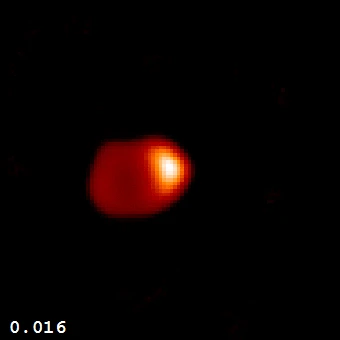
ASASSN-V J173229.06−613712.5
Young contact binary in Mamajek 4 tidal tail.

ASASSN-V J173229.06−613712.5 is a contact binary star system of the W Ursae Majoris type, located in the tidal tail of the open cluster Mamajek 4 at a distance of approximately 444 parsecs (1,450 light-years) in the constellation Ara. It is notable for being a young, deep contact system with an extremely low mass ratio, suggesting accelerated stellar convergence during cluster formation.
- Distance
- 444 parsecs (1,450 light-years)
- Constellation
- Ara
- Orbital inclination
- 68.356+1.358−1.270°
- Contact factor
- 66.3+5.0−5.3%
- Mass ratio
- 0.130±0.004
- Age
- ≤371 million years
- Type
- W Ursae Majoris contact binary
Lore & Background
The object was catalogued by the All Sky Automated Survey for SuperNovae (ASAS-SN) project, with its 'V' index indicating variability and its digits denoting celestial coordinates. A detailed study published in April 2026 by a group led by Xiang Bin and Liu Liang combined TESS photometry and Gaia astrometry, establishing that the star is dynamically linked to the tidal tail of the young open cluster Mamajek 4.
Physical analysis using MCMC modeling of TESS data revealed a noticeable asymmetry in the light curve, attributed to a cool starspot on the more massive primary star. The orbital plane is inclined at 68.356+1.358−1.270°, and the contact factor is 66.3+5.0−5.3%. The photometric mass ratio is extremely low at 0.130±0.004.
Because the system's trajectory and position coincide with the tidal tail of Mamajek 4, its age does not exceed 371 million years. The discovery of such a young and deep contact system suggests the possibility of accelerated stellar convergence even during the cluster formation stage, challenging theories that assume an exclusively long and gradual merger driven by magnetic stellar winds.
Reader's Guide
The significance of ASASSN-V J173229.06−613712.5 lies in its challenge to established theories of binary star evolution. As a young contact binary with an age no greater than 371 million years, it exhibits a deep contact configuration (contact factor 66.3%) and an extremely low mass ratio (0.130). According to the study led by Xiang Bin and Liu Liang, this combination suggests that the components may have converged rapidly during the cluster formation stage itself, rather than through the gradual, long-term process of orbital decay driven by magnetic stellar winds. This finding calls into question the assumption that all contact binaries require billions of years to merge. The system's location in the tidal tail of Mamajek 4 provides a unique evolutionary context, linking its formation to the dynamics of a young open cluster. Its legacy is as a counterexample to slow-merger models, prompting a re-evaluation of the timescales and mechanisms of close binary evolution.
Did You Know?
- The light curve asymmetry is explained by a cool starspot on the more massive primary star.
- The system's age does not exceed 371 million years.
Frequently Asked Questions
What is ASASSN-V J173229.06−613712.5?
It is a W Ursae Majoris-type contact binary star system in which two stars share a common envelope and exchange mass continuously. The pair resides in the tidal tail of the open cluster Mamajek 4, making it one of the youngest known deep-contact systems.
Where can I find ASASSN-V J173229.06−613712.5 in the sky?
The system sits in the southern constellation Ara at a distance of roughly 444 parsecs, or about 1,450 light-years from Earth. Its orbital plane is inclined at approximately 68.4 degrees relative to our line of sight.
What makes ASASSN-V J173229.06−613712.5 unusual compared to other contact binaries?
Its mass ratio of only 0.130 is extraordinarily low, meaning the secondary star holds just a small fraction of the primary's mass while the two remain in deep contact (contact factor ≈ 66 %). Combined with an age capped at roughly 371 million years, this points to a very rapid convergence of the two stars shortly after the cluster formed.
How old is ASASSN-V J173229.06−613712.5?
Current estimates place its age at no more than about 371 million years, which is remarkably young for a system already in such an advanced contact state. This short timescale is a key reason the pair is considered a natural laboratory for studying early-stage binary evolution.
Why do astronomers care about ASASSN-V J173229.06−613712.5?
Because it sits in a cluster tidal tail and shows a deep-contact configuration with an extreme mass asymmetry, it offers direct evidence that stellar pairs can converge and merge much faster than standard models predict. Studying it helps refine theories of how multiple stars form and evolve during the earliest phases of cluster assembly.
More in Binary and Multiple Stars, Part 3 1-24
Spotted an error? Know more?
Reader corrections go straight into our review queue. Suggest an edit · How this site is sourced