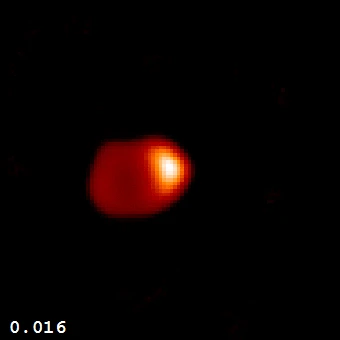
Alpha Reticuli
Brightest star in Reticulum, possibly a binary with a 60,000-year orbit.

Alpha Reticuli, Latinized from α Reticuli and also named Rhombus, is the brightest star in the southern circumpolar constellation of Reticulum. With an apparent visual magnitude of 3.3, it is visible to the naked eye but best observed from the southern hemisphere, south of the Tropic of Cancer. The star appears solitary at a distance of 160 light-years from Earth, though it may be the primary component of a binary star system.
- Apparent magnitude
- 3.3
- Distance
- 160 light-years
- Spectral type
- G8 II-III
- Mass
- about three times the mass of the Sun
- Age
- about 300 million years
- Radius
- 13 times the radius of the Sun
- Effective temperature
- 4,800 K
- X ray luminosity
- 3 × 10^29 erg s−1
Lore & Background
Alpha Reticuli has a stellar classification of G8 II-III, indicating it exhibits traits of both a giant and a bright giant star. Its surface has expanded to 13 times the Sun's radius, and its outer envelope has an effective temperature of 4,800 K. X-ray emission has been detected from this star, with an estimated luminosity of 3 × 10^29 erg s−1. The star has about three times the mass of the Sun and is roughly 300 million years old.
A 12th-magnitude visual companion, CCDM J04144-6228B, lies at an angular separation of 48 arcseconds along a position angle of 355°. Because the two stars share a common proper motion, Alpha Reticuli may not be solitary but rather the primary component of a binary star system with a projected separation of 2,400 au and an orbital period of at least 60,000 years. There is a 94% probability that they are physically related.
In Chinese astronomy, the star is part of an asterism called 夾白 (Jiá Bái), meaning White Patches Attached, which includes α Reticuli and θ Doradus. Alpha Reticuli itself is known as 夾白二 (Jiá Bái èr, the Second Star of White Patches Attached). The IAU Working Group on Star Names approved the name Rhombus for the primary component Alpha Reticuli A on 19 September 2024, after an obsolete name for the constellation Reticulum.
Reader's Guide
Alpha Reticuli is notable as the brightest star in the faint southern constellation Reticulum, serving as a key reference point for observers in the southern hemisphere. Its classification G8 II-III places it in a transitional evolutionary stage between a giant and a bright giant, offering insight into stellar evolution for stars of about three solar masses. The detection of X-ray emission adds to its astrophysical interest, indicating coronal activity typical of evolved stars. The possible binary nature, with a 94% likelihood of physical association, suggests that Alpha Reticuli may have a distant companion with an orbital period exceeding 60,000 years, making it a long-period binary system. The star's naming history reflects both Chinese astronomical traditions and modern IAU standardization, with the name Rhombus reviving an obsolete constellation name. Its visibility constraints—best seen south of the Tropic of Cancer—underscore its role as a southern-hemisphere celestial marker.
Did You Know?
- Alpha Reticuli has an apparent visual magnitude of 3.3 and is the brightest star in Reticulum.
- The star has a 12th-magnitude visual companion with a 94% probability of being physically related.
- Its projected separation from the companion is 2,400 au, with an orbital period of at least 60,000 years.
- The IAU approved the name Rhombus for Alpha Reticuli A on 19 September 2024.
Frequently Asked Questions
What is Alpha Reticuli?
Alpha Reticuli, also known by the name Rhombus, is the brightest star in the southern circumpolar constellation Reticulum. It glows at an apparent visual magnitude of 3.3 and lies roughly 160 light-years from Earth, making it a naked-eye object best seen from the southern hemisphere.
Is Alpha Reticuli actually a binary star?
It looks like a single star to the eye, but it is thought to be the primary component of a binary system with an orbital period of approximately 60,000 years. The companion has not been firmly resolved, so the binary designation remains tentative.
What type of star is Alpha Reticuli?
It is classified as a G8 II-III star, placing it in the orange-yellow giant or bright-giant range. With a radius about 13 times the Sun's and a mass around three solar masses, it is estimated to be roughly 300 million years old.
Where and how can I best observe Alpha Reticuli?
Because Reticulum circles the south celestial pole, the star is most accessible to observers located south of the Tropic of Cancer. At magnitude 3.3 it is visible to the unaided eye under dark skies, though it is far from the brightest object in that region of the sky.
Why is Alpha Reticuli interesting to fans of multiple stars?
Its possible 60,000-year orbit makes it a textbook example of a wide, long-period binary that is difficult to confirm with current astrometric tools. At 160 light-years and appearing visually solitary, it serves as a useful benchmark for techniques that search for faint, distant companions around bright stars.
More in Binary and Multiple Stars, Part 3 1-24
Spotted an error? Know more?
Reader corrections go straight into our review queue. Suggest an edit · How this site is sourced