Antares
Red supergiant binary star, heart of Scorpius.

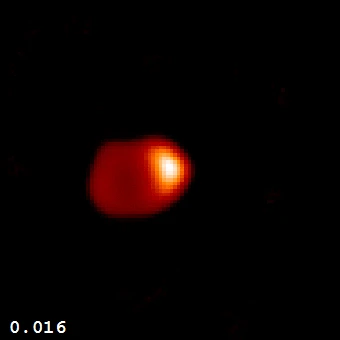
Antares is the brightest star in the constellation of Scorpius, with the Bayer designation α Scorpii (Latinised to Alpha Scorpii). Often referred to as 'the heart of the scorpion', it is a red supergiant and one of the largest stars visible to the naked eye, appearing distinctly reddish. It is actually a binary star system, with components α Scorpii A (the red supergiant) and α Scorpii B (a hot main sequence star). Antares is the brightest and most evolved stellar member of the Scorpius–Centaurus association, the nearest OB association to the Sun, and illuminates the Rho Ophiuchi cloud complex in its foreground.
- Bayer designation
- α Scorpii
- Spectral type
- M1.5Iab-Ib
- Apparent magnitude range
- +0.6 to +1.6
- Distance
- about 170 parsecs (550 ly)
- Mass
- 13 or 15 to 16 times that of the Sun
- Projected separation of components
- about 79.1 Tm (529 AU)
- Companion magnitude
- 5.5
Lore & Background
Antares derives its traditional name from the Ancient Greek Ἀντάρης, meaning 'rival to Ares', due to the similarity of its reddish hue to the planet Mars. The comparison with Mars was once thought to originate with early Mesopotamian astronomers, but this is now considered outdated speculation; in Mesopotamian astronomy the star was always called 'heart of Scorpion' and associated with the goddess Lisin. Some scholars have speculated the star may have been named after Antar, or Antarah ibn Shaddad, the Arab warrior-hero, but the name 'Antares' is already proven in Greek culture, e.g. in Ptolemy's Almagest and Tetrabiblos. In 2016, the International Astronomical Union's Working Group on Star Names approved Antares for the star α Scorpii A.
Antares is a slow irregular variable star, classified as an LC type, with brightness varying between apparent visual magnitude +0.6 and +1.6, usually near +1.0. Radial velocity variations observed in the early 20th century were initially thought to be orbital but were later attributed to pulsation of the star's atmosphere; by 1928 it was calculated that the star's size varies by about 20%. The companion was first reported by Johann Tobias Bürg during an occultation on April 13, 1819, though dismissed as an atmospheric effect, then observed by James William Grant on July 23, 1844, rediscovered by Ormsby M. Mitchel in 1846, and measured by William Rutter Dawes in April 1847.
The binary system's orbit is considered unreliable; the best calculated orbit describes an almost circular orbit seen nearly edge-on, with a period of 1,218 years and a semi-major axis of about 2.9″. Other period estimates range from 880 to 2,562 years. The projected separation is about 529 AU, and spectroscopic examination suggests the companion is over 220 AU beyond the primary.
Reader's Guide
Antares is notable as a red supergiant binary star that is the brightest member of the Scorpius–Centaurus association, the nearest OB association to the Sun. Its variability has been monitored by the American Association of Variable Star Observers since 1945, and research published in 2018 demonstrated that the Ngarrindjeri Aboriginal people from South Australia observed its variability and incorporated it into oral traditions as Waiyungari (meaning 'red man'). Antares is one of four first magnitude stars within 6° of the ecliptic, allowing lunar occultations; the current cycle of lunar occultations began in 2023. It can also be occulted by planets, though rarely—the last occultation by Venus was on September 17, 525 BC, and the next will be November 17, 2400. The star illuminates the Rho Ophiuchi cloud complex, sometimes called the Antares Nebula or VdB 107. Its traditional name and reddish color have made it a prominent object in both ancient and modern astronomy, and it serves as a spectral standard for class M1.5Iab-Ib.
Did You Know?
- Antares is a binary star system with components α Scorpii A (red supergiant) and α Scorpii B (hot main sequence star of magnitude 5.5).
- If placed at the center of the Solar System, Antares would extend out to somewhere in the asteroid belt.
- The Ngarrindjeri Aboriginal people of South Australia observed Antares' variability and called it Waiyungari, meaning 'red man'.
Frequently Asked Questions
What is Antares?
Antares is the brightest star in the constellation Scorpius, carrying the Bayer designation α Scorpii. It is a red supergiant binary system commonly nicknamed the 'heart of the scorpion.'
What are the two components of the Antares system?
The system consists of α Scorpii A, a red supergiant of spectral type M1.5Iab-Ib, and α Scorpii B, a hot main-sequence star. Their projected separation works out to roughly 529 AU, or about 79.1 trillion metres.
How far is Antares from Earth and how massive is it?
Antares sits at a distance of approximately 170 parsecs, or about 550 light-years. Its primary component carries a mass estimated at 13 to 16 times that of the Sun.
Why does Antares matter for studying nearby stellar populations?
It is the brightest and most evolved stellar member of the Scorpius–Centaurus association, the closest OB association to our Sun. Antares also illuminates the Rho Ophiuchi cloud complex, making it a useful anchor for examining nearby star-forming regions.
What does Antares look like to the naked eye?
It appears as a distinctly reddish point of light with an apparent magnitude ranging from about +0.6 to +1.6. Because of its enormous radius, it ranks among the largest stars visible without any optical aid.
More in Binary and Multiple Stars, Part 3 1-24
Spotted an error? Know more?
Reader corrections go straight into our review queue. Suggest an edit · How this site is sourced