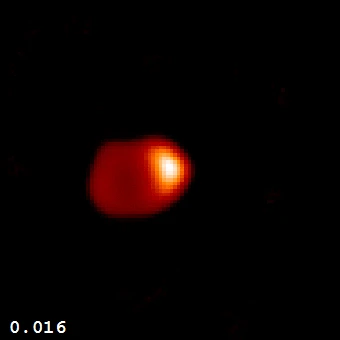
BD+05 4868
Binary star with a disintegrating rocky planet creating a comet-like tail.

BD+05 4868 is a binary star system composed of a K-dwarf primary and an M-dwarf secondary. It is notable for hosting a disintegrating rocky planet, BD+05 4868Ab, which orbits so close to the primary star that it has developed a large comet-like tail detectable in transit observations.
- Primary star type
- K-dwarf
- Secondary star type
- M-dwarf
- Spectral type
- K5:
- Apparent magnitude v
- 10.16
- Planet name
- BD+05 4868Ab
- Transit depth range
- 0.8-2.0%
- Equilibrium temperature
- 1,820±45 K
- Estimated planet mass
- 0.02 M🜨 (lunar-mass)
- Estimated planet radius
- 2,000 km
- Mass loss rate
- 10 M🜨 per billion years
Lore & Background
BD+05 4868 was first cataloged in the Bonner Durchmusterung. In 1961 it was identified as a proper motion star by Giclas et al. Its spectrum was first observed in 1984, classifying it as a K5: type star. The binary nature was first identified from Gaia data, with common proper motion and parallax indicating a physical bound pair. The binary was also detected with the Las Cumbres Observatory Global Telescope (LCOGT) 2 m Faulkes Telescope North and with Keck NIRC2.
The planet BD+05 4868Ab was discovered with TESS in transits. The transits are unusually deep with variable depths of 0.8-2.0% and are asymmetric, with a short ingress followed by a long egress. The transits were also detected in ground-based ASAS-SN and LCOGT 2m telescope data. Seven spectra of the primary obtained with the WIYN 3.5m Telescope detected no radial velocity signal larger than a few m/s. The researchers interpret the transits as a disintegrating rocky planet, similar to Kepler-1520b, KOI-2700b, and K2-22b, but BD+05 4868Ab is around a relatively bright host star (V=10.16 mag) and has consistently deep transits.
Reader's Guide
BD+05 4868Ab is significant as a disintegrating rocky planet that offers a rare opportunity for transmission spectroscopy to characterize exoplanet mineralogy, because it orbits a relatively bright host star and exhibits consistently deep transits (0.8-2.0%) compared to other disintegrating planets which show weaker (~0.5%) and more variable transits. Its relatively low equilibrium temperature of 1,820±45 K may lead to differences in dust properties. The transit shows both a leading and trailing tail, which helped constrain grain sizes to 1–10 μm. Models suggest the planet began with a mass possibly larger than Mercury and lost mass over several billion years due to evaporation of surface minerals. Its current mass is assumed to be about 0.02 M🜨 (lunar-mass) and radius about 2,000 km. The mass-loss rate is 10 M🜨 per billion years, implying it will fully evaporate in about 2 million years. This makes BD+05 4868Ab a compelling target for studying planetary disintegration and interior composition.
Did You Know?
- BD+05 4868Ab has a comet-like tail visible in transits due to its disintegration.
- The planet's transits are unusually deep, varying from 0.8% to 2.0%.
- Its equilibrium temperature is 1,820±45 K, relatively low for a disintegrating planet.
- The planet is estimated to have a mass of about 0.02 Earth masses (lunar-mass) and a radius of 2,000 km.
Frequently Asked Questions
What is BD+05 4868?
BD+05 4868 is a binary star system made up of a K5-dwarf primary and an M-dwarf secondary. It gained attention in the multiple-star community because its primary hosts a rocky planet that is actively falling apart.
What is BD+05 4868Ab and why is it called 'disintegrating'?
BD+05 4868Ab is a rocky planet orbiting extremely close to the K-dwarf primary, so close that tidal and thermal stresses are stripping material off its surface. This shed debris forms a long, comet-like tail that trails behind the planet as it circles the star.
How do astronomers actually see BD+05 4868Ab?
The planet is detected through transit observations, where the body and its dusty tail pass in front of the primary star and dim its light. The transit depth varies between roughly 0.8% and 2.0%, a range that reflects the changing size of the tail as the planet orbits.
What are the basic stellar properties of the BD+05 4868 pair?
The primary is classified as a K5-dwarf, while the companion is a cooler M-dwarf. The system's combined apparent visual magnitude sits at about 10.16, placing it well beyond naked-eye visibility and requiring small telescopes or ground-based photometry to study.
Why do multiple-star fans care about BD+05 4868?
It offers a rare, well-characterized example of how a close-in rocky planet behaves inside a binary environment, with debris production that can be tracked over time. For fans tracking binary systems, it is one of the few cases where both the stellar pairing and a dramatic planetary phenomenon are documented together.
More in Binary and Multiple Stars, Part 3 1-24
Spotted an error? Know more?
Reader corrections go straight into our review queue. Suggest an edit · How this site is sourced