Apep (star system)
Triple star system and top gamma-ray burst progenitor in the Milky Way.

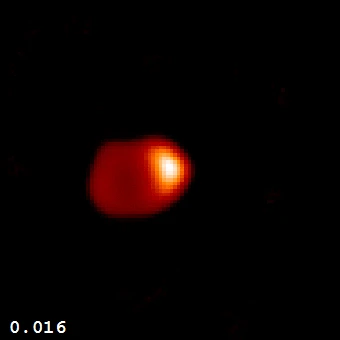
Apep is a triple star system in the constellation Norma, containing a Wolf–Rayet binary and a hot supergiant. It is surrounded by a vast complex of stellar wind and cosmic dust shaped into a pinwheel nebula, and has been identified as the best-known gamma-ray burst progenitor candidate in the Milky Way galaxy.
- Constellation
- Norma
- Right ascension
- 16h 00m 50.5s
- Declination
- −51° 42′ 45″
- Distance
- ~2.4 kiloparsecs (~8,000 light-years), with potential discrepancy +0.2 and −0.5 kiloparsecs
- Total apparent magnitude
- 17.5
- Central engine apparent magnitude
- 19.0
- Northern companion apparent magnitude
- 17.8
- Binary orbital period
- ~100 years
- Outer companion orbital period
- >10,000 years
- Outer companion distance
- ~1,700 astronomical units
Lore & Background
Apep was named by a team led by Joseph Callingham of ASTRON, who studied the system between 2016 and 2018. The name comes from the serpent deity in Egyptian mythology, the mortal enemy of the sun god Ra, described as 'an apt allusion' to the system's appearance in infrared as 'a star embattled within a dragon's coils'. The system is also catalogued as 2XMM J160050.7−514245 and WR 70–16.
The central engine is a binary of two classical Wolf–Rayet stars: a carbon-sequence (WC8) and a nitrogen-sequence (WN4-6b) subtype, making Apep the strongest case of a classical WR+WR binary in the Milky Way. The third star, a hot supergiant described as the 'northern companion', orbits at ~1,700 AU with a period >10,000 years and carves a cavity in the dust shell. The stellar wind travels at 12 million km/h, while the dust moves at 2 million km/h at the system's edge, indicating at least one component is rapidly rotating, with surface gravity nearly balanced by centrifugal force. This produces faster polar winds and slower equatorial winds, whose interaction with the secondary creates the pinwheel shape.
Reader's Guide
Apep is notable as the first gamma-ray burst progenitor candidate discovered in the Milky Way, a finding published in Nature Astronomy on 19 November 2018. Ground-based studies in the 2010s concluded it was the best-known such candidate in our galaxy. Rapidly rotating Wolf–Rayet stars are theoretically capable of producing a gamma-ray burst during a supernova, and Apep's properties align with that scenario. The system was initially identified as an X-ray source by XMM-Newton and Chandra as early as August 2004, but its significance was not recognized until later. Observations with the Very Large Telescope in August 2016, along with the Anglo-Australian Telescope and Australia Telescope Compact Array, confirmed its nature. JWST Mid-Infrared Instrument observations published in 2025 showed the dust structure produced over the last 700 years, expanding at 90±4 mas/yr. The system resembles WR 104, another pinwheel-nebula-producing Wolf–Rayet system, and its discovery challenged the assumption that such gamma-ray burst progenitors only exist in galaxies younger than the Milky Way.
Did You Know?
- Apep is named after the serpent deity from Egyptian mythology, the mortal enemy of the sun god Ra.
- The system's central engine is a binary of two classical Wolf–Rayet stars, the strongest such case in the Milky Way.
- JWST observations in 2025 showed the dust shell expanding at 90±4 mas/yr, produced over the last 700 years.
The December 2004 Alarm and the 2029 Flyby
Discovered on June 19, 2004, by Roy Tucker, David Tholen, and Fabrizio Bernardi working at Kitt Peak National Observatory, the asteroid initially carried the bland provisional label 2004 MN4. What made the find remarkable was the difficulty of the observation: the object sat at a mere 56 degrees of solar elongation and a distance of 1.1 AU, making it an unusually challenging target. By late December of that same year, preliminary orbital calculations raised alarm, suggesting a 2.7 percent chance the rock would strike Earth on April 13, 2029. On December 27, 2004, Apophis claimed the highest rating ever recorded on the Torino hazard scale, reaching Level 4. Subsequent observations, including precovery data stretching back to March 15, 2004, and radar astrometry in January 2005, quickly dispelled the threat. The asteroid will instead sail past Earth in 2029 at roughly 31,600 kilometres above the surface, a distance that, while close by astronomical standards, poses no danger of collision.
Two Decades of Narrowing the Orbit
It took nearly seventeen years to move from a brief public scare to a definitive all-clear. After the initial 2004–2005 observations, the asteroid's orbit was gradually sharpened through successive radar campaigns. In January 2013, Goldstone radar data effectively eliminated the possibility of an Earth impact in 2036, removing the next potential close-approach threat. Then, in early 2021, additional radar observations further tightened the orbital solution. In March of that year, NASA's Jet Propulsion Laboratory issued the long-awaited statement: Apophis has no chance of striking Earth within the next one hundred years. The practical effect of two decades of measurement was dramatic. The uncertainty in the 2029 flyby distance shrank from hundreds of kilometres to just a couple of kilometres, a precision that greatly improves predictions of every future approach. This sustained effort transformed Apophis from a source of public anxiety into a well-characterised object whose trajectory is now known with remarkable confidence.
A Tumbling, Bilobed Rock
Radar imaging from Goldstone and Arecibo in 2012–2013 revealed that Apophis is far from a simple sphere. Brozović and colleagues estimated the body to be an elongated, bilobed object measuring roughly 450 by 170 metres, possibly a contact binary in which two lobes have merged. Its surface is relatively bright, with a geometric albedo of about 0.35, and its composition likely resembles that of LL chondrites. The mass is estimated at around four times ten to the tenth kilograms, though that figure carries a factor-of-three uncertainty. Perhaps most striking is the rotation. Apophis is a tumbler: rather than spinning around a fixed axis, its rotation axis wanders in the body's own frame with a period of roughly 263 hours. The angle between the long axis and the angular momentum vector swings between about 78 and 102 degrees twice each period. A faster precession, averaging 27.38 hours, makes the asteroid appear to flip end over end roughly every 30.56 hours. Its angular momentum axis points 59 degrees south of the ecliptic, marking it as a retrograde rotator.
Serpent of the Duat and the Road to 2029
The name Apophis carries deep mythological resonance. It is the Greek rendering of Apep, the ancient Egyptian serpent who dwelt in the darkness of the Duat and sought to devour the sun-god Ra during his nightly passage. The discoverers chose the name on July 19, 2005, after the asteroid earned its permanent number 99942. There is a subtle astronomical logic to the choice: the 2029 close encounter will shift Apophis from an Aten-type to an Apollo-type asteroid, and Apollo asteroids are conventionally named after Greek deities while Aten asteroids take Egyptian ones. The Greek name of an Egyptian god thus bridges both categories. Two of the co-discoverers, Tholen and Tucker, are fans of Stargate SG-1, whose recurring alien villain shares the name, though Tholen insists the connection is purely coincidental. Looking ahead, the 2029 flyby will be a target for planetary defense missions, including the OSIRIS-REx and Ramses spacecraft, giving scientists a rare opportunity to study the asteroid up close.
Frequently Asked Questions
What is Apep (star system)?
Apep is a triple star system in the southern constellation Norma, made up of a Wolf–Rayet binary pair plus a hot supergiant companion. The three stars are enveloped by a broad shell of stellar wind and cosmic dust that traces out a striking pinwheel-shaped nebula.
Why is Apep called the top gamma-ray burst progenitor in the Milky Way?
Its extreme stellar masses, tight binary interactions, and the surrounding nebular architecture make it the strongest known candidate in our galaxy for eventually producing a gamma-ray burst. Astronomers track it as the best-identified GRB progenitor candidate we have locally.
Where in the sky is Apep located?
Apep sits in Norma at a right ascension of about 16 h 00 m and a declination near −51° 43′. Its combined apparent magnitude of 17.5 means it is well beyond naked-eye visibility and requires at least a small-to-mid telescope to resolve.
How far away is Apep from Earth?
The system is roughly 2.4 kiloparsecs (about 8,000 light-years) distant, with an estimated uncertainty of +0.2 to −0.5 kiloparsecs. That places it comfortably within the inner disk of the Milky Way.
What does Apep's central engine look like observationally?
The central engine of the triple system registers at an apparent magnitude of 19.0, noticeably fainter than the 17.5 total brightness of the full nebular complex. The two Wolf–Rayet stars in the inner binary are the primary drivers of the wind that sculpts the surrounding pinwheel nebula.
More in Binary and Multiple Stars, Part 3 1-24
Spotted an error? Know more?
Reader corrections go straight into our review queue. Suggest an edit · How this site is sourced