W Sagittarii
A Cepheid variable and multiple star in Sagittarius.

W Sagittarii, also known as Dhanusaragra, is a multiple star system located in the constellation Sagittarius and is classified as a Classical Cepheid variable star. It lies nearly a degree away from the much brighter star γ2 Sagittarii (Alnasl) along the same line of sight, though the two are not physically related; Alnasl marks the spout of the teapot asterism.
The star carries the variable star designation W Sagittarii and the Bayer designation Gamma1 Sagittarii (γ1 Sgr). The Indian name Dhanuśarāgra, meaning "the Arrow," has been used since the 14th century for the pair γ1 and γ2 Sgr. On 13 August 2026, the IAU Working Group on Star Names officially adopted the name Dhanusaragra for the component γ1 Sgr Aa1.
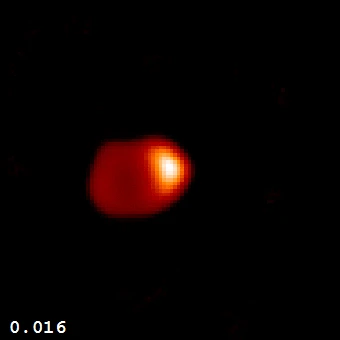
Within the multiple system, W Sgr is listed as component A of ADS 11029 and WDS J18050-2935. Two optical companions, components B and C, lie at separations of 33 and 46 arcseconds, respectively, both shining at 13th magnitude; they are not gravitationally bound to W Sgr. Component A itself is a triple star system, with the components designated Aa1, Aa2, and Ab (also referred to as Aa, Ab, and B). The outer companion, Ab, has been resolved at a separation of 0.14 arcseconds and is more than five magnitudes fainter than the primary supergiant. The inner pair can only be detected through spectroscopic radial velocity variations. The primary is a yellow supergiant of about 6 solar masses, while the secondary is an early F main-sequence star with a mass below 1.4 solar masses.
The star's variability was first noted by Johann Friedrich Julius Schmidt in early June 1866. The supergiant component W Sgr Aa1 pulsates regularly, with its apparent magnitude varying between 4.3 and 5.1 over a period of 7.59 days. During these pulsations, its temperature and spectral type also change. It is categorized as a Classical Cepheid variable, of the δ Cephei type.
- Bayer designation
- Gamma1 Sagittarii (γ1 Sgr)
- Variable star designation
- W Sagittarii (W Sgr)
- Magnitude range
- 4.3 to 5.1
- Pulsation period
- 7.59 days
- Primary mass
- 6 M☉
- Secondary mass
- less than 1.4 M☉
- Discovery of variability
- early June of 1866 by Johann Friedrich Julius Schmidt
Lore & Background
W Sagittarii was discovered to be a variable star in early June of 1866 by Johann Friedrich Julius Schmidt. The supergiant component W Sgr Aa1 pulsates regularly between magnitudes 4.3 and 5.1 every 7.59 days, with its temperature and spectral type also varying during the pulsations. It is classified as a Classical Cepheid (δ Cephei) variable.
The system is listed as component A of a multiple star system catalogued as ADS 11029 and WDS J18050-2935. Components B and C are at 33" and 46" respectively, both 13th magnitude, and are purely optical companions, not physically associated with W Sgr. Component A itself is a triple star system, with components referred to as W Sgr Aa1, Aa2, and Ab. The outer companion Ab has been resolved at a separation of 0.14" and is over 5 magnitudes fainter than the primary supergiant. The inner components can only be identified spectroscopically by their radial velocity variations. The primary is a 6 M☉ yellow supergiant, while the secondary is an early F main sequence star with a mass less than 1.4 M☉.
W Sagittarii also carries the Indian star name Dhanuśarāgra (धनुशराग्र), meaning the Arrow, used since the 14th century for the pair γ1 and γ2 Sgr. The IAU Working Group on Star Names adopted the name Dhanusaragra for γ1 Sgr Aa1 on 13 August 2026.
Reader's Guide
W Sagittarii holds significance as a Classical Cepheid variable, a class of stars used as standard candles for distance measurement, though the article does not explicitly state that use. Its discovery by Johann Friedrich Julius Schmidt in early June of 1866 adds to the historical record of variable star astronomy. The system's multiple-star nature—with optical companions B and C, and a triple inner system including a spectroscopic binary—illustrates the complexity of stellar associations. The adoption of the name Dhanusaragra by the IAU Working Group on Star Names on 13 August 2026 formalizes a traditional Indian star name for the primary component, linking modern astronomy with cultural heritage. The article notes that the inner components can only be identified spectroscopically, highlighting the observational challenges in resolving such systems.
Did You Know?
- W Sagittarii is also known by the Bayer designation Gamma1 Sagittarii (γ1 Sgr).
- The star was discovered to be variable in early June of 1866 by Johann Friedrich Julius Schmidt.
- The primary supergiant has a mass of 6 M☉, while the secondary is less than 1.4 M☉.
More in Binary and Multiple Stars, Part 3 1-24
Spotted an error? Know more?
Reader corrections go straight into our review queue. Suggest an edit · How this site is sourced