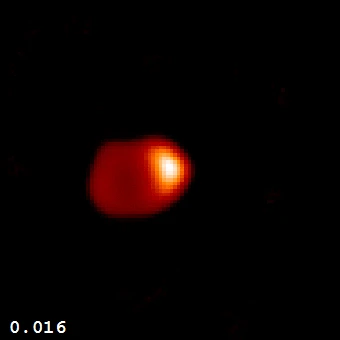
Iota Herculis
A binary star and former pole star in Hercules.

Iota Herculis, also called Tianbang, is a binary star system in the constellation Hercules. It shines at fourth magnitude and lies roughly 139 parsecs (450 light-years) from Earth. The brighter component is a β Cephei variable, meaning it pulsates in brightness. The name Tianbang comes from Chinese astronomy. The asterism 天棓 (Tiān Bàng), meaning "Celestial Flail," includes Iota Herculis along with ξ Draconis, ν Draconis, β Draconis, and γ Draconis. Iota Herculis itself is known as 天棓五 (Tiān Bàng wu), the Fifth Star of the Celestial Flail. The IAU Working Group on Star Names officially adopted the name Tianbang for Iota Herculis A on 20 June 2026. Visibility depends on light pollution. In cities, the star is usually too dim to see without a telescope. In rural areas, it is often visible, and across much of the Northern Hemisphere it is circumpolar, meaning it stays above the horizon all year. Because Iota Herculis lies close to the path traced by Earth’s north celestial pole as it precesses, it serves as a pole star at certain times. It held that role around 10,000 BCE and will again in the future. Polaris, the current pole star, lies only 0.5° off the precessional path, while Iota Herculis is about 4° off. The system is a single-lined spectroscopic binary with an orbital period of 111.5 days. The primary star’s semi-major axis around the system’s barycenter is at least 12.68, and the orbit is somewhat eccentric (e = 0.53). Nothing is known about the companion star. The primary is a B-type subgiant (classification B3IV) nearing the end of its hydrogen-fusing phase. It is much larger than the Sun, with 5.4 times the mass and 4.7 times the radius. Despite an apparent magnitude of only 3.80, it is 2,500 times more luminous than the Sun, giving an absolute magnitude of −2.11—brighter than most hot B stars in the Pleiades cluster. The Hipparcos satellite estimated its distance at about 152 parsecs (496 light-years), but a 2007 recalibration by Floor van Leeuwen placed it at 455 light-years, with an error margin of just 8 light-years. A possible companion about 30 AU away was reported in the Washington Double Star Catalog, but it has been observed only once and is considered unconfirmed.
- Bayer designation
- ι Herculis
- Apparent magnitude
- 3.80
- Distance
- 139 parsecs (450 light-years) (with updated parallax of 455 ly ± 8 ly)
- Spectral type
- B3IV
- Mass
- 5.4 solar masses
- Radius
- 4.7 solar radii
- Luminosity
- 2500 times solar
- Absolute magnitude
- −2.11
- Orbital period
- 111.5 days
- Orbital eccentricity
- 0.53
Lore & Background
Iota Herculis is a single-lined spectroscopic binary with an orbital period of 111.5 days. The primary star's semi-major axis around the barycenter is at least 12.68, and the orbit is somewhat eccentric at e = 0.53. Nothing is known about the companion. The primary component is a B-type subgiant (B3IV) at the end of its hydrogen fusion stage, considerably larger than the Sun with a mass 5.4 times solar and a radius 4.7 times solar. Its apparent magnitude is 3.80, but it is 2,500 times more luminous than the Sun, yielding an absolute magnitude of −2.11, brighter than most hot B stars in the Pleiades open star cluster.
Reader's Guide
Iota Herculis holds significance as a binary star system and a β Cephei variable, a class of pulsating stars. Its historical and future role as a pole star—currently held by Polaris—is notable: it was the pole star in 10,000 BCE and will be again in the future, though it lies 4° off the precessional path compared to Polaris's 0.5°. The star's Chinese name, Tianbang, derives from the asterism Celestial Flail, and the IAU Working Group on Star Names adopted Tianbang for Iota Herculis A on 20 June 2026. Its visibility is limited in light-polluted cities but is generally visible in rural areas of the Northern Hemisphere, where it is circumpolar and visible year-round. The system's uncertain distance—with Hipparcos and van Leeuwen giving different values—and the unconfirmed companion at 30 au highlight ongoing observational challenges. The star's high luminosity and subgiant status mark it as an evolved object near the end of hydrogen fusion, providing insight into stellar evolution of B-type stars.
Did You Know?
- It is a β Cephei variable, a type of pulsating star.
- The star's Chinese name Tianbang was adopted by the IAU Working Group on Star Names on 20 June 2026.
- A companion at about 30 au separation has been reported but only observed once and is considered unconfirmed.
More in Binary and Multiple Stars, Part 3 1-24
Spotted an error? Know more?
Reader corrections go straight into our review queue. Suggest an edit · How this site is sourced