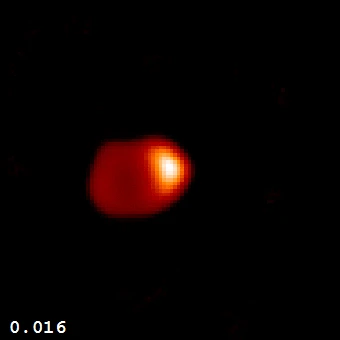
HD 895
A multiple star system with two spectroscopic binary pairs.

HD 895 is a multiple star system in the constellation Andromeda, notable for being composed of two distinct spectroscopic binary pairs. The system has an apparent magnitude of 6.277, making it visible to the naked eye under very favorable conditions, and is located approximately 54 parsecs (180 light-years) away according to Hipparcos parallax measurements.
- Apparent magnitude
- 6.277
- Distance hipparcos
- 54 parsecs (180 ly)
- Distance gaia
- 175 light-years
- Constellation
- Andromeda
- Number of components
- two spectroscopic binary pairs
- Primary pair orbital period
- 421 years
- Secondary pair orbital period
- approximately 6 days
Lore & Background
The system consists of two spectroscopic binary pairs. The first pair comprises a primary yellow giant star of spectral type G0III and a secondary subgiant star of spectral type K2IV, both of which have left the main sequence and are more massive than the Sun. The secondary completes an orbit around the primary every 421 years. The second pair, designated HD 895C, is a double-lined spectroscopic binary located 18 arcseconds away from the first pair. It has an apparent magnitude of 10.37, too faint to be seen without a telescope, and was not recognized as a separate pair in the old Bright Star Catalogue and Henry Draper Catalogue. Both stars in this pair are G-type main sequence stars slightly less massive than the Sun, with spectral types G7V and G8V, and they complete an orbit around their center of mass approximately every 6 days.
Reader's Guide
HD 895 is significant as a multiple star system that challenges simple distance estimates. The Hipparcos parallax placed the system at about 180 light-years, but Gaia parallax suggests the primary-secondary pair is much closer, at an estimated distance of 175 light-years. This discrepancy raises the possibility that the two binary pairs may not be gravitationally bound, despite their apparent proximity in the sky. The system also illustrates the evolution of stellar classification: the second pair was omitted from older catalogs such as the Bright Star Catalogue and Henry Draper Catalogue, only later being recognized as a separate double-lined spectroscopic binary. The primary pair's components, both post-main-sequence stars, provide an example of evolved stars in a long-period orbit, while the close 6-day orbit of the secondary pair exemplifies a short-period binary system. Together, these features make HD 895 a useful object for studying binary star dynamics and distance calibration.
Did You Know?
- HD 895 is made of two different spectroscopic binary pairs.
- The primary pair's secondary completes an orbit every 421 years.
- The second pair, HD 895C, was not listed in the old Bright Star Catalogue or Henry Draper Catalogue.
- Gaia parallax suggests the primary-secondary pair may be at 175 light-years, possibly not gravitationally bound to the other pair.
More in Binary and Multiple Stars, Part 3 1-24
Spotted an error? Know more?
Reader corrections go straight into our review queue. Suggest an edit · How this site is sourced