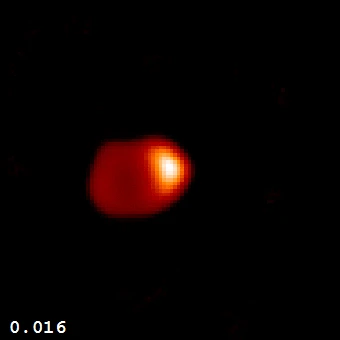
HD 4222
White-hued A-type primary of binary BU 492 in Cassiopeia.

HD 4222, also cataloged as HR 196, is the main star in the binary system BU 492, situated in the northern constellation Cassiopeia. It appears as a faint white point of light to the unaided eye, with an apparent magnitude of 5.41. Based on Gaia DR3 parallax data, it lies about 353 light-years away and is moving toward the Sun at a radial velocity of −8.5 km/s. Its brightness is reduced by 0.13 magnitudes due to interstellar dust, giving it an absolute magnitude of +0.44.
The star is classified as either A2 Vs or A1 V, meaning it is an A-type main-sequence star fusing hydrogen in its core. The "Vs" designation indicates narrow absorption lines from slow rotation, consistent with its projected rotational speed of roughly 25 km/s. HD 4222 has 2.59 times the Sun’s mass and 3.47 times its radius, shining with 69.1 times the Sun’s luminosity at an effective temperature of 9,886 K. It is metal-poor, with an iron abundance about 55% of the Sun’s ([Fe/H] = −0.26). At 407 million years old, it has completed 81.5% of its main-sequence lifetime.
The binary companion, BU 492B, is a red dwarf classified as M2-5V. It lies 1.5 arcseconds from the primary at a position angle of 173°, first noted by astronomer S. W. Burnham in 1878. HD 4222 also has an unrelated optical companion—an 11th-magnitude star 88.6 arcseconds away, which itself is a double star. X-ray emission with a luminosity of 3.031×10²⁰ W has been detected around HD 4222. Since A-type stars are not expected to produce X-rays, the emission likely originates from the red dwarf companion. HD 4222 is considered a probable member of the Sirius supercluster, a moving group of stars that share a common origin with Sirius.
- Apparent magnitude
- 5.41
- Distance
- 353 light-years
- Spectral type
- A2 Vs or A1 V
- Mass
- 2.59 M☉
- Radius
- 3.47 R☉
- Luminosity
- 69.1 L☉
- Age
- 407 million years
Lore & Background
HD 4222 has a stellar classification of A2 Vs or A1 V, both indicating it is an A-type main-sequence star fusing hydrogen in its core. The 'Vs' designation denotes sharp or narrow absorption lines due to slow rotation, consistent with its projected rotational velocity of about 25 km/s. It has 2.59 times the Sun's mass, 3.47 times its radius, and radiates 69.1 times the Sun's luminosity from a photosphere at 9,886 K. The star is metal deficient, with an iron abundance of [Fe/H] = −0.26, or 55% of the Sun's. At 407 million years old, it has completed 81.5% of its main-sequence lifetime.
The binary companion, BU 492B, is a red dwarf with a spectral class of M2-5V, located 1.5 arcseconds away at a position angle of 173°. It was first noticed by astronomer S. W. Burnham in 1878. HD 4222 also has an optical companion: an 11th-magnitude star 88.6 arcseconds away, which is itself a double star. An X-ray emission of 3.031×10^20 W was detected around HD 4222; since A-type stars are not expected to emit X-rays, the emission may originate from the companion.
Reader's Guide
HD 4222 is significant as the primary of the binary system BU 492, discovered by S. W. Burnham in 1878. Its companion, a red dwarf, is the likely source of detected X-ray emission, which is unusual for an A-type star. The system is considered a probable member of the Sirius supercluster, linking it to a group of stars with a common origin with Sirius. Gaia DR3 parallax measurements place it at 353 light-years, and its heliocentric radial velocity of −8.5 km/s indicates it is drifting closer to the Sun. The star's brightness is diminished by interstellar extinction of 0.13 magnitudes, yielding an absolute magnitude of +0.44. Its slow rotation and metal deficiency provide clues to its evolutionary state, having completed over 80% of its main-sequence lifetime. The optical companion, an 11th-magnitude double star, adds further interest to the field.
Did You Know?
- HD 4222 has completed 81.5% of its main-sequence lifetime at an age of 407 million years.
- The X-ray emission detected around HD 4222 likely comes from its red dwarf companion, not the A-type star itself.
- HD 4222 is a probable member of the Sirius supercluster, a group of stars sharing a common origin with Sirius.
More in Binary and Multiple Stars, Part 3 1-24
Spotted an error? Know more?
Reader corrections go straight into our review queue. Suggest an edit · How this site is sourced