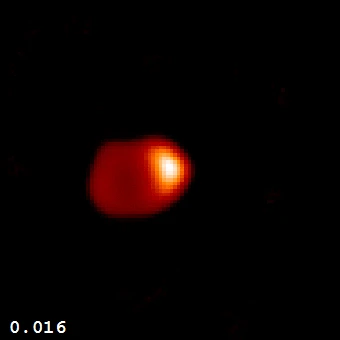
HD 176664
An orange giant approaching the Solar System at −60 km/s.

HD 176664, also cataloged as HR 7190 and 43 G. Telescopii, is a solitary star in the southern constellation Telescopium. It appears as a faint orange point of light to the naked eye, with an apparent magnitude of 5.93. Based on Gaia DR3 parallax data, it lies about 292 light-years away, but it is moving toward the Solar System at a high speed, with a radial velocity of −60 km/s. At this distance, interstellar dust dims its brightness by 0.2 magnitudes, and its absolute magnitude is +0.94.
The star is classified as K0/1 III, meaning it is an evolved giant with a spectrum between K0 and K1 types. Though its mass is similar to the Sun's, it has swollen to 12.4 times the Sun's diameter. Its enlarged photosphere shines with 49.9 times the Sun's luminosity and has an effective temperature of 4,546 K. HD 176664 is metal-rich, with an iron abundance of [Fe/H] = +0.25, and its rotation is too slow to measure accurately. A 1993 study by Olin J. Eggen identified it as part of the Milky Way's old disk population.
The star has two optical companions: CD −51°11893B, a 13th-magnitude star 19.4 arcseconds away at a position angle of 9°, and CD −51°11893C, a 12th-magnitude star 27.5 arcseconds away at a position angle of 29°.
- Apparent magnitude
- 5.93
- Distance
- 292 light years
- Radial velocity
- −60 km/s
- Absolute magnitude
- +0.94
- Stellar classification
- K0/1 III
- Mass
- comparable to the Sun
- Radius
- 12.4 times the Sun
- Luminosity
- 49.9 times the Sun
- Effective temperature
- 4,546 K
- Metallicity
- [Fe/H] = +0.25
Lore & Background
HD 176664 is an evolved K-type giant with a stellar classification of K0/1 III, indicating a spectrum intermediate between a K0 and K1 giant. It has a mass comparable to the Sun but has expanded to 12.4 times its girth, radiating 49.9 times the Sun's luminosity from an enlarged photosphere at an effective temperature of 4,546 K. The star is metal enriched ([Fe/H] = +0.25) and spins too slowly to be measured accurately.
Based on Gaia DR3 parallax measurements, HD 176664 is located at a distance of 292 light years but is rapidly approaching the Solar System with a heliocentric radial velocity of −60 km/s. Its brightness is diminished by two-tenths of a magnitude due to interstellar dust. A 1993 paper by Olin J. Eggen lists HD 176664 as a member of the Milky Way's old disk population.
The star has two optical companions: CD −51°11893B, a 13th magnitude star 19.4" away at a position angle of 9°, and CD −51°11893C, a 12th magnitude star 27.5" away at a position angle of 29°. These are not physically bound to HD 176664.
Reader's Guide
HD 176664 is a solitary K-type giant that serves as an example of an evolved star with near-solar mass but greatly expanded radius and enhanced luminosity. Its high radial velocity of −60 km/s indicates it is rapidly approaching the Solar System, making it kinematically interesting. The star's classification as a member of the Milky Way's old disk population, as noted in a 1993 paper by Olin J. Eggen, places it within the context of galactic structure and stellar population studies. Its metal enrichment ([Fe/H] = +0.25) suggests it formed from material with a higher abundance of heavy elements than the Sun. The two optical companions, CD −51°11893B and C, are unrelated background stars, confirming HD 176664's solitary nature. The star's faint naked-eye visibility (magnitude 5.93) and orange hue make it a modest but accessible target for amateur astronomers in the southern constellation Telescopium. Its measured parallax from Gaia DR3 provides a reliable distance of 292 light years, while the interstellar extinction of 0.2 magnitudes quantifies the effect of dust along the line of sight.
Did You Know?
- HD 176664 is approaching the Solar System at a heliocentric radial velocity of −60 km/s.
- It has expanded to 12.4 times the Sun's radius while retaining a comparable mass.
- The star is metal enriched with an iron abundance of [Fe/H] = +0.25.
- It has two optical companions, CD −51°11893B and C, which are not physically bound.
More in Binary and Multiple Stars, Part 3 1-24
Spotted an error? Know more?
Reader corrections go straight into our review queue. Suggest an edit · How this site is sourced