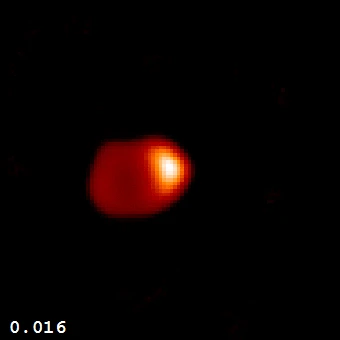
Gamma Cassiopeiae
First star observed with emission lines; prototype of Gamma Cassiopeiae variables.

Gamma Cassiopeiae, Latinized from γ Cassiopeiae and formally named Tiansi, is a multiple star system at the center of the distinctive 'W' asterism in the northern circumpolar constellation of Cassiopeia. It was observed in 1866 by Angelo Secchi as the first star ever observed with emission lines and is now considered a Be star. The system is one of the highest multiplicity systems known, potentially containing a total of eight stars.
- Bayer designation
- γ Cassiopeiae
- Flamsteed designation
- 27 Cassiopeiae
- Apparent visual magnitude
- 2.47
- Distance
- roughly 550 light-years
- Spectral type
- B0.5 IVe
- Mass
- 17 M☉
- Luminosity
- 19,000 L☉
- Effective temperature
- 25,000 K
Lore & Background
Gamma Cassiopeiae is an eruptive variable star and the prototype of the Gamma Cassiopeiae variable class. In the late 1930s it underwent a shell episode, brightening above magnitude 2.0 and then dropping rapidly to 3.4, at maximum outshining both Alpha and Beta Cassiopeiae. It has since gradually brightened back to around 2.2. The star is a rapid rotator with a projected rotational velocity of 389 km/s and a true value of 450±20 km/s, giving it a pronounced equatorial bulge (equatorial radius 10.9 R☉, polar radius 7.9 R☉). This high rotation combined with high luminosity ejects matter that forms a hot circumstellar decretion disk, causing emission lines and brightness variations. The Chinese name Tsih, 'the whip', is commonly associated with this star. The IAU Working Group on Star Names approved the name Tiansi for γ Cassiopeiae Aa on 13 November 2025, after the older Chinese name.
Reader's Guide
Gamma Cassiopeiae is notable as the first star ever observed with emission lines (1866, Angelo Secchi) and as the prototype of the Gamma Cassiopeiae variable stars. It is one of the highest multiplicity systems known, with a common-proper-motion companion HD 5408 and potentially eight stars total. The bright primary is a spectroscopic binary with a 203.5-day orbit and a white dwarf companion of 0.93 M☉, which is accreting mass from the primary. X-ray emission, at least 10 times stronger than from other B or Be stars, was historically debated but high-resolution XRISM data in 2026 validated the scenario of accretion onto a white dwarf. The star also has a Chinese name Tiansi (approved by the IAU in 2025) and was nicknamed Navi by astronaut Gus Grissom for navigational use. Its magnetic field and decretion disk make it a key object for studying Be stars and X-ray emission mechanisms.
Did You Know?
- Gamma Cassiopeiae was the first star ever observed with emission lines, by Angelo Secchi in 1866.
- It is the prototype of the Gamma Cassiopeiae class of eruptive variable stars.
- The system may contain a total of eight stars, making it one of the highest multiplicity systems known.
- American astronaut Gus Grissom nicknamed the star Navi after his own middle name spelled backwards.
More in Binary and Multiple Stars, Part 3 1-24
Spotted an error? Know more?
Reader corrections go straight into our review queue. Suggest an edit · How this site is sourced