Gamma Andromedae
A quadruple star system with a golden-blue visual contrast.

Gamma Andromedae is a multiple star system in the northern constellation of Andromeda, the third-brightest star in the constellation after Alpheratz and Mirach. It is notable as a quadruple star system that appears as a striking double star in small telescopes, with a golden-yellow primary and an indigo-blue secondary separated by about 10 arcseconds.
- Bayer designation
- γ Andromedae
- Distance
- about 390 light-years
- Radial velocity
- −11.7 km/s
- Apparent visual magnitude (γ1 andromedae
- approximately 2.26
- Apparent visual magnitude (γ2 andromedae
- 4.84
- Separation between γ1 and γ2
- 9.6 arcseconds
- Orbital period of γ1 and γ2
- approximately 5,000 years
Lore & Background
In 1778, German physicist Johann Tobias Mayer discovered that Gamma Andromedae is a double star. When examined in a small telescope, it appears as a bright, golden-yellow star next to a dimmer, indigo-blue star, separated by approximately 10 arcseconds. The pair is often considered by stargazers to be a beautiful double star with a striking contrast of color. The brighter member, γ1 Andromedae, is the primary and has the official proper name Almach, which was used as the traditional name of the naked eye star and thus the system as a whole. The fainter secondary, γ2 Andromedae, was later discovered to be itself a triple star system, making the whole a quadruple star system.
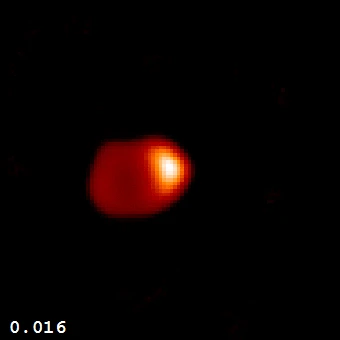
In October 1842, Wilhelm Struve found that γ2 Andromedae was itself a double star whose components were separated by less than an arcsecond. The components are an object of apparent visual magnitude 5.5 (γ Andromedae B) and an A-type main-sequence star with apparent visual magnitude 6.3 (γ Andromedae C), with an orbital period of about 64 years and a high eccentricity of 0.927. Spectrograms taken from 1957 to 1959 revealed that γ Andromedae B was itself a spectroscopic binary, composed of two B-type main-sequence stars orbiting each other with a period of 2.67 days. Photometric observations in 2026 revealed that B's components eclipse each other, making it an eclipsing binary. As of 2019, the angular distance between the B and C stars was 0.16 arcsecond.
γ1 Andromedae A is a massive bright giant star with a spectral classification of K2+IIb and an apparent visual magnitude of approximately 2.26. It has been classified as a candidate post-asymptotic giant branch (AGB) star, but it does not display a chemical enhancement of s-process elements typical of an AGB star.
Reader's Guide
Gamma Andromedae holds significance as a multiple star system that has been studied for over two centuries. Its discovery as a double star by Johann Tobias Mayer in 1778 marked an early observation of stellar multiplicity. The system's striking color contrast—golden-yellow primary and indigo-blue secondary—has made it a favorite among stargazers. The subsequent discovery that the secondary is itself a triple system, including a spectroscopic binary and an eclipsing binary, has provided a rich case study in stellar dynamics. The orbital parameters of its components, such as the 64-year period and high eccentricity of the B-C pair, and the 2.67-day period of the B binary, offer insights into multiple-star evolution. The system's proper name Almach, approved by the IAU in 2016, preserves its historical Arabic heritage, and its inclusion in Chinese and Babylonian star lore reflects its cultural importance. The system's estimated distance of about 390 light-years and radial velocity of −11.7 km/s indicate it is drifting closer to the Sun.
Did You Know?
- Gamma Andromedae was discovered to be a double star in 1778 by German physicist Johann Tobias Mayer.
- The secondary component, γ2 Andromedae, is itself a triple star system, making the whole a quadruple system.
- γ Andromedae B is a spectroscopic binary composed of two B-type main-sequence stars with an orbital period of 2.67 days.
- The system's proper name Almach derives from the Arabic al-‘anāq, meaning 'the caracal' (desert lynx).
More in Binary and Multiple Stars, Part 3 1-24
Spotted an error? Know more?
Reader corrections go straight into our review queue. Suggest an edit · How this site is sourced