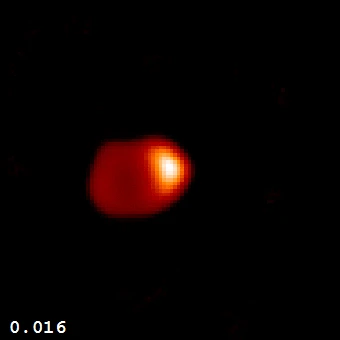
Epsilon Cygni
Third-brightest star in Cygnus, a binary with a named primary.

Epsilon Cygni is a binary star system in the constellation Cygnus, where it goes by the Bayer designation ε Cygni. It shines at an apparent visual magnitude of 2.48, making it easily visible without a telescope and ranking as the third-brightest star in its constellation. Parallax measurements place the system roughly 73 light-years from Earth. The system includes two confirmed components: Epsilon Cygni Aa, officially named Aljanah, and its companion Ab. A visual companion, Epsilon Cygni C, is also thought to be gravitationally bound to the system.
- Bayer designation
- ε Cygni
- Apparent visual magnitude
- 2.48
- Distance
- about 73 light-years
- Constellation
- Cygnus
- Stellar classification of aa
- K0 III
- Effective temperature of aa
- 4,700 K
- Mass of aa
- 10% more massive than the Sun
- Radius of aa
- 11 times the radius of the Sun
- Luminosity of aa
- about 56 times more luminous
- Age of aa
- nine billion years old
Lore & Background
Epsilon Cygni bore the traditional name Gienah from the Arabic al janāħ meaning 'the wing', though that name was more usually applied to Gamma Corvi. For disambiguation it was sometimes called Gienah Cygni. In 2016, the IAU organized a Working Group on Star Names (WGSN) to catalog and standardize proper names for stars. The WGSN decided to attribute proper names to individual stars rather than entire multiple systems. It approved the name Aljanah for the component Epsilon Cygni Aa on 30 June 2017, while Gienah had been approved for Gamma Corvi A on 6 November 2016. Both are now included in the List of IAU-approved Star Names.
In Chinese astronomy, the 'Celestial Ford' (天津; Tiān Jīn) refers to an asterism consisting of Epsilon Cygni, Gamma Cygni, Delta Cygni, 30 Cygni, Alpha Cygni, Nu Cygni, Tau Cygni, Upsilon Cygni and Zeta Cygni. Consequently, the Chinese name for Epsilon Cygni itself is 'the Ninth Star of Celestial Ford' (天津九; Tiān Jīn jiǔ).
Epsilon Cygni A is a single-lined spectroscopic binary. The components take 53 years to complete an orbit and are in a highly eccentric orbit, which puts their distances from 1.1 astronomical units in apoapsis to 30.5 astronomical units in periapsis. Its main component is a giant star with a stellar classification of K0 III, indicating it has left the main sequence and begun the final stages of stellar evolution. After passing through the red-giant branch stage, it underwent a helium flash event and is now a horizontal branch star generating energy through the thermonuclear fusion of helium at its core. The secondary has never been observed directly; its existence was inferred solely from astronomical spectroscopy, and based on this data it should have a mass of at least 0.265 M☉.
Reader's Guide
Epsilon Cygni's significance lies in its role as a stable anchor point for stellar classification. Since 1943, the spectrum of Epsilon Cygni A has served as one of the stable anchor points by which other stars are classified. The system also has a visual companion, Epsilon Cygni C, a 13th magnitude candidate common proper motion companion at an angular separation of 78 arcseconds. If that star is gravitationally bound to Epsilon Cygni A, then they are currently separated by 1,700 AU or more, and have an orbital period of at least 50,000 years. Additionally, ε Cygni lies about three degrees north of the Veil Nebula, a probable ancient supernova remnant, though the nebula is far more distant than the star. The system's primary component, Aljanah, is a K0 III giant that is 10% more massive than the Sun, nine billion years old, with 11 times the Sun's radius and about 56 times its luminosity. Its effective temperature of 4,700 K gives an orange hue characteristic of K-type stars.
Did You Know?
- Epsilon Cygni is the third-brightest star in the constellation Cygnus, with an apparent visual magnitude of 2.48.
- The primary component, Epsilon Cygni Aa, is officially named Aljanah, approved by the IAU on 30 June 2017.
- The system's two main components take 53 years to complete an orbit in a highly eccentric orbit ranging from 1.1 to 30.5 astronomical units.
More in Binary and Multiple Stars, Part 3 1-24
Spotted an error? Know more?
Reader corrections go straight into our review queue. Suggest an edit · How this site is sourced