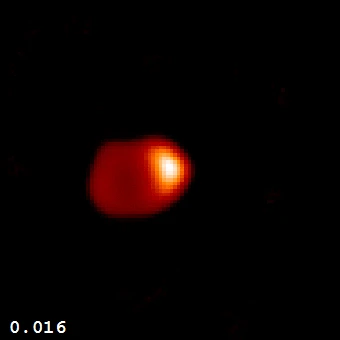
Epsilon Chamaeleontis
Triple star system in Chamaeleon, member of Scorpius-Centaurus Association.

Epsilon Chamaeleontis is a triple star system found in the southern constellation Chamaeleon, which never sets for observers at high southern latitudes. Its Bayer designation, ε Chamaeleontis, is often shortened to Epsilon Cha or ε Cha. The two brightest stars in the system shine at apparent magnitudes of 5.33 and 6.02, bright enough to be seen without a telescope. Based on Hipparcos parallax data, the system lies about 360 light-years away and is moving away from the Sun at a heliocentric radial velocity of 13 km/s.
The system’s binary nature was first noted in February 1836 by Sir John Herschel, who recorded it as the close double star HJ 4486AB. In 2016, astronomers discovered that the primary star, Epsilon Chamaeleontis A, is itself a binary, with components labeled Aa and Ab. This inner pair orbits each other every 6.43 years on a highly eccentric path (eccentricity 0.643), while the outer pair, A and B, takes 751 years to complete a circular orbit.
Epsilon Chamaeleontis belongs to the Scorpius-Centaurus Association, specifically the Lower Centaurus Crux subgroup. It serves as the core of the young Epsilon Chamaeleontis stellar group, which contains at least 36 stars. The region’s nebulosity and ongoing star formation are a key focus of research in the southern sky, with its relative closeness to the Sun providing fresh astrophysical insights. Several recent studies have examined the Lower Centaurus Crux subgroup across the far southern constellations of Musca, Chamaeleon, and Octans, which surrounds the south celestial pole.
- Bayer designation
- ε Chamaeleontis
- Apparent magnitudes
- 5.33 (primary), 6.02 (secondary)
- Distance
- 360 light years
- Heliocentric radial velocity
- 13 km/s
- Inner orbital period
- 6.43 years
- Inner eccentricity
- 0.643
- Outer orbital period
- 751 years
Lore & Background
The binary nature of this system was first observed during February 1836 when Sir John Herschel found it as the close double star, HJ 4486AB. In 2016, it was discovered that Epsilon Chamaeleontis A is a binary system itself, with components designated Aa and Ab, thus making the system triple. The inner (Aa-Ab) system has an orbital period of 6.43 years and a high eccentricity of 0.643, while the outer (A-B) system has an orbital period of 751 years and a circular orbit.
The system is a member of the Scorpius-Centaurus Association or the smaller portion known as the Lower Centaurus Crux subgroup. The system forms the nucleus of the very young Epsilon Chamaeleontis stellar group, which comprises at least 36 stars. The nebulosity and star formation occurring in this region is currently a very important line of study in the southern hemisphere, whose proximity to the Sun is yielding new astrophysical information.
Reader's Guide
Epsilon Chamaeleontis is notable as a triple star system discovered in stages: first as a binary by Sir John Herschel in February 1836, and later in 2016 as a triple when the primary was resolved into a close binary. Its inner pair has a short orbital period of 6.43 years with high eccentricity, while the outer pair has a long period of 751 years on a circular orbit. The system is a member of the Scorpius-Centaurus Association, specifically the Lower Centaurus Crux subgroup, and serves as the nucleus of the young Epsilon Chamaeleontis stellar group of at least 36 stars. The region's nebulosity and star formation are important for southern hemisphere astrophysical studies, with several recent papers published on the Lower Centaurus Crux subgroup in the constellations Musca, Chamaeleon, and Octans. The system's proximity to the Sun yields new astrophysical information, making it a key target for ongoing research.
Did You Know?
- The binary nature was first observed by Sir John Herschel in February 1836.
- In 2016, it was discovered that the primary is itself a binary, making the system triple.
- The inner pair has an orbital period of 6.43 years and an eccentricity of 0.643.
- The system is the nucleus of the Epsilon Chamaeleontis stellar group, comprising at least 36 stars.
More in Binary and Multiple Stars, Part 3 1-24
Spotted an error? Know more?
Reader corrections go straight into our review queue. Suggest an edit · How this site is sourced