Beta Leporis
Second brightest star in Lepus, a G-type bright giant.

Beta Leporis (β Leporis, abbreviated Beta Lep, β Lep), formally named Nihal, is the second brightest star in the constellation of Lepus. It is a G-type bright giant located about 160 light-years from Earth, with an apparent visual magnitude of 2.84. The star is notable for being a double star system that may be a binary, and for its traditional name derived from Arabic.
- Bayer designation
- Beta Leporis
- Traditional name
- Nihal
- Apparent visual magnitude
- 2.84
- Stellar classification
- G5 II
- Distance from earth
- about 160 light-years (49 parsecs)
- Mass
- 3.5 times the mass of the Sun
- Age
- about 240 million years
- Radius
- 15.9 times the radius of the Sun
Lore & Background
Beta Leporis is known by the traditional name Nihal, Arabic for 'quenching their thirst'. The occasional spelling Nibal appears to be due to a misreading. In 2016, the International Astronomical Union organized a Working Group on Star Names (WGSN) to catalog and standardize proper names for stars; the WGSN's first bulletin of July 2016 included Nihal for this star. In Chinese, 廁 (Cè), meaning Toilet, refers to an asterism consisting of β Leporis, α Leporis, γ Leporis and δ Leporis. Consequently, the Chinese name for β Leporis itself is 廁二 (Cè èr), 'the Second Star of Toilet'.
Reader's Guide
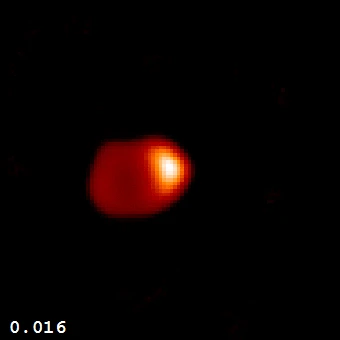
Based on parallax measurements from the Hipparcos astrometry satellite, Beta Leporis is located about 160 light-years from Earth. It has an apparent visual magnitude of 2.84 and a stellar classification of G5 II. The mass of this star is 3.5 times the mass of the Sun and it is about 240 million years old, which is sufficient time for a star this massive to consume the hydrogen at its core and evolve away from the main sequence, becoming a G-type bright giant. The angular diameter of Beta Leporis, after correction for limb darkening, is 3.003±0.066 mas. At the distance to this star, it yields a physical radius of 15.9 times the radius of the Sun. This is a double star system and may be a binary, whereby the second star has a brightness of 7.34 mag. Using adaptive optics on the AEOS telescope at Haleakala Observatory, the pair was found to be separated by an angle of 2.58 arcseconds at a position angle of 1.4°. Component B has been observed to fluctuate in brightness and is catalogued as suspected variable star NSV 2008.
Did You Know?
- Beta Leporis is formally named Nihal, Arabic for 'quenching their thirst'.
- The star is about 240 million years old and has a mass 3.5 times that of the Sun.
- It is a double star system; the second star has a brightness of 7.34 mag and is a suspected variable star (NSV 2008).
- In Chinese astronomy, Beta Leporis is part of an asterism called 'Toilet' and is known as 'the Second Star of Toilet'.
More in Binary and Multiple Stars, Part 3 1-24
Spotted an error? Know more?
Reader corrections go straight into our review queue. Suggest an edit · How this site is sourced